![]() |
|
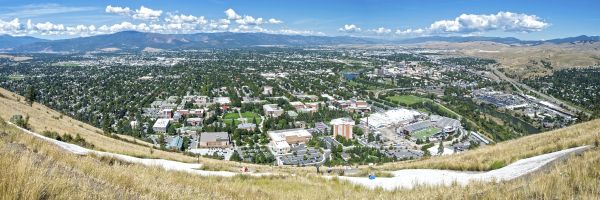
A. GENERAL INFORMATION A1. Address Information Name of College or University – The University of Montana-Missoula Mailing Address, City/State/Zip/Country- The University of Montana 32 Campus Drive Missoula, MT 59812-0002 United States Main Phone Number – (406)
243-0211 WWW Home Page Address –
http://www.umt.edu Admissions Phone Number –
Local: 243-6266 Admissions Toll-free Number- 800-462-8636
Admissions Office Mailing Address, City/State/Zip/Country
– The University of Montana
Admissions Office
Missoula, MT 59812-0002
United States Admissions Fax Number - 406-243-5711 Admissions E-mail Address
– admiss@selway.umt.edu A2. Source of institutional control (check one only) X Public Private (nonprofit) Proprietary A3. Classify your undergraduate institution:
A4. Academic year calendar
A5. Degrees offered
by your institution
B. ENROLLMENT AND PERSISTENCEB1. Institutional Enrollment—Men and Women Provide numbers of students for each of the following categories
as of the institution’s official fall reporting date or as of October
15, 2001.
Total all
undergraduates 10,828_________ Total all
graduate and professional students: 1,818_____ GRAND TOTAL
ALL STUDENTS: 12,646 B2. Enrollment by Racial/Ethnic Category. Provide numbers of undergraduate students for each of the following categories as of the institution’s official fall reporting date or as of October 15, 2001. Complete the “Total Undergraduates” column only if you cannot provide data for the first two columns.
Persistence B3. Number of degrees awarded by your institution from July 1, 2000, to
June 30, 2001. Certificate/diploma
90 Associate degrees
147 Bachelor’s degrees
1684 Postbachelor’s certificates
0 Master’s degrees
414 Post-master’s certificates
7 Doctoral degrees
26 First professional degrees
83 First professional certificates 0 Graduation
Rates The items in this section correspond
to data elements collected by the IPEDS Web-based Data Collection
System’s Graduation Rate Survey (GRS). For complete instructions and definitions of
data elements, see the IPEDS GRS instructions and glossary on the 2001
Web-based survey. For Bachelor’s or Equivalent
Programs Report for
the cohort of full-time first-time bachelor’s (or equivalent) degree-seeking
undergraduate students who entered in fall 1995. Include in the cohort those who entered your institution
during the summer term preceding fall 1995. B4. Initial 1995 cohort of first-time, full-time
bachelor’s (or equivalent) degree-seeking undergraduate students; total
all students: 1452 B5. Of the initial 1995 cohort, how many did not
persist and did not graduate for the following reasons: deceased, permanently
disabled, armed forces, foreign aid service of the federal government,
or official church missions; total allowable exclusions: _______3_______________ B6. Final 1995 cohort, after adjusting
for allowable exclusions: 1449
(Subtract question B5 from question B4) B7. Of the initial 1995 cohort, how many completed
the program in four years or less (by August 31, 1999): 260 B8. Of the initial 1995 cohort, how many completed
the program in more than four years but in five years or less (after August
31, 1999 and by August 31, 2000): 230 B9. Of the initial 1995 cohort, how many completed
the program in more than five years but in six years or less (after August
31, 2000 and by August 31, 2001): 95 B10. Total graduating within
six years (sum of questions B7, B8, and B9): 585 B11. Six-year graduation
rate for 1995 cohort (question B10 divided by question B6): 40% For
Two-Year Institutions: B12. Initial 1998 cohort,
total of first-time, full-time degree/certificate-seeking students: __________________ B13. Of the initial 1998
cohort, how many did not persist and did not graduate for the following
reasons: deceased, permanently disabled, armed forces, foreign aid service
of the federal government, or official church missions; total allowable
exclusions: ___________________ B14. Final 1998 cohort, after adjusting for allowable
exclusions___________________ (Subtract
question B13 from question B12) B15. Completers of programs
of less than two years duration (total): ___________________ B16. Completers of programs
of less than two years within 150 percent of normal time: ____________ B17. Completers of programs
of at least two but less than four years (total): _______________ B18. Completers of programs
of at least two but less than four-years within 150 percent of normal
time: ____________ B19. Total transfers-out
(within three years) to other institutions: _________________ B20. Total transfers to two-year institutions:
__________________ B21. Total transfers to four-year institutions:
__________________ Retention
Rates Report for
the cohort of all full-time, first-time bachelor’s (or equivalent) degree-seeking
undergraduate students who entered in fall 2000 (or the preceding summer
term). The initial cohort may be adjusted for students who departed
for the following reasons: deceased, permanently disabled, armed forces,
foreign aid service of the federal government or official church missions.
No other adjustments to the initial cohort should be made. B22. For the cohort of all full-time bachelor’s (or
equivalent) degree-seeking undergraduate students who entered your institution
as freshmen in fall 2000 (or the preceding summer term), what percentage
was enrolled at your institution as of the date your institution calculates
its official enrollment in fall 2001? 69.7% C. FIRST-TIME, FIRST-YEAR (FRESHMAN) ADMISSIONApplications C1. First-time, first-year
(freshman) students: Provide the
number of degree-seeking, first-time, first-year students who applied,
were admitted, and enrolled (full- or part-time) in fall 2001. Include
early decision, early action, and students who began studies during summer
in this cohort. Applicants should include only those students who fulfilled
the requirements for consideration for admission (i.e., who completed
actionable applications) and who have been notified of one of the following
actions: admission, nonadmission, placement
on waiting list, or application withdrawn (by applicant or institution).
Admitted applicants should include wait-listed students who were subsequently
offered admission. Total first-time, first-year (freshman) men who applied 1689 Total first-time, first-year (freshman) women who applied 1871 Total first-time, first-year (freshman) men who were admitted
1488 Total first-time, first-year (freshman) women who were admitted
1654 Total full-time, first-time, first-year (freshman) men who
enrolled 862 Total part-time, first-time, first-year (freshman) men who
enrolled 50 Total full-time, first-time, first-year (freshman) women who
enrolled 954 Total part-time, first-time, first-year (freshman) women who
enrolled 48 C2. Freshman wait-listed
students (students who met admission requirements but whose final admission
was contingent on space availability) Do you have a policy of placing students on a waiting list? Yes X
No If yes, please
answer the questions below for fall 2001 admissions: Number of qualified applicants placed on waiting list _____ Number accepting a place on the waiting list _____ Number of wait-listed students admitted _____ Admission
Requirements C3. High school completion requirement Check the appropriate box to identify your high school completion
requirement for degree-seeking entering students:
C4. Does your institution
require or recommend a general college-preparatory program for degree-seeking
students? X Require Recommend Neither require
nor recommend C5. Distribution of
high school units required and/or recommended. Specify the distribution of academic high school course units
required and/or recommended of all or most degree-seeking students using
Carnegie units (one unit equals one year of study or its equivalent).
If you use a different system for calculating units, please convert.
Basis for
Selection C6. Do you have an open admission policy, under which virtually
all secondary school graduates or students with GED equivalency diplomas
are admitted without regard to academic record, test scores, or other
qualifications? UM does not have an
open policy. Entrance requirements for traditional full-time students
are: high school graduation, 2.5 cumulative grade
average or score of 22 on the ACT or 1030 combined verbal/math on the
SAT, and successful completion of college prep program requirements. Nontraditional students, GED freshman, and summer-only
students are exempt from the above requirements. C7. Relative importance of each of the following academic and nonacademic
factors in your first-time, first-year, degree-seeking (freshman) admission
decisions.
SAT and
ACT Policies C8. Entrance exams A. Does your institution
make use of SAT I, SAT II, or ACT scores in admission decisions for first-time,
first-year, degree-seeking applicants? X
Yes No If
yes, place check marks in the appropriate boxes below to reflect your
institution’s policies for use in admission.
In
addition, does your institution use
applicants' test scores for placement or counseling?
B. Does your institution
use the SAT I or II or the ACT for placement only? If so, please
mark the appropriate boxes below:
C. Latest date by
which SAT I or ACT scores must be received for fall-term admission August 2 Latest date by which SAT II scores must
be received for fall-term admission August
2
D.
If necessary, use this space to clarify your test policies (e.g., if tests
are recommended for some students, or if tests are not required of some
students): In lieu of a 2.5 cumulative grade average from high school
and a ranking in the upper half of the graduating class the following
test scores may also be used to qualify a student for admission: 22 composite on the enhanced ACT 920 combined verbal/math on
SAT (up to April 1995) 1030 combined score beginning
April 1995 Non-traditional freshman, GED freshman, part-time students,
and summer only students are exempt from this academic or testing requirement. Freshman
Profile Provide
percentages for ALL enrolled, degree-seeking, full-time and part-time,
first-time, first-year (freshman) students enrolled in fall
2001, including students who began studies during summer, international
students/nonresident aliens, and students admitted under special arrangements. C9. Percent and number
of first-time, first-year (freshman) students enrolled in fall 2001 who
submitted national standardized (SAT/ACT) test scores. Include information for ALL enrolled,
degree-seeking, first-time, first-year (freshman) students who submitted
test scores. Do not include
partial test scores (e.g., mathematics scores but not verbal for a category
of students) or combine other standardized test results (such as TOEFL)
in this item. SAT scores should be recentered
scores. The 25th percentile is
the score that 25 percent scored at or below; the 75th percentile score
is the one that 25 percent scored at or above. Percent submitting SAT scores 35%___ Number submitting SAT scores 653 Percent submitting ACT scores 63%_ __
Number submitting ACT scores
1184
Percent of first-time, first-year (freshman) students with scores in each
range:
C10. Percent of all degree-seeking, first-time, first-year (freshman) students
who had high school class rank within each of the following ranges (report
information for those students from whom you collected high school rank
information). Percent in top tenth of high school graduating class 14%_ Percent in top quarter of high school graduating class 33%_ Percent in top half of high school graduating class
66%_ Percent in bottom half of high school graduating class 34%_ Percent in bottom quarter of high school graduating class
12%_ Percent of total first-time, first-year (freshman) students
who submitted high school class rank:
82%
C11. Percentage of all
enrolled, degree-seeking, first-time, first-year (freshman) students who
had high school grade-point averages within each of the following ranges
(using 4.0 scale).
Report information only for those students from whom you collected
high school GPA. Percent who had GPA of 3.0 and higher 64% Percent who had GPA between 2.0 and 2.99 34% Percent who had GPA between 1.0 and 1.99 3% Percent who had GPA below 1.0 0% C12. Average high school GPA of all degree-seeking, first-time,
first-year (freshman) students who submitted GPA: 3.184 Percent of total first-time, first-year (freshman) students
who submitted high school GPA: 89% Admission
Policies C13. Application fee Does your institution have an application fee? X Yes
No Amount of application fee:
30 dollars non-refundable
Can it be waived for applicants with financial need? Yes
X No The fee can be defered but not waived. C14. Application closing date Does your institution have an application closing date? Applications for first-time first-year freshman are on a
rolling space-available basis. For transfers application priority deadlines
are March 1st
for fall semester and November 15th for spring
semester.
C15. Are first-time, first-year students
accepted for terms other than the fall? X Yes No C16. Notification to applicants
of admission decision sent (fill in one only) On a rolling basis beginning (date): August
1 By (date): __________ Other: __________ C17. Reply policy for admitted applicants (fill in one only) Must reply by (date): __________ No set date: X Must reply by May 1 or within _____ weeks if notified thereafter Other: __________ C18. Deferred admission: Does your institution
allow students to postpone enrollment after admission? X Yes No If yes, maximum
period of postponement: 1 year then must reapply C19. Early admission of high school students: Does your institution allow high school students to enroll
as full-time, first-time, first-year (freshman) students one year or more
before high school graduation? X Yes
No C20. Common application: Will you accept the Common Application distributed by the National Association
of Secondary School Principals if submitted?
X Yes
No If “yes,” are supplemental forms required? Yes
X No Is your college a member of the Common Application Group?
Yes
X No Early Decision and Early
Action Plans C21. Early decision: Does
your institution offer an early decision plan (an admission plan that
permits students to apply and be notified of an admission decision well
in advance of the regular notification date and that asks students to
commit to attending if accepted) for first-time, first-year (freshman)
applicants for fall enrollment?
Yes X No If “yes,” please
complete the following: First or only
early decision plan closing date
__________ First
or only early decision plan notification date
__________ Other early
decision plan closing date
__________ Other
early decision plan notification date
__________ For the
Fall 2001 entering class: Number of early
decision applications received by your institution __________ Number
of applicants admitted under early decision plan __________ Please provide significant details about your early decision
plan: ___________________________________________ ________________________________________________________________________________________________ C22. Early action: Do
you have a nonbinding early action plan whereby students are notified
of an admission decision well in advance of the regular notification date
but do not have to commit to attending your college? Yes
X No If “yes,” please
complete the following: Early action
closing date __________ Early
action notification date __________ D. TRANSFER ADMISSION Fall Applicants D1. Does your institution
enroll transfer students? X Yes
No
(If no, please skip to Section E) If yes, may
transfer students earn advanced standing credit by transferring credits
earned from course work completed at other colleges/universities? X
Yes No D2. Provide the number of students who applied,
were admitted, and enrolled as degree-seeking transfer students in fall
2001.
Application
for Admission D3. Indicate terms for
which transfers may enroll:
D4. Must a transfer applicant
have a minimum number of credits completed or else must apply as an entering
freshman? X Yes
No If yes, what
is the minimum number of credits and the unit
of measure? 12 D5. Indicate all items
required of transfer students to apply for admission:
D6. If a minimum high school
grade point average is required of transfer applicants, specify (on a 4.0 scale): ____________ D7. If a minimum college
grade point average is required of transfer applicants, specify (on a 4.0 scale): 2.0 D8. List any other application requirements specific
to transfer applicants:
Transfer applicants need to submit their medical history
records, and an application form and fee of $30. D9. List application priority, closing, notification,
and candidate reply dates for transfer students. If applications are reviewed
on a continuous or rolling basis, place a check mark in the “Rolling admission”
column.
D10. Does an open admission
policy, if reported, apply to transfer students?
Yes
No D11. Describe additional
requirements for transfer admission, if applicable: ______________________________________________________________________________________________ ______________________________________________________________________________________________ Transfer
Credit Policies D12. Report the lowest grade earned for any course
that may be transferred for credit: D D13. Maximum number of credits or courses that may
be transferred from a two-year institution: Number no limit Unit
type ____________ D14. Maximum number of credits or courses that may
be transferred from a four-year institution:
Number no limit Unit
type ____________ D15. Minimum number of credits that transfers must
complete at your institution to earn an associate degree: 30 D16. Minimum number of credits that transfers must
complete at your institution to earn a bachelor’s degree: 30 D17. Describe other transfer
credit policies: Transfer
students must earn 39 upper division credits and at least 30 credits from
UM E. ACADEMIC OFFERINGS AND POLICIES E1. Special study options:
Identify those programs available
at your institution. Refer to the glossary for definitions.
E2. Has
been removed from the CDS. E3. Areas in which all
or most students are required to complete some course work prior to graduation:
Library Collections Report the number of holdings.
Refer to the most recent Academic Libraries Survey for corresponding equivalents. E4. Books, serial backfiles, electronic documents, and government documents
(titles) that are accessible through the library’s catalog: 889,280 E5. Current serial subscriptions
(paper, microform, electronic): 6,654 E6. Microforms (units): 298,909 E7. Audiovisual materials
(units): 65,645 F. STUDENT LIFE F1. Percentages of first-time,
first-year (freshman) students and all degree-seeking undergraduates enrolled
in fall 2001 who fit the following categories:
First-time, first-year
Undergraduates
(freshman) students Percent who are from out of state (exclude international/nonresident
aliens) 27 26 Percent of men who join fraternities
6 6 Percent of women who join sororities
5 5 Percent who live in college-owned, -operated, or -affiliated
housing 69 20 Percent who live off campus or commute
31 80 Percent of students age 25 and older
4 18 Average age of full-time students
19 22 Average age of all students (full- and part-time)
19 23 F2. Activities offered Identify those programs available at your institution.
F3. ROTC (program
offered in cooperation with Reserve Officers’ Training Corps) Army ROTC is offered:
Naval ROTC is offered:
Air Force ROTC is offered:
F4. Housing: Check all types of college-owned, -operated, or -affiliated
housing available for undergraduates at your institution.
G. ANNUAL EXPENSES Provide 2002-2003 academic
year costs for the following categories that are applicable to your institution. G1. Undergraduate full-time tuition, required fees, room and board List the typical tuition, required fees, and room and board
for a full-time undergraduate student for the FULL 2002-03 academic year (30 semester hours or 45 quarter hours for institutions
that derive annual tuition by multiplying credit hour cost by number of
credits). A full academic year refers to the period of time generally
extending from September to June; usually equated to two semesters, two
trimesters, three quarters, or the period covered by a four-one-four plan.
Room and board is defined as double occupancy and 19 meals per week or
the maximum meal plan. Required fees include only charges that
all full-time students must pay that are not included in
tuition (e.g., registration, health, or activity fees.) Do not
include optional fees (e.g., parking, laboratory use).
Comprehensive tuition and room and board fee (if your college
cannot provide separate tuition and room and board fees): N/A Other ______________________________________________________________________________________ G2. Number of credits
per term a student can take for the stated full-time tuition 12minimum 25maximum G3. Do tuition and fees
vary by year of study (e.g., sophomore, junior, senior)? X Yes No G4. If tuition and fees
vary by undergraduate instructional program, describe briefly: Additional fees are charged for Pharmacy and Physical Therapy G5. Provide the estimated expenses for a typical full-time undergraduate
student:
G6. Undergraduate per-credit-hour charges:
Undergraduate per-credit-hour
charges are calculated by summing tuition and required fees and dividing
by 12 H. FINANCIAL AID Aid Awarded to Enrolled
Undergraduates H1. Enter total dollar amounts awarded to full-time and
less than full-time degree-seeking undergraduates (using the same
cohort reported in CDS Question B1, “total degree-seeking” undergraduates)
in the following categories. Include aid awarded to international students
(i.e., those not qualifying for federal aid). Aid that is non-need-based
but that was used to meet need should be reported in the need-based
aid columns. (For a suggested order of precedence in assigning categories
of aid to cover need, see the entry for “non-need-based gift aid” on the
last page of the definitions section.) Indicate
the academic year for which data are reported for items H1, H2,
H2A, and H6 below: 2001-2002 estimated
or X
2000-2001 final
H2. Number of Enrolled Students Receiving Aid:
List the number of degree-seeking full-time and less-than-full-time
undergraduates who applied for and received financial aid. Aid that
is non-need-based but that was used to meet need should be counted
as need-based aid. Numbers should reflect the cohort receiving
the dollars reported in H1. Note: In the chart below, students may be counted
in more than one row, and full-time freshmen should also be counted as
full-time undergraduates.
H2A. Number of Enrolled Students
Receiving Non-need-based Grants and Scholarships: List the number of degree-seeking full-time
and less-than-full-time undergraduates who had no financial need and who
received non-need-based gift aid. Numbers should reflect the cohort receiving
the dollars reported in H1. Note: In the chart
below, students may be counted in more than one row, and full-time freshmen
should also be counted as full-time undergraduates.
H3: Which needs-analysis
methodology does your institution use in awarding institutional aid?
X Federal
methodology (FM) ___ Institutional methodology
(IM) ___ Both FM and IM H4. Percent of the 2001 undergraduate class who graduated between
July 1, 2000 and June 30, 2001 and borrowed through any loan programs
(federal, state, subsidized, unsubsidized, private, etc.; exclude parent
loans). Include only students who borrowed while enrolled at your institution.
62% H5. Average per-borrower cumulative undergraduate
indebtedness of those in line H4. Do not include money
borrowed at other institutions: $15,611 Aid to Undergraduate Degree-seeking Nonresident
Aliens (Note: Report numbers and dollar amounts for the same
academic year checked in item H1.)
H6. Indicate your institution’s policy regarding financial aid
for undergraduate degree-seeking nonresident aliens:
If
college-administered financial aid is available for undergraduate degree-seeking
nonresident aliens, provide the number of undergraduate degree-seeking
nonresident aliens who received need-based or non-need-based aid: ___N/A___ Average
dollar amount awarded to undergraduate degree-seeking nonresident aliens:
$ ____N/A____ Total
dollar amount of financial aid from all sources awarded to all undergraduate
degree-seeking nonresident aliens: $
____N/A___ Process for First-Year/Freshman
Students H7. Check off all financial aid forms domestic first-year (freshman)
financial aid applicants must submit:
H8. Check off all financial aid forms nonresident alien first-year
financial aid applicants must submit:
H9. Indicate filing dates for first-year (freshman) students: Priority
date for filing required financial aid forms:
March 1st Deadline
for filing required financial aid forms:
_____________ No
deadline for filing required forms (applications processed on a rolling
basis): ____X____ H10. Indicate notification dates for first-year (freshman) students
(answer a or b): a.) Students notified on or about (date): _____________
b.) Students notified on a rolling basis: yes If yes, starting date:
April 1st H11. Indicate reply dates: Students
must reply by (date): 30 days or within 4 weeks
of notification. Types of Aid Available
Please check off all types
of aid available to undergraduates at your institution: H12. Loans
H13. Scholarships and Grants
H14. Check off criteria used in awarding institutional aid. Check
all that apply.
I. INSTRUCTIONAL FACULTY AND CLASS SIZE
I-1. Please report number of instructional faculty members in
each category for Fall 2001. The following definition of
instructional faculty is used by the American Association of University
Professors (AAUP) in its annual Faculty Compensation Survey. Instructional
Faculty is defined as those members of the instructional-research staff
whose major regular assignment is instruction, including those with released
time for research. Institutions are asked to EXCLUDE: (a) instructional
faculty in preclinical and clinical medicine (b) administrative
officers with titles such as dean of students, librarian, registrar, coach,
and the like, even though they may devote part of their time to classroom
instruction and may have faculty status, (c) undergraduate
or graduate students who assist in the instruction of courses, but have
titles such as teaching assistant, teaching fellow, and the like (d) faculty
on leave without pay, and (e) replacement
faculty for faculty on sabbatical leave. Full-time: faculty employed on a full-time basis Part-time: faculty teaching less than two semesters, three quarters,
two trimesters, or two four-month sessions. Also includes adjuncts and
part-time instructors. Minority faculty: includes faculty who designate themselves as black, non-Hispanic;
American Indian or Alaskan native; Asian or Pacific Islander; or Hispanic. Doctorate: includes such degrees as Doctor of Education, Doctor of
Juridical Science, Doctor of Public Health, and Doctor of Philosophy degree
in any field such as agronomy, food technology, education, engineering,
public administration, ophthalmology, or radiology. First-professional: includes the fields of dentistry (DDS or DMD), medicine
(MD), optometry (OD), osteopathic medicine (DO), pharmacy (DPharm
or BPharm), podiatric medicine (DPM), veterinary
medicine (DVM), chiropractic (DC or DCM), law (JD) and theological professions
(MDiv, MHL). Terminal degree: the highest degree in a field: example, M. Arch (architecture)
and MFA (master of fine arts).
I-2. Student to Faculty
Ratio
Report the Fall
2001 ratio of full-time equivalent students (full-time plus 1/3 part time)
to full-time equivalent instructional faculty (full time plus 1/3 part
time). In the ratio calculations, exclude both faculty and students in
stand-alone graduate or professional programs such as medicine, law, veterinary,
dentistry, social work, business, or public health in which faculty teach
virtually only graduate level students. Do not count undergraduate or
graduate student teaching assistants as faculty. Fall 2001 Student to Faculty
ratio: 19
to 1. I-3. Undergraduate Class Size In the table below, please
use the following definitions to report information about the size of
classes and class sections offered in the Fall
2001 term. Class Sections: A class section is
an organized course offered for credit, identified by discipline and number,
meeting at a stated time or times in a classroom or similar setting, and
not a subsection such as a laboratory or discussion session. Undergraduate
class sections are defined as any sections in which at least one degree-seeking
undergraduate student is enrolled for credit. Exclude distance
learning classes and noncredit classes and individual instruction such
as dissertation or thesis research, music instruction, or one-to-one readings.
Exclude students in independent study, co-operative programs, internships,
foreign language taped tutor sessions, practicums,
and all students in one-on-one classes. Each class section should be counted
only once and should not be duplicated because of course catalog cross-listings. Class Subsections: A class subsection
includes any subsection of a course, such as laboratory, recitation, and
discussion subsections that are supplementary in nature and are scheduled
to meet separately from the lecture portion of the course. Undergraduate
subsections are defined as any subsections of courses in which degree-seeking
undergraduate students enrolled for credit. As above, exclude noncredit
classes and individual instruction such as dissertation or thesis research,
music instruction, or one-to-one readings. Each class subsection should
be counted only once and should not be duplicated because of cross-listings. Using the above definitions,
please report for each of the following class-size intervals the number
of class sections and class subsections offered in Fall
2001. For example, a lecture class with 800 students who met at another
time in 40 separate labs with 20 students should be counted once in the
“100+” column in the class section column and 40 times under the “20-29”
column of the class subsections table. Number of Class Sections with Undergraduates Enrolled
Undergraduate Class Size (provide numbers)
J. DEGREES CONFERRED
Degrees conferred between
July 1, 2000 and June 30, 2001 Reference: IPEDS Completions,
Part A For each of the following discipline areas, provide the percentage of diplomas/certificates, associate, and bachelor’s degrees awarded.
Common Data Set Definitions 2001
¨
All definitions related to the financial aid section appear
at the end of the Definitions document.
¨
Items preceded by an asterisk (*) represent definitions agreed to
among publishers which do not appear on the CDS document but may be present
on individual publishers’ surveys. *Academic advisement: Plan under which each student is assigned to a faculty member
or a trained adviser, who, through regular meetings,
helps the student plan and implement immediate and long-term academic
and vocational goals. Accelerated program: Completion of a college program of study in fewer than the
usual number of years, most often by attending summer sessions and carrying
extra courses during the regular academic term. Admitted
student: Applicant who is offered
admission to a degree-granting program at your institution. *Adult student services:
Admission assistance, support, orientation, and other services
expressly for adults who have started college for the first time, or who
are re-entering after a lapse of a few years. American Indian or Alaska native:
A person having origins in any of
the original peoples of North America and who maintains cultural identification
through tribal affiliation or community recognition. Applicant (first-time, first year):
An individual who has fulfilled the
institution’s requirements to be considered for admission (including payment
or waiving of the application fee, if any) and who has been notified of
one of the following actions: admission, nonadmission,
placement on waiting list, or application withdrawn (by applicant or institution). Application fee: That amount of money that an institution charges for processing
a student’s application for acceptance. This amount is not creditable
toward tuition and required fees, nor is it refundable if the student
is not admitted to the institution. Asian or Pacific Islander: A person having origins in any of the original peoples of
the Far East, Southeast Asia, the Indian Subcontinent, or Pacific Islands.
This includes people from China, Japan, Korea, the Philippine Islands,
American Samoa, India, and Vietnam. Associate degree: An award that normally requires at least two but less than
four years of full-time equivalent college work. Bachelor’s degree: An award (baccalaureate or equivalent degree, as determined
by the Secretary of the U.S. Department of Education) that normally requires
at least four years but not more than five years of full-time equivalent
college-level work. This includes ALL bachelor’s degrees conferred in
a five-year cooperative (work-study plan) program. (A cooperative plan
provides for alternate class attendance and employment in business, industry,
or government; thus, it allows students to combine actual work experience
with their college studies.) Also, it includes bachelor’s degrees in which
the normal four years of work are completed in three years. Black, non-Hispanic: A person having origins in any of the black racial groups
of Africa (except those of Hispanic origin). Board (charges): Assume average cost for 19 meals per week or the maximum meal
plan. Books and supplies (costs): Average cost of books and supplies. Do not include unusual
costs for special groups of students (e.g., engineering or art majors),
unless they constitute the majority of students at your institution. Calendar system: The method by which an institution structures most of its
courses for the academic year. *Career and placement services:
A range of services, including (often)
the following: coordination of visits of employers to campus; aptitude
and vocational testing; interest inventories, personal counseling; help
in resume writing, interviewing, launching the job search; listings for
those students desiring employment and those seeking permanent positions;
establishment of a permanent reference folder; career resource materials. Carnegie units: One year of study or the equivalent in a secondary school
subject. Certificate: See Postsecondary award, certificate, or diploma. Class rank: The relative numerical position of a student in his or her
graduating class, calculated by the high school on the basis of grade-point
average, whether weighted or unweighted. College-preparatory program: Courses in academic subjects (English, history and social
studies, foreign languages, mathematics, science, and the arts) that stress
preparation for college or university study. Common Application: The standard application form distributed by the National
Association of Secondary School Principals for a large number of private
colleges who are members of the Common Application Group. *Community service program:
Referral center for students wishing to perform volunteer
work in the community or participate in volunteer activities coordinated
by academic departments. Commuter: A student who lives off campus in housing that is not owned
by, operated by, or affiliated with the college. This category includes
students who commute from home and students who have moved to the area
to attend college. Contact hour: A unit of measure that represents an hour of scheduled instruction
given to students. Also referred to as clock hour. Continuous basis (for program enrollment):
A calendar system classification
that is used by institutions that enroll students at any time during the
academic year. For example, a cosmetology school or a word processing
school might allow students to enroll and begin studies at various times,
with no requirement that classes begin on a certain date. Cooperative housing: College-owned, -operated, or -affiliated housing in which
students share room and board expenses and participate in household chores
to reduce living expenses. Cooperative (work-study plan) program:
A program that provides for alternate
class attendance and employment in business, industry, or government. *Counseling service: Activities designed to assist students in making plans and
decisions related to their education, career, or personal development. Credit: Recognition of attendance or performance in an instructional
activity (course or program) that can be applied by a recipient toward
the requirements for a degree, diploma, certificate, or other formal award. Credit course: A course that, if successfully completed, can be applied toward
the number of courses required for achieving a degree, diploma, certificate,
or other formal award. Credit hour: A unit of measure representing an hour (50 minutes) of instruction
over a 15-week period in a semester or trimester system or a 10-week period
in a quarter system. It is applied toward the total number of hours needed
for completing the requirements of a degree, diploma, certificate, or
other formal award. Cross-registration: A system whereby students enrolled at one institution may
take courses at another institution without having to apply to the second
institution. Deferred admission:
The practice of permitting admitted
students to postpone enrollment, usually for a period of one academic
term or one year. Degree: An award conferred by a college, university, or other postsecondary
education institution as official recognition for the successful completion
of a program of studies. Degree-seeking students: Students enrolled in courses for credit who
are recognized by the institution as seeking a degree or formal award.
At the undergraduate level, this is intended to include students enrolled
in vocational or occupational programs. Differs by program
(calendar system): A calendar system
classification that is used by institutions that have occupational/vocational
programs of varying length. These schools may enroll students at specific times depending
on the program desired. For example, a school might offer a two-month
program in January, March, May, September, and November; and a three-month
program in January, April, and October. Diploma: See Postsecondary award, certificate, or diploma. Distance learning: An option for earning course credit at off-campus locations
via cable television, internet, satellite classes, videotapes, correspondence
courses, or other means. Doctoral degree: The highest award a student can earn for graduate study. The
doctoral degree classification includes such degrees as Doctor of Education,
Doctor of Juridical Science, Doctor of Public Health, and the Doctor of
Philosophy degree in any field such as agronomy, food technology, education,
engineering, public administration, ophthalmology, or radiology. For the
Doctor of Public Health degree, the prior degree is generally earned in
the closely related field of medicine or in sanitary engineering. Double major: Program in which students may complete two undergraduate programs
of study simultaneously. Dual enrollment: A program through which high school students may enroll in
college courses while still enrolled in high school. Students are not
required to apply for admission to the college in order to participate. Early action plan: An admission plan that allows students to apply and be notified
of an admission decision well in advance of the regular notification dates.
If admitted, the candidate is not committed to enroll; the student may
reply to the offer under the college’s regular reply policy. Early admission: A policy under which students who have not completed high
school are admitted and enroll full time in college, usually after completion
of their junior year. Early decision plan: A plan that permits students to apply and be notified of an
admission decision (and financial aid offer if applicable) well in advance
of the regular notification date. Applicants agree to accept an offer
of admission and, if admitted, to withdraw their applications from other
colleges. There are three possible decisions for early decision applicants:
admitted, denied, or not admitted but forwarded for consideration with
the regular applicant pool, without prejudice. English as a Second Language (ESL):
A course of study designed specifically
for students whose native language is not English. Exchange student program-domestic:
Any arrangement between a student
and a college that permits study for a semester or more at another college
in the United States without extending the amount of time required
for a degree. See also Study abroad. External degree program: A program of study in which students earn credits toward
a degree through independent study, college courses, proficiency examinations,
and personal experience. External degree programs require minimal or no
classroom attendance. Extracurricular activities (as admission
factor): Special consideration in
the admissions process given for participation in both school and nonschool-related activities of interest to the college, such
as clubs, hobbies, student government, athletics, performing arts, etc. First professional certificate (postdegree): An award
that requires completion of an organized program of study designed for
persons who have completed the first professional degree. Examples could
be refresher courses or additional units of study in a specialty or subspecialty. First professional degree: An award in one of the following fields: Chiropractic (DC,
DCM), dentistry (DDS, DMD), medicine (MD), optometry (OD), osteopathic
medicine (DO), rabbinical and Talmudic studies (MHL, Rav),
Pharmacy (BPharm, PharmD),
podiatry (PodD, DP, DPM), veterinary medicine
(DVM), law (LLB, JD), divinity/ministry (BD, MDiv). First-time student: A student attending any institution for the first time at
the level enrolled. Includes students enrolled in the fall term who attended
a postsecondary institution for the first time at the same level in the
prior summer term. Also includes students who entered with advanced standing
(college credit earned before graduation from high school). First-time, first-year (freshman)
student: A student attending any
institution for the first time at the undergraduate level. Includes students
enrolled in the fall term who attended college for the first time in the
prior summer term. Also includes students who entered with advanced standing
(college credits earned before graduation from high school). First-year student: A student who has completed less than the equivalent of 1
full year of undergraduate work; that is, less than 30 semester hours
(in a 120-hour degree program) or less than 900 contact hours. Freshman: A first-year undergraduate student. *Freshman/new student orientation:
Orientation addressing the academic,
social, emotional, and intellectual issues involved in beginning college.
May be a few hours or a few days in length; at some colleges, there is
a fee. Full-time student (undergraduate):
A student enrolled for 12 or more
semester credits, 12 or more quarter credits, or 24 or more contact hours
a week each term. Geographical residence (as admission
factor): Special consideration in
the admission process given to students from a particular region, state,
or country of residence. Grade-point average (academic high
school GPA): The sum of grade points
a student has earned in secondary school divided by the number of courses
taken. The most common system of assigning numbers to grades counts four
points for an A, three points for a B, two points for a C, one point for
a D, and no points for an E or F. Unweighted
GPA’s assign the same weight to each course. Weighting gives students
additional points for their grades in advanced or honors courses. Graduate student: A student who holds a bachelor’s or first professional degree,
or equivalent, and is taking courses at the post-baccalaureate level. *Health services: Free or low cost on-campus primary and preventive health care
available to students. High school diploma or recognized
equivalent: A document certifying
the successful completion of a prescribed secondary school program of
studies, or the attainment of satisfactory scores on the Tests of General
Educational Development (GED), or another state-specified examination. Hispanic: A person of Mexican, Puerto Rican, Cuban, Central or South
American, or other Spanish culture or origin, regardless of race. Honors program: Any special program for very able students offering the opportunity
for educational enrichment, independent study, acceleration, or some combination
of these. Independent study: Academic work chosen or designed by the student with the approval
of the department concerned, under an instructor’s supervision, and usually
undertaken outside of the regular classroom structure. In-state tuition: The tuition charged by institutions to those students who
meet the state’s or institution’s residency requirements. International student: See Nonresident alien. Internship: Any short-term, supervised work experience usually related
to a student’s major field, for which the student earns academic credit.
The work can be full- or part-time, on- or off-campus, paid or unpaid. *Learning center: Center offering assistance through tutors, workshops, computer
programs, or audiovisual equipment in reading, writing, math, and skills
such as taking notes, managing time, taking tests. *Legal services: Free or low cost legal advice for a range of issues (personal
and other). Liberal arts/career combination:
Program in which a student earns undergraduate degrees in
two separate fields, one in a liberal arts major and the other in a professional
or specialized major, whether on campus or through cross‑registration. Master’s degree: An award that requires the successful completion of a program
of study of at least the full-time equivalent of one but not more than
two academic years of work beyond the bachelor’s degree. Minority affiliation (as admission
factor): Special consideration in
the admission process for members of designated racial/ethnic minority
groups. *Minority student center:
Center with programs, activities, and/or services intended
to enhance the college experience of students of color. Nonresident alien: A person who is not a citizen or national of the United States
and who is in this country on a visa or temporary basis and does not have
the right to remain indefinitely. *On-campus day care: Licensed day care for students’ children (usually age 3 and
up); usually for a fee. Open admission: Admission policy under which virtually all secondary school
graduates or students with GED equivalency diplomas are admitted without
regard to academic record, test scores, or other qualifications. Other expenses (costs): Include average costs for clothing, laundry, entertainment,
medical (if not a required fee), and furnishings. Out-of-state tuition: The tuition charged by institutions to those students who
do not meet the institution’s or state’s residency
requirements. Part-time student (undergraduate):
A student enrolled for fewer than
12 credits per semester or quarter, or fewer than 24 contact hours a week
each term. *Personal counseling: One-on-one or group counseling with trained professionals
for students who want to explore personal, educational, or vocational
issues. Post-baccalaureate certificate:
An award that requires completion of an organized program
of study requiring 18 credit hours beyond the bachelor’s; designed for
persons who have completed a baccalaureate degree but do not meet the
requirements of academic degrees carrying the title of master. Post-master’s certificate: An award that requires completion of an organized program
of study of 24 credit hours beyond the master’s degree but does not meet
the requirements of academic degrees at the doctoral level. Postsecondary award, certificate,
or diploma: Includes the following
three IPEDS definitions for postsecondary awards, certificates, and diplomas
of varying durations and credit/contact hour requirements— Less
Than 1 Academic Year: Requires completion
of an organized program of study at the postsecondary level (below the
baccalaureate degree) in less than 1 academic year (2 semesters or 3 quarters)
or in less than 900 contact hours by a student enrolled full-time. At Least
1 But Less Than 2 Academic Years:
Requires completion of an organized program of study at the postsecondary
level (below the baccalaureate degree) in at least 1 but less than 2 full-time
equivalent academic years, or designed for completion in at least 30 but
less than 60 credit hours, or in at least 900 but less than 1,800 contact
hours. At Least
2 But Less Than 4 Academic Years:
Requires completion of an organized program of study at the postsecondary
level (below the baccalaureate degree) in at least 2 but less than 4 full-time
equivalent academic years, or designed for completion in at least 60 but
less than 120 credit hours, or in at least 1,800 but less than 3,600 contact
hours. Private institution: An educational institution controlled by a private individual(s)
or by a nongovernmental agency, usually supported primarily by other than
public funds, and operated by other than publicly elected or appointed
officials. Private for-profit institution:
A private institution in which the individual(s) or agency
in control receives compensation, other than wages, rent, or other expenses
for the assumption of risk. Private nonprofit institution: A private institution in which the individual(s) or agency
in control receives no compensation, other than wages, rent, or other
expenses for the assumption of risk. These include both independent nonprofit
schools and those affiliated with a religious organization. Proprietary institution: See Private for-profit institution. Public institution: An educational institution whose programs and activities are
operated by publicly elected or appointed school officials, and which
is supported primarily by public funds. Quarter calendar system: A calendar system in which the academic year consists of three
sessions called quarters of about 12 weeks each. The range may be from
10 to 15 weeks. There may be an additional quarter in the summer. Race/ethnicity: Category used to describe groups to which individuals belong,
identify with, or belong in the eyes of the community. The categories
do not denote scientific definitions of anthropological origins. A person
may be counted in only one group. Race/ethnicity unknown: Category used to classify students or employees whose race/ethnicity
is not known and whom institutions are unable to place in one of the specified
racial/ethnic categories. Religious affiliation/commitment
(as admission factor): Special consideration
given in the admission process for affiliation with a certain church or
faith/religion, commitment to a religious vocation, or observance of certain
religious tenets/lifestyle. *Religious counseling: One-on-one or group counseling with trained professionals
for students who want to explore religious problems or issues. *Remedial services: Instructional courses designed for students deficient in the
general competencies necessary for a regular postsecondary curriculum
and educational setting. Required fees: Fixed sum charged to students for items not covered by tuition
and required of such a large proportion of all students that the student
who does NOT pay is the exception. Do not include application fees or
optional fees such as lab fees or parking fees. Resident alien or other eligible
non-citizen: A person who is not
a citizen or national of the United States and who has been admitted as
a legal immigrant for the purpose of obtaining permanent resident alien
status (and who holds either an alien registration card [Form I-551 or
I-151], a Temporary Resident Card [Form I-688], or an Arrival-Departure
Record [Form I-94] with a notation that conveys legal immigrant status,
such as Section 207 Refugee, Section 208 Asylee, Conditional Entrant Parolee or Cuban-Haitian). Room and board (charges)—on campus:
Assume double occupancy in institutional
housing and 19 meals per week (or maximum meal plan). Secondary school record (as admission
factor): Information maintained by
the secondary school that may include such things as the student’s high
school transcript, class rank, GPA, and teacher and counselor recommendations. Semester calendar system: A calendar system that consists of two semesters during the
academic year with about 16 weeks for each semester of instruction. There
may be an additional summer session. Student-designed major: A program of study based on individual interests, designed
with the assistance of an adviser. Study abroad: Any arrangement by which a student completes part of the
college program studying in another country. Can be
at a campus abroad or through a cooperative agreement with some other
U.S. college or an institution of another country. *Summer session: A summer session is shorter than a regular semester and not
considered part of the academic year. It is not the third term of an institution
operating on a trimester system or the fourth term of an institution operating
on a quarter calendar system. The institution
may have 2 or more sessions occurring in the summer months. Some schools,
such as vocational and beauty schools, have year-round classes with no
separate summer session. Talent/ability (as admission factor):
Special consideration given to students
with demonstrated talent/abilities in areas of interest to the institution
(e.g., sports, the arts, languages, etc.). Teacher certification program: Program designed to prepare students to meet the requirements
for certification as teachers in elementary, middle/junior high, and secondary
schools. Transfer applicant: An individual who has fulfilled the institution’s requirements
to be considered for admission (including payment or waiving of the application
fee, if any) and who has previously attended another college or university
and earned college-level credit. Transfer student: A student entering the institution for the first time but
known to have previously attended a postsecondary institution at the same
level (e.g., undergraduate). The student may transfer with or without
credit. Transportation (costs): Assume two round trips to student’s hometown per year for
students in institutional housing or daily travel to and from your institution
for commuter students. Trimester calendar system: An academic year consisting of 3 terms of about 15 weeks each. Tuition: Amount of money charged to students for instructional services.
Tuition may be charged per term, per course, or per credit. *Tutoring: May range from one-on-one tutoring in specific subjects to
tutoring in an area such as math, reading, or writing. Most tutors are
college students; at some colleges, they are specially trained and certified. Unit: a standard of measurement representing hours of academic instruction
(e.g., semester credit, quarter credit, contact hour). Undergraduate: A student enrolled in a four- or five-year bachelor’s degree
program, an associate degree program, or a vocational or technical program
below the baccalaureate. *Veteran’s counseling: Helps veterans and their dependents obtain benefits for their
selected program and provides certifications to the Veteran’s Administration.
May also provide personal counseling on the transition
from the military to a civilian life. *Visually impaired: Any person whose sight loss is not correctable and is sufficiently
severe as to adversely affect educational performance. Volunteer work (as admission factor):
Special consideration given to students
for activity done on a volunteer basis (e.g., tutoring, hospital care,
working with the elderly or disabled) as a service to the community or
the public in general. Wait list: List of students who meet the admission requirements but will
only be offered a place in the class if space
becomes available. Weekend college: A
program that allows students to take a complete course of study and attend
classes only on weekends. White, non-Hispanic: A person having origins in any of the original peoples of
Europe, North Africa, or the Middle East (except those of Hispanic origin). *Women’s center: Center with programs, academic activities, and/or services
intended to promote an understanding of the evolving roles of women. Work experience (as admission factor):
Special consideration given to students
who have been employed prior to application, whether for relevance to
major, demonstration of employment-related skills, or as explanation of
student’s academic and extracurricular record. Financial aid definitions Financial aid applicant:
Any applicant who submits any one of the institutionally
required financial aid applications/forms, such as the FAFSA. Indebtedness: Aggregate dollar amount borrowed through any loan programs
(federal, state, subsidized, unsubsidized, private, etc.; excluding parent
loans) while the student was enrolled at an institution. Student loans
co-signed by a parent are assumed to be the responsibility of the student
and should be included. Institutional and external
funds: Endowment, alumni, or external
monies for which the institution determines the recipient or the dollar
amount awarded. Financial need: As determined by your institution using the federal methodology
and/or your institution's own standards. Need-based aid: College-funded or college-administered award from institutional,
state, federal, or other sources for which a student must have financial
need to qualify. This includes both institutional and noninstitutional student aid (grants, jobs, and loans). Need-based gift aid: Scholarships and grants from institutional, state, federal,
or other sources for which a student must have financial need to qualify. Need-based self-help aid:
Loans and jobs from institutional, state, federal, or
other sources for which a student must demonstrate financial need to qualify. Non-need-based gift aid:
Scholarships and grants, gifts, or merit-based aid from institutional,
state, federal, or other sources (including unrestricted funds or gifts
and endowment income) awarded solely on the basis of academic achievement,
merit, or any other non-need-based reason. When reporting questions H1
and H2, non-need-based aid that is used to meet need should be counted
as need-based aid. Note:
Suggested order of precedence for counting non-need money as need-based: Non-need
institutional grants Non-need
tuition waivers Non-need
athletic awards Non-need
state grants Non-need
outside grants Non-need
student loans Non-need
parent loans Non-need
work Non-need-based self-help
aid: Loans and jobs from institutional, state, or other sources
for which a student need not demonstrate financial need to qualify. Scholarships/grants from
external sources: Monies received
from outside (private) sources that the student brings with them (e.g.,
Kiwanis, National Merit scholarships). The institution may process paperwork
to receive the dollars, but it has no role in determining the recipient
or the dollar amount awarded. Work study and employment: Federal and state work study aid, and any employment packaged by your
institution in financial aid awards. |
|||||||||||||||||||||||||||||||||||||||||||||||||||||||||||||||||||||||||||||||||||||||||||||||||||||||||||||||||||||||||||||||||||||||||||||||||||||||||||||||||||||||||||||||||||||||||||||||||||||||||||||||||||||||||||||||||||||||||||||||||||||||||||||||||||||||||||||||||||||||||||||||||||||||||||||||||||||||||||||||||||||||||||||||||||||||||||||||||||||||||||||||||||||||||||||||||||||||||||||||||||||||||||||||||||||||||||||||||||||||||||||||||||||||||||||||||||||||||||||||||||||||||||||||||||||||||||||||||||||||||||||||||||||||||||||||||||||||||||||||||||||||||||||||||||||||||||||||||||||||||||||||||||||||||||||||||||||||||||||||||||||||||||||||||||||||||||||||||||||||||||||||||||||||||||||||||||||||||||||||||||||||||||||||||||||||||||||||||||||||||||||||||||||||||||||||||||||||||||||||||||||||||||||||||||||||||||||||||||||||||||||||||||||||||||||||||||||||||||||||||||||||||||||||||||||||||||||||||||||||||||||||||||||||||||||||||||||||||||||||||||||||||||||||||||||||||||||||||||||||