Current Research Projects
PREDATOR USE OF UNGULATES IN NORTH IDAHO WITH EMPHASIS ON WHITE-TAILED DEER POPULATION DYNAMICS
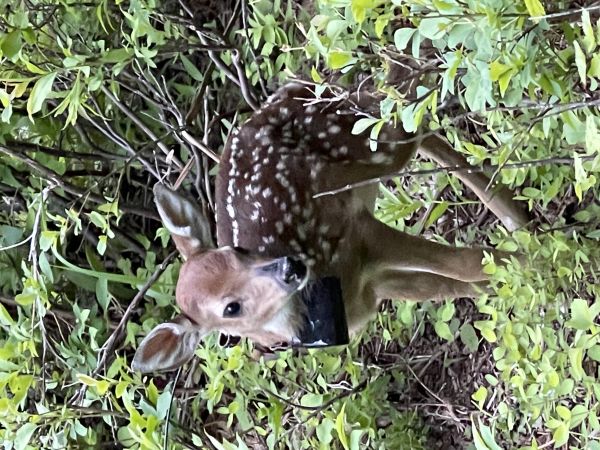
Northern Idaho currently supports a full complement of native carnivores and ungulates in what remains a largely intact ecosystem for the lower 48 states. The carnivore complex includes robust black bear and mountain lion populations, reestablished wolf populations, and grizzly bears. Ungulate species include white-tailed deer, mule deer, elk, and moose. An expanding carnivore community coupled with changing fire disturbance regimes has led to challenges for biologists who are responsible for managing and conserving the full set of species. White-tailed deer have taken on an increasingly important role because they are now the most abundant ungulate in northern Idaho. White-tailed deer are integral to the system as a prey item for the large predator complex, a game species that supports hunting opportunity, and a revenue source for Idaho Department of Fish and Game. Although white-tailed deer are one of the most studied species in North America, little work has been conducted on the species in Northwest forests. The purpose of this research is to quantify white-tailed deer population dynamics while enhancing our understanding of their interactions with other large mammals in the system. Ph.D. candidate Elizabeth Painter is leading this research in collaboration with Idaho Department of Fish and Game.
ELK, DEER, AND WILD HORSE ABUNDANCE AND INTERACTIONS ON THE YAKAMA INDIAN RESERVATION
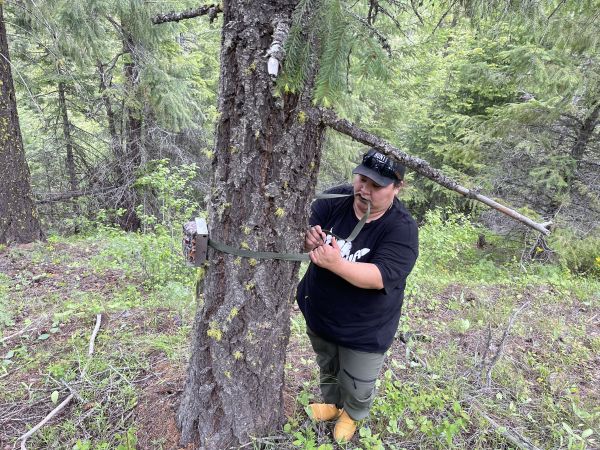
Wild horse populations have become a growing challenge in the western United States because populations have far surpassed sustainable targets and managers have few options for reducing horse numbers. Horses have in turn negatively impacted landscapes and other native and domestic ungulates. A robust wild/feral horse population resides on the Yakama Indian Reservation in southwestern Washington and concerns have arisen over horse impacts on other species, namely elk and deer. The horse population is widely distributed across the reservation, occupying both rangeland and forested ecosystems. Unchecked growth of horses could negatively impact elk and deer in a couple of ways. First, they could displace elk and deer from key portions of their range through direct competition. Second, horses could reduce the quality and quantity of forage available to elk and deer. Eithe rform of competition could influence elk and deer landscape use and possibly cause a reduction in native ungulate fecundity and survival. Direct evaluation of competition among ungualtes has proven challenging. However, competition can be indirectly assessed by evaluating distribution and landscape use to identify areas of overlap and areas of avoidance by one or more species. Additionally, competition could be assessed by evaluating forage resources in areas occupied by horses compared to similar areas only occupied by deer and elk. We are using field cameras to assess abundance and distribution of elk, deer, and wild horses across the forested portion of the Yakama Nation. Study results will help elucidate effects of horses on elk and deer and provide Yakama wildlife managers with data to help inform future decisions regarding the horse population on the Yakama Indian Reservation. M.S. student Sattie Fisher is leading this research in collaboration with the Yakama Nation Tribal Wildlife Management Program.
POPULATION AND HABITAT MONITORING OF MEXICAN AND NORTHERN SPOTTED OWLS ON THE MESCALERO APACHE AND YAKAMA INDIAN RESERVATIONS
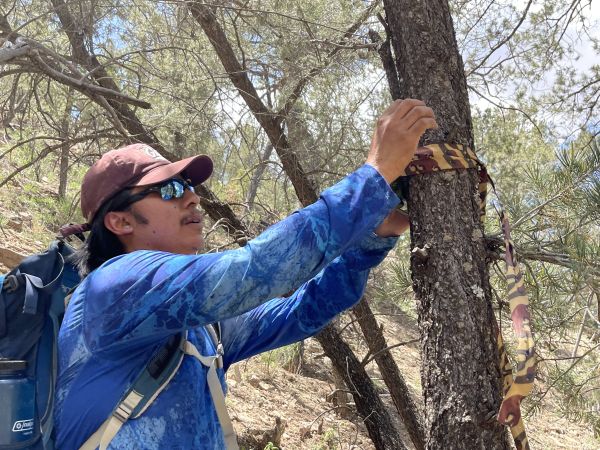
Mexican and Northern spotted owls have experienced widespread population declines in recent decades due to reductions in the amount of old growth forest in the West. They are listed as threatened species under the Endangered Species Act and now face additional threats of climate change and competition from other owl species. Barred owls, in particular, pose a serious threat to northern spotted owls as their distribution has expanded into the Northwest. Spotted owl population monitoring is critically important to track population status through time and to understand how management interventions influence population dynamics. Traditional survey methods employ call-back surveys conducted at night when owls are active. Acoustic recording units (ARUs) offer a new cost-effective approach to passively monitor owls. We are evaluating the utility of ARUs for passively monitoring Mexican spotted owl populations on the Mescalero Apache Reservation in New Mexico. We are also evaluating the effectiveness of a habitat suitability model (Hoagland et al. 2018) for predicting Mexican spotted owl occupancy across the reservation. Separately, we are working collaboratively with the Yakama Indian Tribe to quantify survival of previously-marked juvenile northern spotted owls as a step in better understanding owl population declines on the Yakama Reservation. M.S. student Xavier Lovato is leading this research in collaboration with the Mescalero Apache and Yakama Indian Reservations.
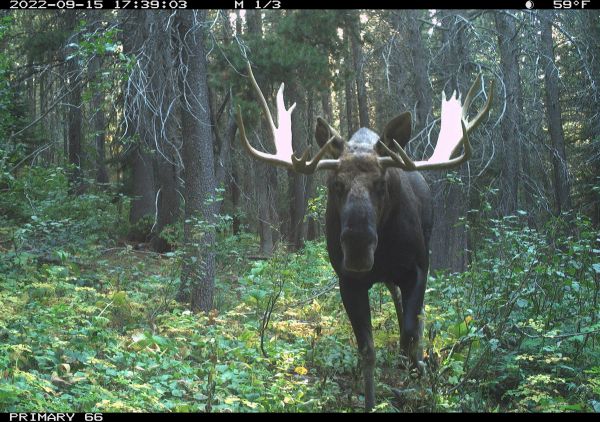
MOOSE ABUNDANCE AND CALF RECRUITMENT ON THE BLACKFEET INDIAN RESERVATION AND GLACIER NATIONAL PARK
Native to North America, moose are widely distributed across Canada, Alaska, and the northern portion of the lower 48 states, extending south through Utah and Colorado. A number of moose populations in the contiguous U.S. have experienced apparent declines in recent years, prompting wildlife managers to direct more resources to monitoring population status and identifying factors responsible for the declines. Moose populations are notoriously difficult to monitor in a cost-effective manner due to their relative low density, use of densely-vegetated habitat, and broad distribution. However, recent advances in the use of remote-sensed field cameras for estimating abundance of other ungulate populations offers a new possibility for cost-effectively monitoring moose abundance and recruitment over time. We are conducting a study on the Blackfeet Indian Reservation and eastern portion of Glacier National Park to assess the utility of field cameras for estimating moose abundance and calf recruitment. Our study results have implications for moose managers across North America. Our research will also provide data on a key moose population that has not been studied in recent decades. This moose population provides an important source of revenue through hunting to the Blackfeet Indian Tribe and supports wildlife viewing in the adjacent Glacier National Park. The population occupies a landscape that remains largely intact and is expected to remain that way for the foreseeable future. M.S. student Landon Magee is leading this research in collaboration with the Blackfeet Tribe and Glacier National Park.
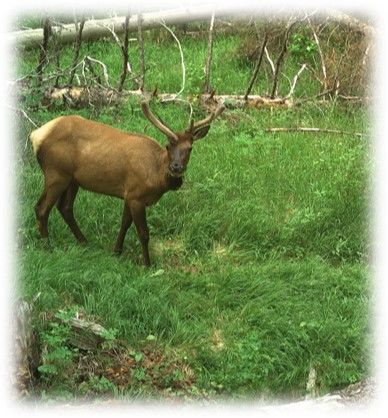
EFFECTS OF TIMBER HARVEST ON ELK SUMMER NUTRITION AND RESOURCE SELECTION
Bottom-up factors like nutrition can constrain ungulate population vital rates, stressing the need for managers to understand nutritional resources and how they may be alterned by different landscape processes. Recent studies in Montana have focused on the effects of prescribed and wildland fire on elk nutrition and resource selection, but the effects of timber harvest, another landscape-scale disturbance, on the state's elk populations remain relatively understudied. We are seeking to understand the impacts of two common timber harvest strategies on elk summer nutritional resources and resource selection in northwestern Montana. We are recording forage quantity and quality at vegetation transects distributed across Montana hunt district 121, near Noxon, MT, and using these data to create early and late summer nutritional landscape predictive models. We are using GPS locations from radiocollared elk in conjunction with occupancy data from a remote camera grid to assess elk resource selection to create a summer resource selection probability function for elk in northwestern Montana. This research is part of a broader collaborative research project evaluating elk abundance, survival, and cause-specific mortality in hunt district 121. M.S. student Trevor Weeks is leading this research in collaboration with Montana Fish, Wildlife, and Parks.