What Can Melting Alpine Ice Reveal About the Past?
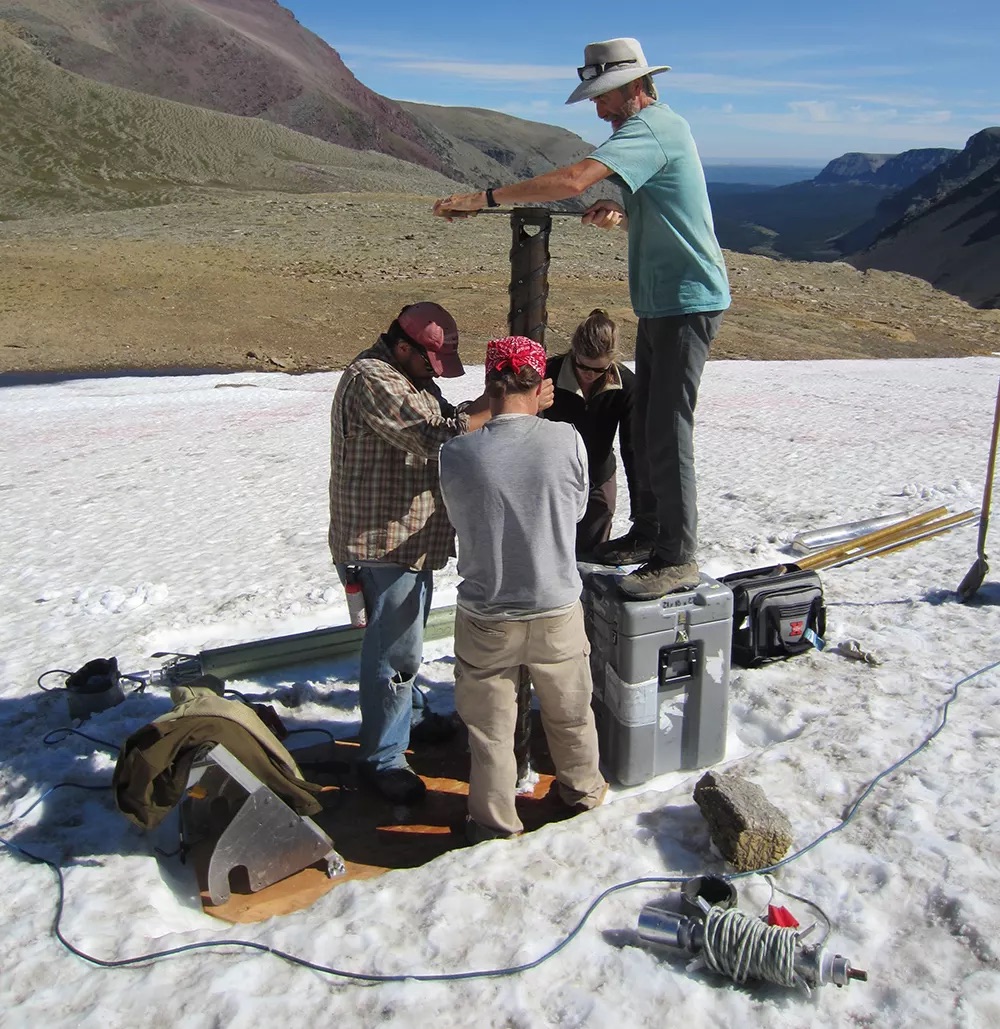
RM-CESU would like to highlight the research of our partner Dr. Craig Lee and his work in ice patch archeology. Dr. Lee researches the human ecology and landscape archeology of alpine and high latitude environments, sharing his process and results with numerous audiences, including the professional scientific community, Native American communities, and public.
The Glacier National Park Ice Patch Archeology and Paleoecology Project is a collaborative research effort between RM-CESU partners; Glacier National Park, CU Boulder, Montana State University, University of Wyoming, University of Arizona, the Confederated Salish and Kootenai Tribes of the Flathead Reservation, the Blackfeet Nation, and units of the National Park Service.
Melting ice poses a risk to previously preserved cultural and natural resources. The project partnership conducted cutting-edge, culturally informed fieldwork to survey, map, and sample stable ice patches in the park in 2010, 2011, 2013 and aerial photography in 2015. The research was used to establish a National Park Service-wide protocol for the collection, documentation, analysis and curation of artifacts recovered from melting ice patches.
Ice patches develop at high elevations when snow and ice accumulate to levels that do not completely melt in the summer. Over years, the patches become stable and the snow turns into low-density ice. Items deposited on an ice patch by wind, animals, or humans can be frozen for centuries. Unlike glaciers, ice patches do not move at all, so encased objects remain in the same spot. Researchers studying ice patches identify and document artifacts and organic materials left behind as the ice melts. Such finds can include animal bones and scat, leaves deposited by wind, fragments of ancient wood, and Native American artifacts.
“We have learned an astronomical amount, ranging from, ancient forests that are melting out of ice, ancient ice cores that let you see what wintertime temperatures have been over the last 10 millennia. And of course, the cultural material, the archeological material contains all kinds of interesting organic elements,” said Lee.
Ice patch melt is an issue with both ecological and cultural implications. The impending loss of these ice patches will uncover ancient plant and animal remains that could tell us about past climates, as well as irreplaceable Native American artifacts from the region’s tribes. The ice patches have kept these otherwise perishable objects frozen in time, but when the ice melts they will be exposed to the elements for the first time in centuries. If these fragile objects are not swiftly retrieved by archeologists, they could rapidly deteriorate (Ice Patch Archeology Resource Brief).