Science and Scholarship are Essential to Many Student Journeys at UM. Here are a few of the many standouts.
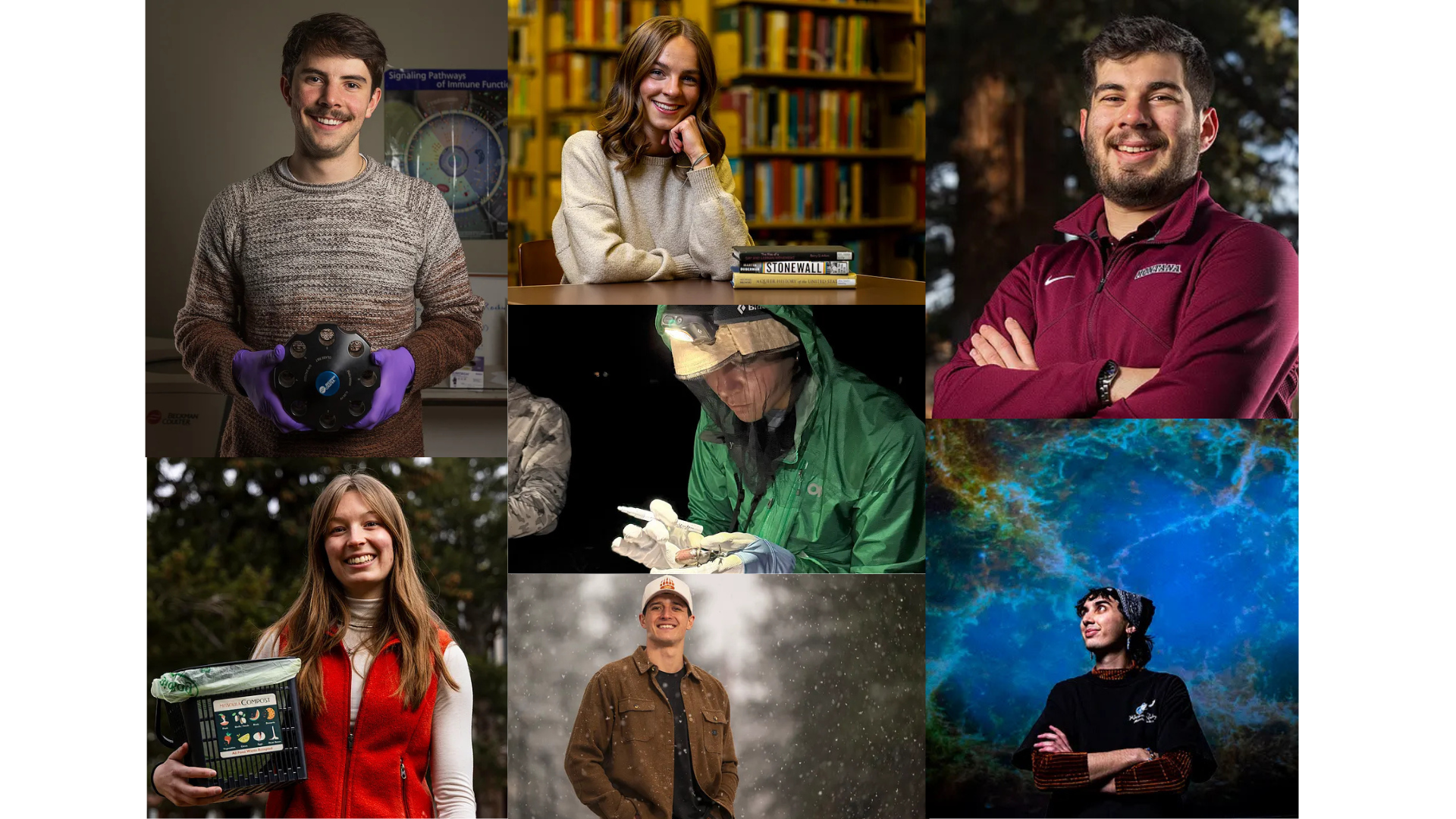

Ephraim Mortenson
Junior biochemistry student Ephraim Mortenson is maybe the only person on campus fully trained to use UM’s Analytical Ultracentrifugation Core from data collection to result analysis.
Borries Demeler, a director of the Northern Rockies Center for Hydrodynamics, heads the lab mainly from Canada, but Mortenson says he’s felt mentored and guided since being trained to use the core.
“He’s been wonderful in supporting me and training me from afar — I still feel really supported as I’ve figured out this really new, complicated thing — especially being independent for most of this summer,” Mortenson says. “I’m the only person on campus trained how to use this machine now, and when something’s not working, it was like, ‘Okay, I got to make this work now.
“It’s been really good and really confidence boosting,” he says.
Analytical ultracentrifugation is a technique for characterizing different biomolecules by spinning them quickly while shooting the sample with different wavelengths of light. The process allows researchers to learn about interactions between molecules, as well as their size, shape and how they might change in different solutions. The process often is used to inform drug or vaccine development but has many other applications.
“I’ve worked on so many different things, it’s kind of insane,” Mortenson says, noting that samples with different applications are sent to the lab from across the U.S. and Canada. “It really can be used for all sorts of stuff.”
The research has allowed Mortenson to present to conferences at UM, Denver and Oslo, Norway. Before graduating, Mortenson will train another student to take his place and run the core.
His ultimate goal is medical school after UM, but he is aiming for a big stop along the way: joining the Peace Corps. He’s preparing by pursuing UM’s Peace Corps Prep Program certificate.
Additionally, he works as a volunteer EMT, tutors and is UM’s general chemistry coordinator. Mortenson hopes to combine these skills in the Peace Corps by working in rural medicine and healthcare education.

Nari Lee
Nari Lee’s path to UM was neither straight nor easy. Trilingual, with a bachelor’s degree in culture and art, Lee spent several years working to support the arts in her hometown of Daegu, a large city in South Korea. But she dreamed of exploring true wilderness, so she quit her job and moved to a remote region of Mongolia near the Gobi Desert, where she worked closely with migrants displaced from their homes by the effects of climate change.
There she learned the importance of international work in conservation — Mongolia’s sandstorms resulted in dangerous air conditions in South Korea, too, creating a shared air community between the two countries.
“I lived with Indigenous communities, and we didn’t have any languages in common, but it didn’t matter,” Lee says. “We had shared goals and experiences as human beings.”
When Lee learned about environmental studies, which combines disciplines like social science with the environment, she was able to unify her interests in UM’s master’s program. She’s also completing a minor in gender and sexuality studies and a certificate in international development studies, combining these subjects to co-teach a course in global feminism for UM’s Franke Global Leadership Initiative.
“I feel like UM is the perfect fit where I can pursue all my passions,” Lee says. “I may seem scattered in all these different areas, but here it’s more flexible for me to do that.”
Being a female conservationist and activist in male-dominated fields inspired Lee to center her research around gender barriers in conservation in Mongolia and South Korea. Lee hopes to return to Mongolia after she completes her degree and help implement changes based on her work.

Aiden Agostinelli
For third-year Aiden Agostinelli, exploring the history of supernovae and chronicling the cosmos possesses a fantastical quality that they find challenging and delightful.
“It’s kind of the closest thing to real-world magic,” says Agostinelli, a physics major concentrating in astronomy. “But these are real physical processes that we can explain and understand.”
Their interest was spurred while attending Sentinel High School in Missoula, where good teachers and specialized STEM classes like astronomy and physics provided early insight into what a practicing scientist does. They found a future career goal.
Agostinelli got to live that future last summer through the National Science Foundation’s Research Experience for Undergraduates exchange in Nantucket, Massachusetts, at the Maria Mitchell Association studying supernova dust formation. They sifted through James Webb Space Telescope images to examine a supernova that exploded in 2011, studying what happens to the resulting dust over time.
While much is known about supernovas’ initial blasts and what they look like hundreds of years post-eruption, the middle part of their lifecycles is less studied. Agostinelli’s role was to find the supernova, figure out what’s going on with it and then fit that into a narrative about how the objects evolve. They’ve continued that work since returning to UM.
After graduating, Agostinelli hopes to pursue both their love for teaching and research by obtaining a master’s in science education and a Ph.D. in cosmology. They also hope to be an example to queer youth interested in physics and astronomy.

McKayl Bailey
Computer science senior McKayl Bailey sees the labyrinth of problem-solving inherent to their major as an exciting frontier to explore.
“It’s like solving a puzzle where there’s like 50 ways to do it, but you can find your own niche in a way that is really fun and satisfying to you, and then do it again in a different way if you want to,” they say. “It’s also very new. There’s a lot of problems we haven’t solved yet.”
Eager to investigate those problems, Bailey got involved in undergraduate research early as a first year, initially in UM’s Bird Ecology Lab and then the University’s Information Technology department. By their sophomore year, they were the junior admin for the Hellgate Shared Computing Cluster — a high-performance computing system located on campus that serves as a valuable resource for the scientific community, providing advanced computing capabilities for cutting-edge research and innovation. Bailey trained graduate students on scientific computing.
Bailey then dove into the complex and niche field of computational biology in UM Assistant Professor Lucia Williams’ lab, analyzing genomes through a computer science lens with fellow student Jose Rodriguez. Bailey’s work focuses on viruses — recently COVID-19 strains. The research could help scientists better understand diversity within a viral population.”
“I think computational biology is cool because you get to learn about the intersection of two very different fields, and there’s a lot of biology problems that you can tell haven’t really been looked at by computer science people before,” Bailey says. “Which to me is very fun.”
The work has taken Bailey to conferences in Bozeman, Alaska and South Korea, furthering their interest in the research world. After graduating, Bailey plans to continue in this field by pursuing graduate school.

Iris McKean
Iris McKean is fascinated by the butterfly effect: the idea that the small flap of butterfly wings can ripple into much larger impacts. Aptly, lots of lesser decisions launched her journey from the small northeastern Montana town of Glasgow, famously dubbed the “middle of nowhere,” to crouching beneath sappy oak trees in the middle of the night to scrutinize the mating habits of rhinoceros beetles — in Japan.
That adventure began with McKean’s decision to attend UM. She grew up hunting and fishing and describes herself as “outdoorsy” and “the most curious person ever.” She found herself wanting to know more about Montana’s animals and ecosystems and decided to pursue UM’s top-ranked Wildlife Biology program and pre-veterinary studies.
Her sophomore year, McKean took a genetics and evolution class from Professor Doug Emlen, who studies animal weaponry and is one of the few Montanans ever elected to the National Academy of Sciences. McKean was hooked and hungry for more, so she asked to get further involved.
“Students like Iris are a joy to work with,” Emlen says, “so I jumped at the chance to get her involved with our research.”
The decision eventually earned her one of three undergraduate spots on the summer research trip to Japan with one of Emlen’s Ph.D. students. The group set up base about an hour outside of Tokyo, examining why female rhinoceros beetles select certain males to mate with.
While research was the focus, McKean, also a UM student-athlete, spent a lot of time running in the Japanese humidity to maintain her cross-country training regimen.
“UM has given me so many unique experiences and learning opportunities,” says McKean, now a senior. “The faculty have been so supportive, my classmates have pushed me, and my team has been the light of my life. And there’s such an emphasis on experiential learning, so you can end up having the craziest, best summer ever.”

Lauren Schulte
UM senior Lauren Schulte is inherently curious about how humans think, connect and behave. That curiosity led the psychology major and climate change studies minor on a dynamic path through varied research opportunities across multiple subfields. Tying it all together is the urge to help people feel understood, capable and grounded.
“I just love listening to people, trying to understand what they’re going through,” she says.
Schulte’s research experience began with an undergraduate research assistant position in the lab of UM Clinical Psychology Professor Dr. Bryan Cochran. She joined a project studying historical trauma for LGBTIQ-plus individuals. The group piloted a study in collaboration with the University of Nevada, Reno, assessing how much people know about the history of trauma and oppression toward that community.
She also established her own independent research project on intergroup contact between cisgender, heterosexual and queer individuals and how it might impact non-LGBTIQ-plus folks. She presented her results at the UM Conference on Undergraduate Research and a cognitive and behavioral therapy convention in New Orleans.
Schulte also joined Dr. Rachel Williamson’s Existential Trauma Lab, tying in her interest in climate change to examine how Montana mental health providers are responding to the issue. Additionally, Schulte works with a graduate student on a study about how counseling clients talk about climate change, how their feelings about it are expressed in therapy (through anxiety, grief and other emotions) and what therapeutic interventions are being used to quell those climate concerns. Schulte plans to present the project at the Climate & Health in the 406 Conference in Bozeman, as well as UMCUR.
Her various research experiences have confirmed to Schulte that she’s on the right path.
“I think one of my main goals for my career is to always keep in mind how research and practice are inherently connected, and how good practice doesn’t exist without research,” she says. “Specializing in a field where listening, connection and empathy are so inherent to diagnosing, treating and helping people function in their daily lives, I think I’ll hopefully make an important impact.”

Ava Worbets
After Ava Worbets graduated from UM with undergraduate degrees in environmental science and parks, tourism and recreation management, she still had research questions and was hungry to satiate them. So she decided to dig deeper by pursuing a master’s in PTRM, too.
Funded by UM’s Institute for Tourism and Recreation Research, Worbets’ work investigates how recreation influences the way people connect to community. Her recently published thesis, “The New Wild West: How economic transition influences sense of place in rural trail communities,” examines how the rural Montana communities of Anaconda, Augusta, Lima and Lincoln have been impacted by the Continental Divide Trail.
“My research is focused on people’s connection to place and change,” Worbets says. “Because a lot of the research is focused on the impact of communities on the trail, not the other way around. So it was fun to take that perspective.”
Worbets interviewed nearly 30 people throughout those communities, building trust and having deep conversations with local residents. One talk early on in her research stood out:
“I was still really nervous about asking people kind of personal questions about their community,” Worbets says. “We met up outside this campground, and there was a herd of elk. We were sitting on this log as the sun rose, eating breakfast together, having a really amazing conversation about what community means to them and how they see their community changing and the impacts of recreation.”
Worbets underscored how grateful she is to everyone who took the time to have those conversations with her. The insight deepened understanding of place theory and rural economic transition.

Vivi Ostheimer
Raised in small-town Buffalo, Wyoming, Vivi Ostheimer — like many Western youth — participated in 4-H. Beyond the typical projects, Ostheimer took on an initiative of her own: establishing a recycling program at her town’s big rodeo event, funneling scores of cans and glass bottles into bins for reuse rather than rubbish.
“I grew up in a land of wide-open spaces at the base of the Bighorn Mountains with two parents that are super invested in conservation,” Ostheimer says of her hometown. “But it was a very conservative ranching town…so I’ve always had a passion for sustainability efforts and trying to help people engage with those — especially people that might not respond well to the word ‘sustainability.’”
Nearly a decade later, Ostheimer is a UM junior majoring in journalism and environmental science. But the program she started still lives on — as does her enterprising spirit.
Living in UM’s Lewis and Clark Village, Ostheimer grew concerned about the food waste being thrown out. She pitched UM’s Kless Sustainability Fund on a composting pilot program. Once approved, Ostheimer personally knocked on 150 of her neighbor’s doors to pass out composting bins. She hopes to make it through the remaining 55 by the end of the semester.
“Nobody was really saying no, even if they hadn’t ever composted. They were excited to learn and try,” Ostheimer says. “People really want to do the right thing. They just need it to be accessible and convenient.”
Ostheimer, who also pursued a climate changes studies minor, put her studies into practice interning with the City of Missoula climate team last summer.

James Straw
Growing up on a farm in Rifle, Colorado, James Straw “really wasn’t a fan of school.” He loved competitive snowboarding and tinkering with his old truck while waiting to begin his lifelong goal of enlisting in the U.S. Marines. After graduating high school, he did just that and served his country for five years — first as an infantry machine gunner and then in a sniper platoon.
Now a senior integrative physiology major with a biochemistry minor, Straw is UM’s latest recipient of the Marshall Scholarship, considered among the most prestigious scholarships. Straw will travel to the University of Edinburgh this fall to achieve two master’s degrees in human complex trait genetics and genomic and experimental medicine.
“I’m still just this kid who wanted to be a Marine, and I didn’t even like school,” Straw says. “So, to be in this spot is crazy. It’s just such a privilege.”
Straw’s journey into higher education prestige started at Missoula College in the anatomy and physiology department. He’d planned to pursue an associate degree in paramedicine and try out for the Special Forces. Then an autoimmune disease diagnosed forced him to change course.
Straw reevaluated options that would allow him more flexibility through a flare-up but still fulfill his desire to leave a positive impact and push society forward.
Mentors at Missoula College and UM encouraged him to explore research, eventually leading Straw to a pediatric cancer research position at Children’s Hospital Colorado. There he found medicine was his new calling.
The project had Straw digging into data going back 20 years for a retrospective chart review. But he also got to shadow physicians across various specialties and interact with patients in different stages of treatment. The doctors actually took quality time to sit, talk and answer questions with their patients, offering answers and hope in the midst of a difficult time. Straw was inspired.
“If I can just change one person’s life, that’s a win,” Straw says.

Ryan Fleetwood
Admittedly, Ryan Fleetwood likes to stay busy.
“I find it personally hard to pass up a good opportunity,” says the senior environmental science and sustainability major.
Fleetwood is concentrating in water resources while also double majoring in geography and pursuing a minor in climate change studies, as well as a GIS certificate. As an undergrad, Fleetwood has leveraged his interests to participate in a diverse array of research opportunities in Montana and beyond.
After his first year at UM, Fleetwood participated in the Boone and Crockett Club’s Demmer Scholars Program, interning with the Office of Environmental Policy and Compliance, Department of the Interior, on sustainability, environmental cleanup and environmental justice projects in Washington, D.C. During his second year, Fleetwood got involved with the Montana Climate Office’s Montana Mesonet project, looking to estimate snow water equivalent.
The following summer, he worked with the Department of Defense as an imagery analyst. He also had stints as a Baucus Climate Scholar, interned for the Big Sky Passenger Rail Authority and worked with the USGS Northern Rocky Mountain Science Center, as well as UM’s President’s Office.
As a junior, Fleetwood joined the GRate (Greenland Rate) project with UM’s Department of Computer Science, doing AI machine learning modeling of the ice sheet. Fleetwood presented his work at UMCUR, and multiple works are expected to be published in the next year.
“By May, I may have two or three first-author publications as an undergrad,” Fleetwood says. “I mean, that’s so exciting. And I think it prepares me for graduate school.”