UM Computer Scientists Land Grant to Improve Models of Melting Greenland Glaciers
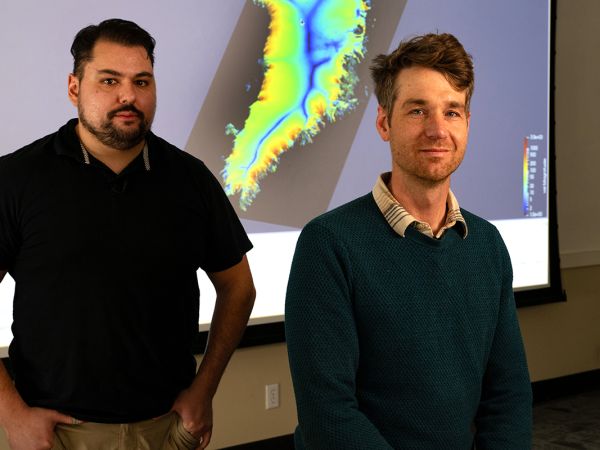
UM researchers Jacob Downs (left) and Doug Brinkerhoff were awarded a $600,000 grant to improve models involving melting Greenland ice and sea level rise. (UM photo by Ryan Brennecke)
MISSOULA – The melting Greenland ice sheet and glaciers contribute significantly to global sea level rise. Now two University of Montana researchers are using advanced neural networks, machine learning and artificial intelligence to improve climate models to better predict the threat to coastal areas.
Assistant Professor Jacob Downs and Associate Professor Doug Brinkerhoff are faculty members in UM’s Department of Computer Science. They earned a $600,000 grant from the National Science Foundation to train neural nets on historical data, which should build capacity to project future glacier evolution.
Neural networks are highly flexible computational models loosely inspired by the human brain, Downs said. Just as human brains use interconnected neurons to process information, these networks transform complex data to detect underlying patterns.
“While neural networks form the backbone of everyday AI tools like ChatGPT, in our research we use them to uncover patterns in complex climate and satellite data that traditional physics models struggle to capture,” he said. “It's thrilling to think we can make better predictions about the future of the Greenland Ice Sheet using advanced mathematical ideas.
“We have to contend with rising sea levels, and attempting to ignore the problem won’t change the reality of what’s happening,” Downs continued. “Improving our ice sheet models and reducing their uncertainties is a necessary step toward making credible predictions and helping communities plan for the future.”
He said the project grew out of several years of collaborative research between himself, Brinkerhoff and colleagues at Dartmouth College focused on understanding why certain glaciers, such as Helheim Glacier in southeast Greenland, change speed and shed ice seasonally in ways that existing models struggle to explain.
That earlier work, supported by the Heising Simons Foundation, highlighted a persistent gap between what researchers can observe from satellites and what traditional physics-based models can represent. As new datasets became available and machine-learning methods matured, the team began discussing how new computational approaches could address limitations in current ice sheet models.
Downs said projections of sea level rise over the next century depend strongly on how well researchers can represent certain physical processes in ice sheet models – particularly how glaciers slide over the rock or sediment beneath them and how icebergs break off into the ocean. These processes play a major role in how quickly ice flows into the sea, but they are difficult to observe directly and describe using simple physical equations.
“For example, it’s extremely challenging and expensive to measure conditions at the front of a glacier where icebergs calve, a process through which large chunks of ice break off the edge of a glacier and fall into the water,” Downs said. “Similarly, while some information about the environment beneath the Greenland Ice Sheet can be inferred, direct observations are very limited. As a result, it’s hard to build models that fully explain why ice sheets behave the way they do, particularly because these conditions change over time.”
He said machine learning is used to connect observational data – such as ice motion and climate conditions – to processes that cannot be directly observed, like glacier sliding or ocean conditions that affect iceberg calving. The goal is to develop improved models of these processes that have strong predictive power.
“In other words, if the model is developed using information about climate and ice conditions, it should be able to produce reasonable estimates of how fast glaciers slide or how frequently icebergs break off,” Brinkerhoff said. “By learning from available observations while respecting known physical constraints, this approach aims to reduce uncertainty in future projections of ice loss and sea level rise.”
In addition to Downs and Brinkerhoff, a UM computer science graduate student will participate in the project, helping develop and refine the machine learning models that represent the core of the research. Community building, education and outreach are also central components of the award.
As part of the project, the team will host the third year of UM’s Glaciology and Machine Learning Summer School, an intensive program that brings together graduate students and early-career researchers for hands-on training in machine learning applied to a wide array of problems in glaciology.
Held at the Taft Nicholson Center in Montana’s Centennial Valley, the summer school provides participants with both foundational skills and exposure to cutting-edge research at the intersection of AI and climate science while fostering collaboration amongst students and instructors.
“I’ve always been fascinated by the natural world and mathematics, which made me gravitate toward computational modeling,” Downs said. “I’m also deeply motivated to do work that feels significant and purposeful. With this project, I feel like I have the great privilege to tick all of those boxes at once.”
View a video of Downs and Brinkerhoff speaking about their work.
###
Contact: Jacob Downs, UM computer science assistant professor, 406-243-2883, jacob1.downs@umontana.edu; Doug Brinkerhoff, UM computer science associate professor, 208-521-8411, douglas1.brinkerhoff@umontana.edu.