UM Doctoral Student Digs Up Archaeological Accomplishment
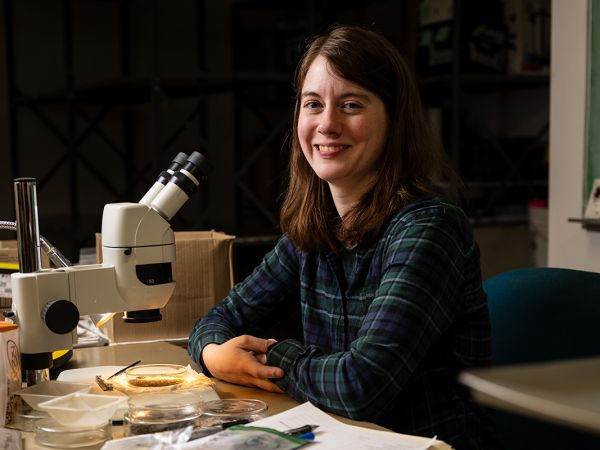
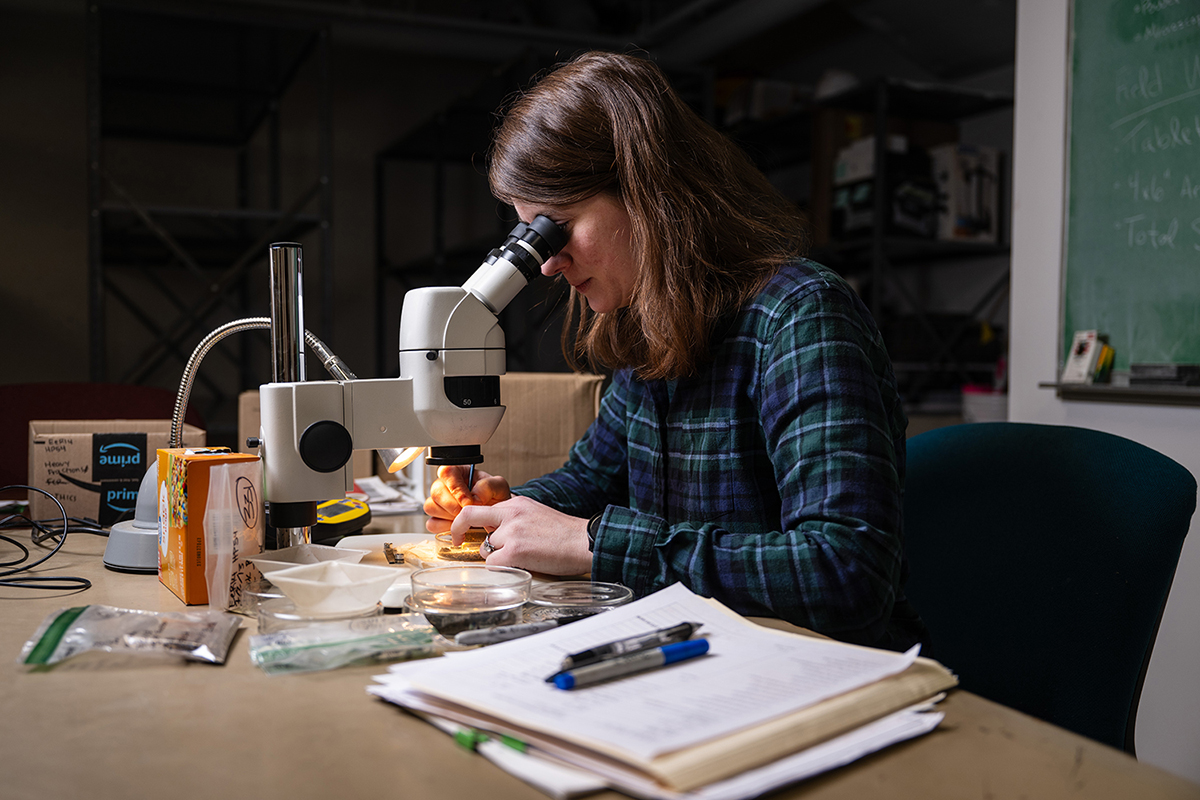
Doctoral student Megan Denis explores ancient cultures with this microscope at the University of Montana. (UM photo by Ryan Brennecke)
By Cary Shimek, UM News Service
MISSOULA – The journey of Megan Denis to becoming a globetrotting doctoral student at the University of Montana started at an archaeological dig in British Columbia.
Originally from Bremerton, Washington, Denis as a college undergrad attended the field school of Anna Prentiss, a UM Regents Professor of Anthropology renowned for her meticulous and holistic methods leading archeological digs.
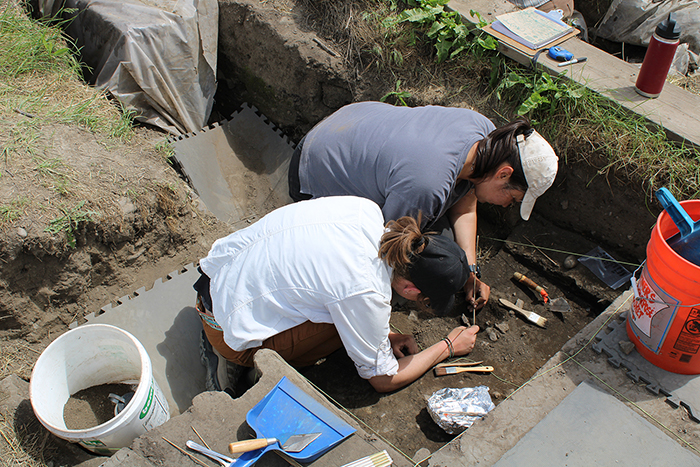
Denis soon found herself delving into Housepit 54, an ancient site inhabited for hundreds of years by the Xwísten people of modern-day British Columbia. The site is part of the Bridge River Archaeological Project near Lillooet.
The Xwísten would create a house by digging a large pit and roofing it over. Housepit 54 grew to 13 meters wide over time and lodged up to 44 people at the same time. The initial pit was deep enough that whenever the floor became too gnarly from processing fish and other human activity, people would clean up by bringing in another layer of soil. They did this 15 times – roughly every 25 years – creating a priceless layered record across centuries of where and how they lived within the home.
“When we go there, it’s usually like six weeks at a time,” Denis said. “I’ve gotten to go on three full excavations in that area, and it’s been amazing.”
Prentiss made a decades-long career out of revealing the mysteries of pithouses, and her field school attracted Denis to UM for graduate school. Denis earned her master’s in 2021 and is now working toward a UM doctorate in anthropology, with Prentiss as her mentor.
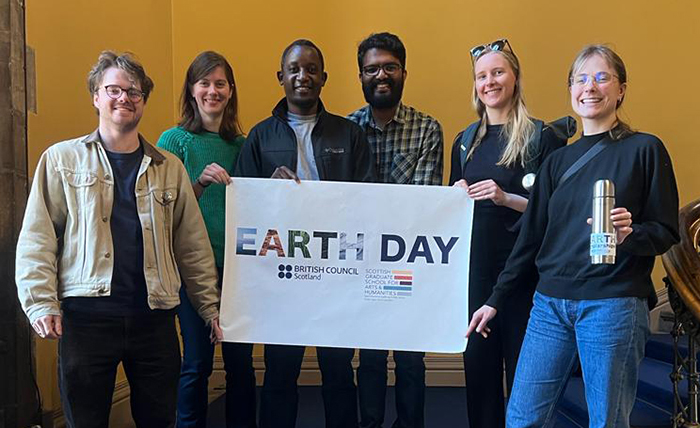
Part of her UM journey was being named one of the first EARTH Scholars by the British Council and Scottish Graduate Schools of Arts and Humanities in 2023. Denis traveled abroad to the University of Glasgow in Scotland to study how the Rannoch Moor boglands are affected by human activity and climate change. She worked with Professor Nicki Whitehouse, who taught her the nuances of ancient pollen.
She also collaborated with Cynthia Larbey, another renowned archaeologist, who discovered the first evidence of humans using a cooking recipe in a South African cave more than 80,000 years ago. Larbey and Prentiss are research colleagues, and that trans-Atlantic connection between scientists helped make the Scottish research experience happen for Denis.
“I was the first person from Montana – and I think all of America – to be named one of these scholars,” she said. “Cynthia Larbey taught me about parenchyma [plant cell] identification using material from Bridge River, and that’s exciting because that type of identification is a relatively new field.”

The working title of Denis’ doctoral dissertation is “Cooperation in the Archaeological Record.” By studying ancient clues left in the housepits, she is trying to discover how people cooperated with one another. These clues include stone tools, bones, seeds, plant matter and charcoal. The location of items and types of materials tell long-lost stories, indicating things like wealth and ancient trading practices.
“I have this working theory that the appearance of bigger or more expensive materials – like obsidian – indicate wealth,” Denis said. “And if the excess pieces of the tools are bigger, that means they didn’t have to use every tiny little piece of the obsidian. That shows excess and wealth, because the closest obsidian source we know of is 260 kilometers from the Bridge River site, and that’s not an easy trek.”
She said tools like sandstone saws also may indicate wealth, as they take a long time to make and are incredibly fragile. Items from farther away also might indicate wealth. In addition, the archaeological evidence reveals individual skillsets, like a highly accomplished flint knapper (tool creator) or seamstress. Tool and plant remains suggest professions and how valued and prosperous those workers were.
“What’s great about the people we study is that they were into competitive giving,” she said. “They would trade things that were significant and important and give them to people to impress them and basically indebt them. It was like, ‘Hey, I gave you this really cool thing, and now you have to give me something.’”
Denis said the ultimate goal of her doctoral research is to create a math equation – involving unearthed lithics (stone tools), plant remains and botanical databases of an area – which could describe the cooperation of ancient people over time. She envisions such an equation that could be used at archaeological sites around the world.
“Megan Denis is an extraordinary student,” Prentiss said. “Not only has she developed significant skills and experiences in Pacific Northwest archaeology, paleobotany and cultural evolutionary analysis, she also maintains a demanding staff archaeologist position on the Bitterroot National Forest.
“I’m expecting her dissertation to be a tour de force in the application of archaeological data to address a major anthropological problem,” Prentiss continued.
Denis hasn’t experienced a mind-blowing “eureka” moment working at the Bridge River site, though she was part of a team that unearthed a deer scapula (shoulder bone) implement and a horn core (part of a mountain goat skull) near the remains of an ancient hearth.
“Why was the horn core there?” she asked. “This was heavy material you probably weren’t going to eat. What was the purpose? Was there some sort of party going on?”
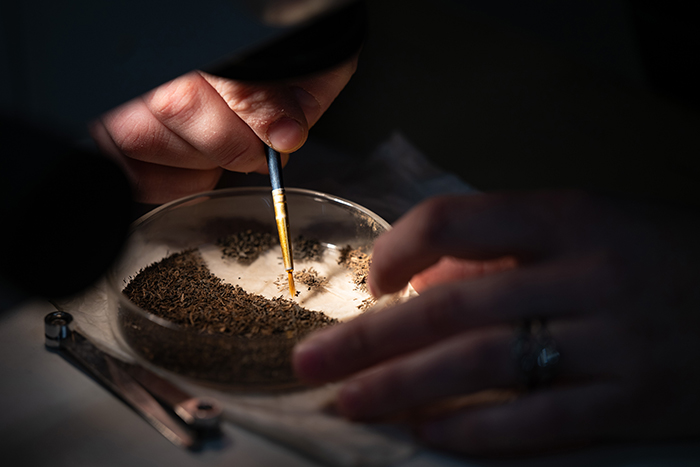
Denis said much of her research involves long hours of “looking at itty bitty things under a microscope – charcoal mostly. It’s all like a massive puzzle to me.” She focuses on plants and the botanical materials found at sites, which she said have been overlooked for too long. She is constantly counting and cataloguing materials found on the same section of floor, such as different kinds of seeds.
“With one of the last things I sorted, I found 6,000 Douglas fir needles,” she said.
Denis loves working with charcoal, which she contends tell long-lost stories. But it also can be frustrating.
“Charcoal likes to stick to everything, and if there is any static in the air, everything goes everywhere,” she said. “And if I have things counted and nicely sorted and that happens, I have to redo everything.”
Denis studies cultural phylogenetics, the transmission, diversification and evolution of cultural traits over time. She wants to know how cultural information is passed between human groups and passed on between generations.
She admits it’s a big goal, but one she’s working toward – one seed and pine needle at a time.
###
Contact: Dave Kuntz, UM director of strategic marketing, 406-243-5659, dave.kuntz@umontana.edu; Megan Denis, UM anthropology doctoral student, megan.denis@umconnect.umt.edu.