UM to Launch New Montana Healthy Communities Dashboard
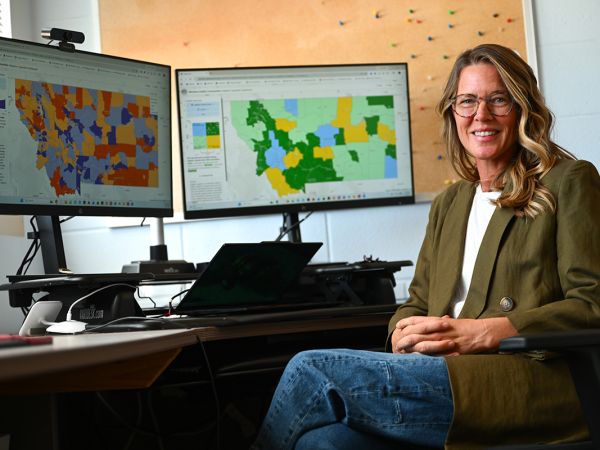
UM Professor Erin Landguth helped create the Montana Healthy Communities Dashboard, a new tool for those in need of health data. (UM photo by Ryan Brennecke)
By Sheridan Wood, UM News Service
MISSOULA – Historically, researchers looking to find Montana data for their projects or grant proposals had to hunt it down, often by contacting the University of Montana’s School of Public and Community Health.
Health data, like asthma or cardiovascular hospitalizations, is typically in a separate location from environmental or socioeconomic data, like wildfire smoke days or median household income. This makes the process for finding connections between environmental and social factors and health difficult.
To make the data collection process more accessible, SPCH researchers developed the Montana Healthy Communities Dashboard, an interactive online map of the state that puts all the collected data, as well as data from the state and counties, in one centralized location.
The goal is for researchers, Montana policymakers and health officials to be able to easily analyze data for health- or climate-related projects. The dashboard launched April 14.
“We started it because we had so much data, and we wanted to have it in a place that anyone – community members, researchers, local health officers or whoever wanted access to the data – could look at it in a visual way,” said Ava Orr, one of the UM research scientists involved in the project.
Erin Landguth is an SPCHS professor who directs UM’s Data and Modeling Core of the Center for Population Health Research. She said the new tool is designed to highlight both environmental hazards and community resilience.
“The Montana Healthy Communities Dashboard is an open-access, interactive web platform designed to break down data silos,” Landguth said. “It brings together environmental exposures like air quality and wildfire smoke, health outcomes like asthma and premature mortality, and socioeconomic resources like income and housing stock – all onto a single, localized map.”
Inspired by the California Healthy Places Index, the dashboard’s interactive map of Montana is made up of orange and purple patches designating which areas rank high and low for certain health, social and environmental determinants, such as wildfire smoke days or asthma. Most importantly, the dashboard visualizes the Adaptive Capacity Index across the state, a metric that measures a community’s ability to recover from things like natural disasters, public health crises and economic disruptions.
Researchers calculate ACI by analyzing 13 variables that are broken into four categories: demographics, housing and transportation, language and education, and socioeconomics. Cindy Leary, a statistician on the project, said this is a valuable tool to assess how susceptible areas are to events like wildfire or high air pollution exposure.
“We want to be able to understand how vulnerable different communities are, and then list potential interventions to help those different communities,” Leary said.
The point is for researchers and intervention programs to have the tools necessary to understand health and environment in Montana and use resources to collaborate with communities that need it most. And although the dashboard is built for use in the public health research and decision-making sphere, the website is free and public.
“In our hearts as researchers, we want everyone to have as much access to information as they possibly can,” Leary said. “If people want to be able to explore the impacts of air pollution on health or how social determinants of health are correlated with different health outcomes, that’s our goal in terms of being part of an educational system and giving power to people to be able to ask their own questions.”
While the UM researchers handled the data, David Heyman of interactive map building company Axis Maps created the software that brought the project to life.
Additionally, community stakeholders collaborated with UM researchers throughout the process, including Missoula Public Health, Missoula Invest Health, United Way and the Montana Department of Public Health and Human Services.
After the April 14 launch, the dashboard’s builders hope to expand datasets on the website by getting community feedback and tailoring the information available to the specific needs of Montana public health departments and research projects.
The dashboard is funded by grants from Missoula Invest Health and UM’s Center for Population Health Research, which is funded by the National Institutes of Health.
“The April 14 launch is not the finish line; it’s the starting line,” Landguth said. “This initial phase gave us the incredible opportunity to build the core structure and data framework with stakeholder feedback. Now that the architecture is in place, there are endless avenues for where this can go.”
###
Contact: Erin Landguth, professor, UM School of Public and Community Health, Data and Modeling Core director of the Center for Population Health Research, 406-243-5221, erin.landguth@umontana.edu