High Above the Valley Floor, a UM Researcher Studies a Vanishing Tree Species
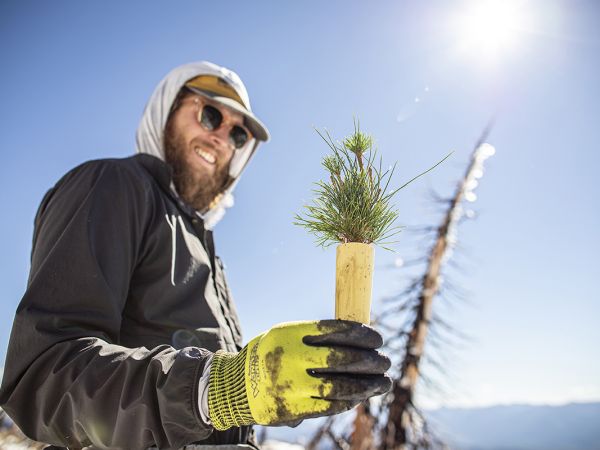
UM graduate student Josh Beisel holds a whitebark pine seedling in Glacier National Park. Beisel earned his doctorate in systems ecology from UM on May 9. (Photo courtesy of Glacier National Park)
By Libby Riddle, UM News Service
MISSOULA – Deep in the wilderness of Montana’s Bitterroot Mountains, Josh Beisel and his team of field technicians heft 60-pound packs across rough terrain. Alongside their sleeping bags and dehydrated meals, they carry poster tubes full of tree cores – small cylinders of wood collected from the trunks of high-elevation trees, including one of the West’s most imperiled species: the whitebark pine.
Whitebark pine trees (Pinus albicaulis) are some of the only trees that can grow at Montana’s highest elevations. They provide food for grizzly bears and habitat for birds like Clark’s nutcrackers. They stabilize the snowpack by acting like a fence that holds snow on steep slopes. The shade they provide keeps snow from melting too quickly and reduces the risk of spring floods.
But whitebark pine trees are in danger. Their populations are in decline due to several different stressors, including climate change, pine beetle outbreaks and an invasive fungus known as white pine blister rust. Now a Ph.D. candidate at the University of Montana, Beisel has spent his early career learning more about this unique species to inform conservation efforts.
Beisel grew up in Bothell, Washington, just north of Seattle. Surrounded by the towering cedars, hemlocks and Douglas-fir trees of the Pacific Northwest, he’s always been interested in forest ecosystems. Beisel credits his aunt Carla Cole, who’s worked for the National Park Service for as long as he can remember, with inspiring him to pursue his love for the forest as a career.
“We’d go visit her and get to see her work at the park, and she’d take us mushroom foraging,” Beisel said. “I’m really grateful that I had her as a role model.”
Beisel earned a bachelor’s degree in biology from Occidental College in Los Angeles, where he learned about plant physiology. He leveraged those skills right out of college, first helping manage invasive plants with the U.S. Forest Service, then as a biological science technician in Glacier National Park. It was there that he became part of the fight to save the whitebark pine.
White pine blister rust is caused by a fungus introduced to North America in the early 1900s. The fungus creates sores on the tree’s branches that prevent the flow of water and nutrients and can eventually kill the tree. Because the fungus isn’t native here, whitebark pine trees have little resistance to the disease. Due to rapidly spreading blister rust on top of threats from climate change and pine beetle outbreaks, whitebark pine trees are considered threatened under the Endangered Species Act.
But some whitebark pines can naturally resist the fungus. While working in Glacier, Beisel was part of a team tasked with collecting cones from potentially resistant trees. They shipped the cones to a special nursery in Coeur d’Alene, Idaho, that exposed the seeds to blister rust to determine which ones were genetically resistant. Those seedlings were propagated and shipped back to Glacier where Beisel replanted them.
Beisel noticed they would plant these seedlings in areas that were recently burned by wildfires. He knew there was concern that fire suppression and competition with other tree species might contribute to the decline of whitebark pine. But his initial inquiry into these processes didn’t yield clear answers.
“Despite all the great work that’s been done, there’s things we still don’t really know about this species, but there’s all this interest and effort and money being put into trying to conserve and restore it,” Beisel said. “That was a light bulb moment of like huh … it seems like there’s still more to be learned about this.”
When a research assistantship position opened up in Andrew Larson’s forest ecology lab at UM, Beisel applied and pitched his idea to study the fire ecology of whitebark pine trees. It was supposed to be a master’s position, but Beisel quickly acquired the ideas and the funding to turn it into a Ph.D. project. Beisel’s dissertation is teasing apart the relative influences of climate, disturbance and competition across an environmental gradient from whitebark pine forests down to lower-elevation western larch stands.
To get the data he needed, Beisel and three field technicians spent a summer hiking deep into the backcountry of the Bitterroot Mountains, where whitebark pine trees grow in one of the most remote areas in Montana.
In Beisel’s words, the trail system in the Bitterroots has seen better days. They often found themselves bushwhacking through dense shrub or navigating across scree fields. Beisel’s field sites were so remote, the Forest Service had to resupply the team with food packed in by mules. By the end of the summer, they had hiked over 130 miles with 75,000 feet of elevation gain.
When they reached a site where fire had burned through but whitebark pine trees were still standing, they used an increment borer – a specialized tool that extracts wood samples without damaging the tree – to collect tree cores. Each pencil-sized core revealed the tree’s growth rings. From the 1,200 cores Beisel collected, he pieced together the environmental and ecological history of the Bitterroot’s whitebark pine trees.
Beisel expected to see complex interactions between the whitebark pines and other tree species, like subalpine firs. These two species compete for resources, but in stressful environments whitebark pines can protect subalpine firs from cold temperatures and wind. But decreasing snowpack is having a much bigger impact than these tree-to-tree relationships.
“What we found is that climate change is steamrolling those interactions,” Beisel said.
Typically, whitebark pine trees grow less during big snow years because more snow on the ground means the growing season is shorter. But 30 years ago, that relationship switched. Now these trees grow more during larger snow years – which are fewer and farther between due to climate change – because they are becoming more limited by access to water than by cold temperatures and short growing seasons. These results suggest that climate change is overriding everything Beisel was taught about how these high-elevation forests function.
Beisel published his results in the journal Ecosphere, along with another paper about the western larch forests earlier this year. His research is funded in part by the Wilderness Institute Meier Graduate Fellowship, an endowed fund created by donors Joel and Patti Meier. The fellowship supports graduate research or creative scholarship focused on Wilderness or wildlands.
“I got to meet the folks that funded that fellowship, and it was really cool to get to talk to them,” Beisel said. “Part of my analysis wouldn’t have been able to happen without that funding.”
The fellowship allowed Beisel to analyze seedling and sapling data from his sites in the Bitterroot, so he can study how climate change and fire are shaping the future of the forest. He used these data to create maps of the Bitterroot that predict where whitebark pine trees are most likely to succeed in the future. He hopes to publish this work later this year.
Beisel graduated with his Ph.D. in systems ecology on May 9. He is in the process of applying to postdoctoral research positions across the West, where he can continue to research climate and disturbance dynamics in forests. He’s excited by the opportunity to use his research to inform natural resources management.
While he enjoys the other aspects of conducting research, what keeps him inspired is the time spent in such special places.
“In the last four years, I’ve gained a lot in terms of knowledge of these systems and technical skills,” Beisel said. “But at the end of the day, what brought me to this work and what continues to inspire me is getting out into the field.”
###
Contact: Dave Kuntz, UM Director of Strategic Communications, 406-243-5659, dave.kuntz@umontana.edu; Libby Riddle, science communications coordinator, W.A. Franke College of Forestry and Conservation, elizabeth.riddle@umontana.edu.