UM Chemist Earns Grant to Make Pharmaceutical Manufacturing More Sustainable
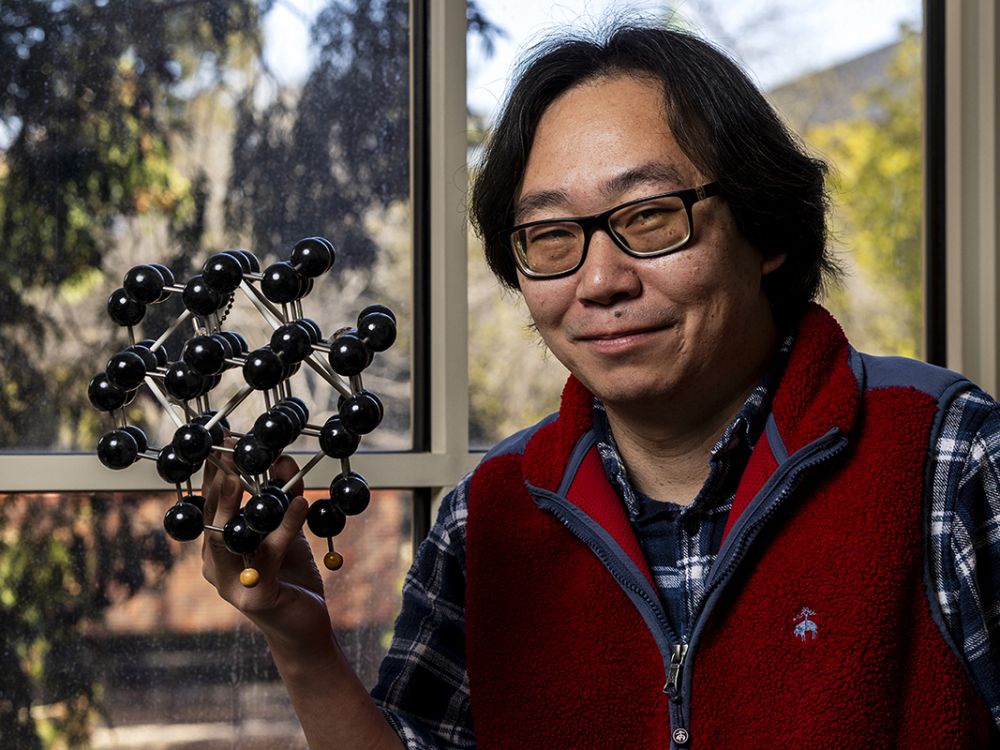
The lab of UM chemist Dong Wang recently earned a $1.2 million grant that may lead to new pharmaceutical drug-design strategies. (UM photo by Marley Barboeisel)
MISSOULA – Dong Wang, a University of Montana chemistry associate professor, leads a research team designing molecules that mimic nature to reduce the toxins and energy used in pharmaceutical manufacturing. The resulting synthetic molecules could significantly lower the energy and toxic materials now required for precise molecular transformations.
The National Institutes of Health recently funded this work with a $1.2 million grant.
“By studying biological catalysis, the way that enzymes speed up chemical reactions, our team aims to replicate these natural processes using inexpensive and abundant substances as raw materials,” Wang said.
In pharmaceutical manufacturing, molecular transformation is the process that builds complex drugs with inexpensive starting materials such as plant matter.
“The catalyst is the substance driving those steps and is often environmentally damaging,” Wang said. “Typical catalysts contain heavy metals, work under extreme temperatures or pressure and generate hazardous waste.”
His lab focuses on metalloenzymes, naturally occurring enzymes that use earth-abundant (rather than precious) metals such as iron to perform the same transformations more cleanly and sustainably than conventional industrial catalysts.
By studying their structures, properties and functions using advanced analytical instrumentations and computational methods, Wang’s team will design synthetic molecules inspired by metalloenzymes with high oxidizing powers. They will build these biomimetic – life-imitating – molecules around selected metal elements such as cobalt and nickel in order to achieve unusually high reactivity.
This engineered reactivity will drive precise chemical transformations that have not yet been demonstrated with conventional catalysts. This may lead to new pharmaceutical and therapeutic drug design strategies using cleaner, more sustainable methods.
“This research will benefit the scientific community, especially those who work in medicinal and pharmaceutical chemistry and energy science,” Wang said. “Unprecedented chemistry expands what’s possible. Other researchers will build on it in directions we haven’t yet imagined.”
Wang grew up in China, where he earned an undergraduate degree in materials chemistry at the University of Science & Technology. In 2004, he came to Minneapolis to pursue his Ph.D. at the University of Minnesota. After six years studying iron-dependent metalloenzymes and their synthetic mimics, he “fell in love” with metals in biology.
Now he leads a UM interdisciplinary team of biological metal lovers working at the intersection of biological chemistry, inorganic chemistry, catalysis and energy science. The group is committed to training the next generation of chemists and providing research opportunities for UM undergraduate and graduate students, as well as motivated high school students around Missoula.
Additionally, each spring Wang directs the Montana Science Fair at UM, hosting middle school and high school students from around the state for a day of research and discovery.
###
Contact: Dong Wang, UM associate professor of chemistry, 406-243-4290, dong1.wang@umontana.edu; Dave Kuntz, UM director of strategic communications, 406-243-5659, dave.kuntz@umontana.edu.