UM Researcher Uncovers How Atmospheric Rivers Recharge the Arid West
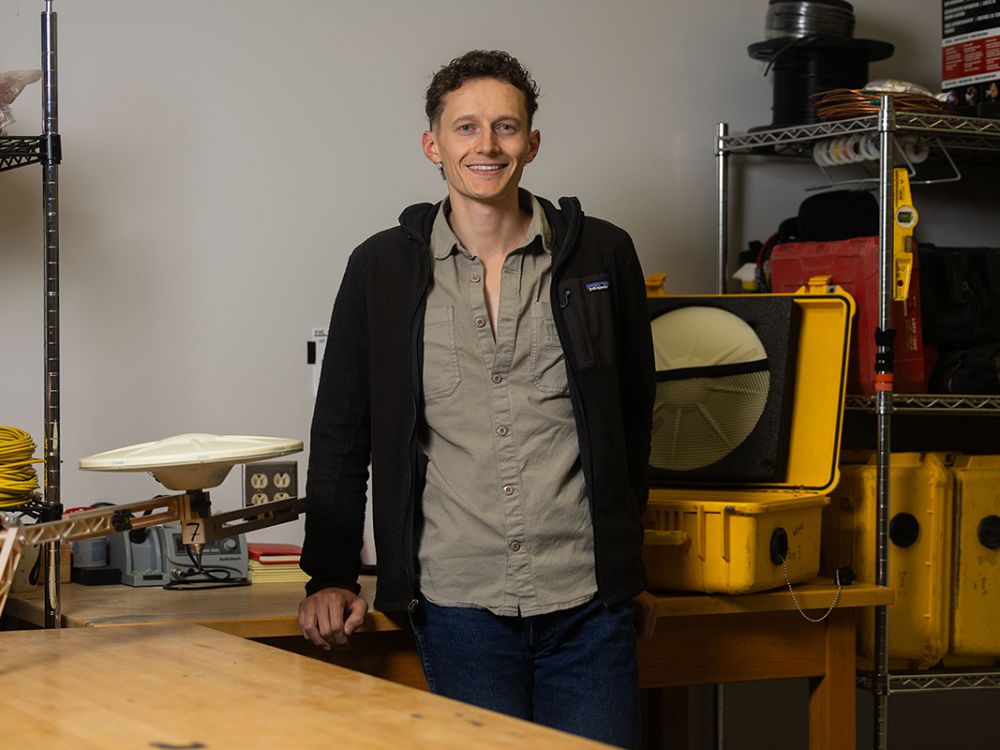
UM doctoral student Matthew Swarr uses high-precision GPS antennas in his research that record changes in the shape of the Earth with millimeter precision. (UM photo by Cassandra Evans)
MISSOULA – The steady release of groundwater from the fractured rock that composes most mountainous regions sustains ecosystems and human activity during periods of drought. These groundwater systems are critically important for communities in mountainous areas such as Missoula, according to new research from the University of Montana.
The new science was conducted by Matthew Swarr, a UM geosciences doctoral student, who worked with faculty researchers Payton Gardner, Zachary Hoylman and Hilary Martens. Their work was published in the journal Water Resources Research.
“Drought and inconsistent snow accumulation in recent winters have resulted in significant depletion of mountain groundwater, composing over 90% of the total water lost in mountainous regions over the past two decades,” said Swarr, who earned his doctorate in geosciences from UM this spring. “However, in the Western United States excessive amounts of precipitation during infrequent extremely wet winters can result in significant replenishment of mountain groundwater, driving conditions from historic lows back to normal in as few as six months.”
Swarr studies groundwater systems in narrow mountain ranges, such as the Sierra Nevada and Cascades. He measures changes in the shape of the Earth produced by fluctuating water storage with high-precision GPS stations. The stations record changes in the shape of the Earth at daily or even sub-daily intervals, allowing scientists to estimate changes in storage with high resolution in mountain watersheds, where traditional observations like groundwater monitoring wells are limited.
“We’ve found that these systems release water to adjacent regions, such as the Central Valley of California, at a relatively constant rate, allowing them to store extra water for years following particularly wet winters, such as what we saw in 2023,” Swarr said.
As extreme winter precipitation events are expected to become increasingly frequent in coming years, Swarr and his team hypothesize those may help offset groundwater losses associated with the region becoming increasingly dry.
“Our team hopes that this work will demonstrate the utility of GPS observations in the study of hydrology and will be used by scientists and water managers to understand the state of water resources throughout the region,” he said.
The work will improve response to future extremes, helping to effectively manage water resources for those living in arid climates such as the Western United States, as well as improve the current understanding of mountain groundwater systems that are notoriously difficult to study.
The project builds on a recent work by Martens, a UM geosciences professor, which used GPS observations to produce daily estimates of water storage change in the Western United States associated with atmospheric rivers during the extremely wet winter of 2023.
“We found that water storage gains in mountainous areas associated with these storms were more than twice what we expect during a normal year,” Swarr said. “Nearly all of the region was in some category of drought prior to this winter, and following it only 35% of the region was left under drought conditions. The impact these short but intense precipitation events can have on regional water resources is significant.”
The team will continue to study whether groundwater gains within mountainous regions associated with extreme precipitation events are short-lived or persist over time. They also are preparing to head to the high mountains of Colorado this summer to install new GPS stations within the Upper Gunnison River Watershed in collaboration with the Rocky Mountain Biological Laboratory and Lawrence Berkeley National Laboratory.
The new effort will help scientists understand the evolution of water resources within the Upper Colorado River Basin following this year’s historic snow drought, which threatens water resources for nearly 1 in 10 Americans and many living within Northern Mexico.
“Ultimately, these efforts will benefit those living and depending on water in the West,” Swarr said.
###
Contact: Matthew Swarr, UM doctoral student, matthew.swarr@umconnect.umt.edu; Dave Kuntz, UM director of strategic communications, 406-243-5659, dave.kuntz@umontana.edu.