
An education program that delved below the surface...
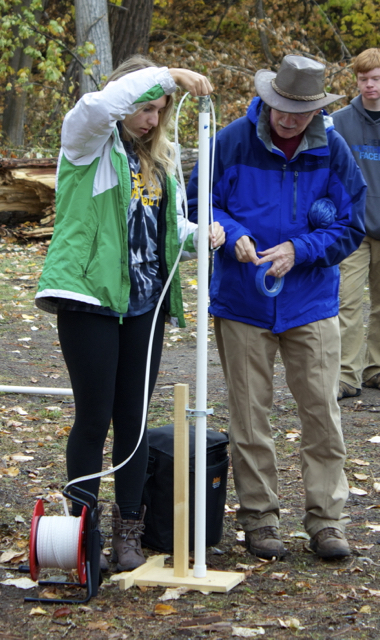
Students who participated in the Montana Groundwater Academy (MGA) used physical models and conducted field investigations to develop knowledge of groundwater system structure and process, and then applied their understanding to solve a real-world groundwater contamination case. The MGA program exemplified how science, technology, engineering and math (STEM) education can help prepare individuals to participate in citizen and professional activities related to managing our water resources.
The Montana Groundwater Academy program is no longer being offered through the University of Montana, but the Watershed Education Network (WEN) in Missoula is continuing many related groundwater monitoring and education activities. Please contact water@montanawatershed.org for more information about WEN’s groundwater activities.
To learn more about the Montana Groundwater Academy, check out this article published in 2018 in NSTA's Connected Science Learning online journal.
You can also access the Montana Comp Hydro high school ground water instructional unit that was supported by a subsequent, NSF-funded STEM+C project. In this unit, students take on the role of hydrogeologists who need to investigate and develop a remediation plan for groundwater contamination at the East Helena, MT Superfund Site. Please contact Beth Covitt at beth.covitt@mso.umt.edu with queries about the Comp Hydro unit or project.
This project was supported in part by a grant from the Environmental Protection Agency: Montana Groundwater Academy (96830301). Additional funding was provided by Missoula Valley Water Quality District, Mountain Water Company, University of Montana, and other organizations and individuals. Any opinions, findings, and conclusions or recommendations expressed in this material are those of the author(s) and do not necessarily reflect the views of the Environmental Protection Agency or other funders. The development of the Comp Hydro unit was supported by NSF STEM+C (#1543228) Research on Effects of Integrating Computational Science and Model Building in Water Systems Teaching and Learning. Any opinions, findings, and conclusions or recommendations expressed in the unit are those of the authors and do not necessarily reflect the views of the National Science Foundation.