
Welding Technology
Credential: Certificate of Applied Science (CAS)
Length: 2 semesters
Schedule: Daytime, hands-on lab-based instruction
Start Terms: Fall Semester
Cost: See Tuition & Aid
Location: West Campus – 2795 37th Ave, Missoula, MT
About the Program
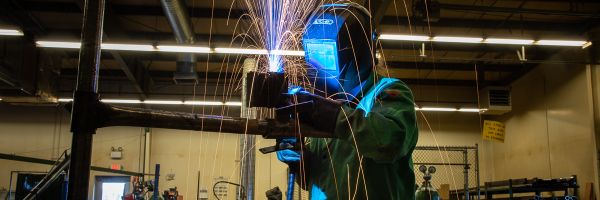
The Welding Certificate program provides students with the foundational skills needed to enter the welding workforce. Through hands-on training with industry-standard equipment, students learn to safely operate welding tools and perform basic welding techniques.
This program is ideal for individuals looking to quickly gain practical skills and begin working in entry-level welding positions. It also serves as the first step toward more advanced training in welding and fabrication.
Due to high demand and limited space, students are encouraged to apply to the welding program early. Admission is based on the order in which completed applications are received.
What You'll Learn
• Basic welding techniques and processes
• Safe operation of welding equipment
• Equipment setup and maintenance basics
• Introduction to blueprint reading
• Industry safety standards and practices
Semester 1 (Fall)
-
1 credit
This course will introduce students to interpersonal communication theory which can be applied to a workplace environment. Students will learn effective communication strategies that promote success in professional and personal relationships.
-
3 credits
An introduction to the techniques and standard practices of communicating technical graphics. The class studies and practices drawing skills and learns the drawing standards that support the needs of the design team in advancing ideas. It also provides the foundation for successful drawing communication in the CAD environment. Topics covered include; drawing media and tools, hand drawing skills, perspectives, views, sketching, standard scales, geometric construction, sections, dimensioning, and tolerances.
Gen Ed Attributes: Expressive Arts
-
3-4 credits
An introduction to mathematical ideas and their impact on society. Intended for students wishing to satisfy the general education mathematics requirement. Co-Requisite Support sections of M 105 are 4 credits; they are offered autumn and spring.
Gen Ed Attributes: Math Competency
*Mathematics courses higher than 105 will also be accepted
-
3 credits
Instruction and use of drills, files, threads and threading processes, basic lathe, drill press, and band saw operation, including precision measuring instruments. Fasteners, layout procedures, and basic hand tools are covered.
-
4 credits
Theory and safe operation of shielded metal arc welding (SMAW) of carbon steel on plate and structural components in all positions to industry standards. Visual inspection and destructive testing used to determine acceptability based upon industry standards (American Welding Society Structural Welding Code-Steel). Power sources and electrodes are covered in depth. Materials are prepared using mechanical plate shears and thermal cutting techniques. Thermal cutting techniques are examined relative to theory of operation and safe practices. Processes used are oxy-fuel cutting, plasma arc cutting, and air carbon arc cutting. Theory and operation of oxyacetylene welding examined.
-
3-4 credits
Expository prose and research paper; emphasis on structure, argument, development of ideas, clarity, style, and diction. Students expected to write without major faults in grammar or usage. Co-Requisite Support sections of WRIT 101 are 4 credits.
Gen Ed Attributes: Introductory Writing
Semester 2 (Spring)
-
3 credit
Requirements include career fairs, employer panels, and career counseling.
-
1 credits
Course will cover the required elements of the OSHA10 General Construction Safety training as well as an introduction of Industry specific Workplace Safety expectations. Course graded only on CR/NCR basis, requiring full 15 hour attendance and successful completion of all OSHA exams at 70% or better.rts
-
3 credits
Prereq., DDSN 113A. Practical experience in reading and drawing orthographic projections, interpreting dimensions, notes, scales, and welding symbols. Isometric projection (pictorial), sections, and auxiliary views with practical experience using conventional drafting tools and computer aided drafting (CAD).
-
4 credits
Prereq., WLDG 180; coreq., WLDG 117, 187. Conception, design, and construction of a metal structure to industry standards using shears, presses, and other machine tools common to the welding industry. Skills are developed in the areas of shielded metal arc welding and flux core arc welding, oxyacetylene cutting, plasma arc cutting, and air carbon arc cutting.
-
4 credits
Prereq., WLDG 180. Theory, practice, and safe operation of flux core arc welding equipment. Coupons are welded in the flat, horizontal, and vertical positions to industry standards using a variety of welding electrodes, diameters, and power sources, which prepare students for welding qualification to the American Welding Society Structural Welding Code specifications.
Career Opportunities
• Entry-Level Welder
• Production Welder
• Welding Helper / Shop Assistant
Graduates are prepared to enter the workforce quickly in entry-level welding roles.
Pathways to Advance
Students who complete the Welding Certificate can continue into the second year of the program to earn the Associate of Applied Science (AAS) degree. The certificate fully stacks into the degree, allowing students to build advanced skills in fabrication and expand their career opportunities.
Advising & Support
Contact Information
Lucy Ruediger - Program Coordinator
Email: lucy.ruediger@umontana.edu
Phone: (406) 243-7640
Due to high demand and limited space, students are encouraged to apply early. Admission is based on the order in which applications are received.