A Ph.D. Student at the Intersection between Natural and Social Sciences
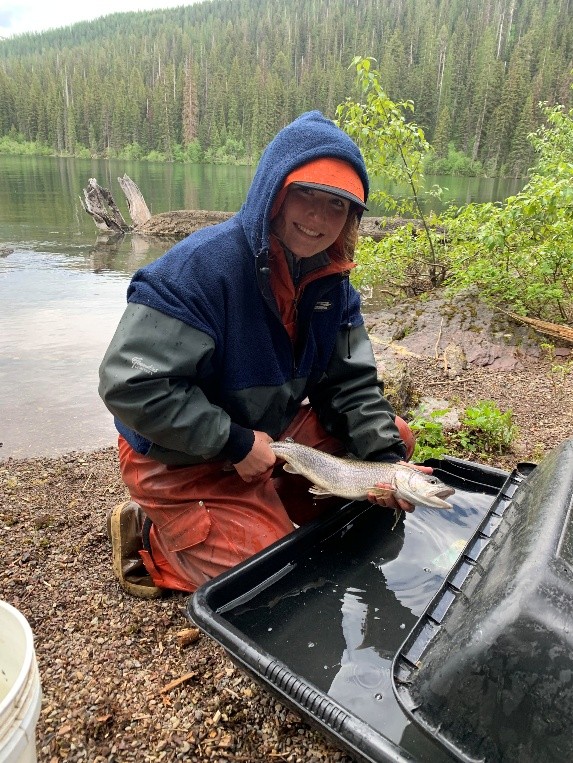
Adalyn Vergara, a PhD student in outdoor recreation and wilderness management at the University of Montana, is creating her own path at the intersection of natural and social sciences. With dual degrees in Wildlife and Fisheries Biology and Management and in Environment and Natural Resources, she brings both scientific depth and a personal connection to the landscapes she studies. Raised in Colorado with the Rocky Mountains as her playground, Adalyn grew up with a deep love for wild places—and for the people who depend on them for joy, challenge, economics and solace. As a proud woman angler, her commitment to protecting Montana’s rivers and fisheries is both personal and professional.
Her research focuses on a growing challenge in wilderness management: How to maintain wilderness character while also supporting healthy, accessible fisheries. Climate change and rising visitor use have brought new pressures, and proposed actions such as fish stocking or removal often spark debates. Although agencies and advocacy groups weigh in on these trade-offs, anglers, the people most affected are rarely part of the conversation.
Adalyn is working to change that. Through field interviews with anglers in the Selway-Bitterroot and Scapegoat Wilderness Areas, she is exploring how people understand these management decisions, how their identities shape their values, and how those values influence their behavior on the water. Paired with photos and stories she’s collecting along the way, her work aims to give wilderness managers a clearer, more human look on the social side of fisheries management.
Her efforts have already earned her meaningful recognition. Adalyn was selected as the 2025 Meier Graduate Fellow, a fellowship endowed by Joel and Patti Meier to support graduate work focused on wilderness and wildlands. She is also a recipient of the Matthew Hansen Endowment for Wilderness Studies. In fall 2025, she shared her work through an educational gallery titled The Art of Wilderness Stewardship: Visualizing Trade-offs in Fisheries Management through an Educational Gallery, which drew more than 70 people to its opening reception.
Adalyn also expanded her reach by participating in the UM Launchpad Beyond the Lab program, which encourages STEM students & faculty to think creatively, explore different applications of their work, and build community with peers. The program helps participants stretch their thinking through mentorship, collaboration, and hands-on exposure to innovation tools like the Lean Startup method.
Through her participation in the Beyond the Lab program and attendance at industry conferences, Adalyn developed stakeholder discovery skills and expanded her professional network while exploring ways to broaden participation and stewardship in the recreational angling industry and wilderness management world beyond the classroom or laboratory. Although she had not yet formalized a solution, these experiences opened new possibilities and helped her identify key management needs. Through her research and hands-on exploration, she observed a clear desire for stronger communication among managers, anglers, and other wilderness users, as well as a shared commitment to deepening people’s connection to the rivers they depend on.
Beyond the Lab gave her the chance to attend conferences, sharpen her entrepreneurial mindset, and grow her professional network. More importantly, it helped her see her research in a new light: not just as academic work, but as something that can create meaningful impact for communities and the landscapes they care about.
Adalyn Vergara continues to show what’s possible when scientific curiosity, personal passion, and innovative thinking come together, connecting people with place and helping shape a future where both communities and wild waters can thrive.
Contact: Naomi DeMarinis, Associate Director of Research Development, Communications, naomi.demarinis@umontana.edu; Adalyn Vergara, PhD student, adalyn.vergara@umconnect.umt.edu