Translating Science to Wildlife Conservation
- My collaborative research with the Yellowstone to Yukon Conservation Initiative (Y2YCI) assessed 25 years of progress in large landscape conservation in the Y2Y region. My research showed that in Canada, collaborative efforts were successful in reaching the Aichi 2021 conservation targets of 17% protected areas. This science supports international goals of international conservation policy goals of 25% protection by 2025. (show figure)
- My graduate student, Jean Polfus, and I led the identification of 1,000,000 km2 of Federally designated critical habitat under Canada’s Species at Risk Act (SARA) for threatened Boreal Woodland caribou for Environment Canada. Our models still provide the operational basis for identification, protection and recovery planning for 65 boreal woodland caribou populations across Canada.
- Klinse-Za Caribou recovery - My collaboration with two First Nations in British Columbia on mountain caribou conservation led to population recovery from < 20 to now > 150, creation of a 7,500km2 Provincial Park dedicated to caribou recovery, and pioneering on-the-ground habitat restoration. We also recently published a Science Policy perspective with over half Indigenous coauthors calling for reforms for Endangered Species Policy & Legislation to address Indigenous rewilding and recovery.
- Collaborated with Endangered Canada Lynx research in the Northern Rockies Ecosystem (NRE) with United States Forest Service (USFS) and United States Fish and Wildlife Services (USFWS) that lead to delineation and identification of critical habitat that supports female lynx reproduction that was adopted into the Federal Register by the USFWS.
- Collaborated on threatened Wolverine research where we radiocollared ~ 30 individual wolverines in the Greater Yellowstone Ecosystem and NRE. Research was cited as support in Federal Rule for Threatened status, and led to policy changes in winter recreation in wolverine denning habitat in late winter, restricting snowmobile access and other forms of recreation.
- My graduate student Brenna Cassidy’s PhD research, in collaboration with the Yellowstone wolf project, was formally read into the record at the 2024 MTFWP commission meeting that lead to the reinstatement of a transboundary buffer zone limiting wolf harvests adjacent to Yellowstone National Park.
- Internationally, my collaborative research with the Chinese Academy of Sciences, Wildlife Conservation Society-Russia, and World Wildlife Fund led to the formal policy adoption of our Amur tiger habitat model by the Chinese National Government, expansion of the Hunchun National Park by >10,000km2 , and was a contributing factor to China being the only country to successfully double wild tigers numbers by the recent year of the tiger, following the Global Tiger Initiative’s commitment to this goal 13 years ago.
- Rewilding Plains Bison to Banff National Park – my graduate students and I collaborated with Parks Canada to identify suitable habitat for Plains Bison in Banff. This was then integrated into an eco-cultural re-wilding project by Parks Canada and local Treaty 6 First Nation Indigenous communities in Banff. Plains Bison were released into BNP in 2016, the 6th wild population in the world, and their population has now increased to > 150 free-ranging Bison.
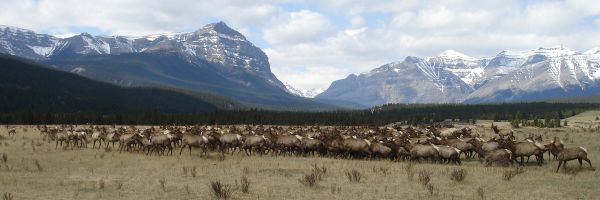
- Our research on elk at the Ya Ha Tinda, Alberta, has led to numerous policy changes in application of prescribed fire to Parks Canada and Alberta lands, changes in hunting regulations to promote bull elk survival, have been used to counter arguments for wolf control to enhance elk populations, and calls for quota’s in the transboundary buffer zones surrounding Banff National Park to reduce transboundary wolf harvest.
- I was a founding science advisor of the Global Initiative for Ungulate Migration, a collaboration with University of Wyoming, the Convention for Migratory Species (CMS) of the Bonn Convention, the United Nations, and dozens of other international conservation organizations. We held our first global conference just after the COVID pandemic, published a high-profile Policy Forum in Science, and have recently published the world’s first Global atlas on ungulate migration with direct, on the ground conservation policy implications across the globe.