FAQs
-
UM's astronomy program is exclusively undergraduate — meaning undergraduates are the primary researchers, not secondary to graduate students. This gives astronomy majors earlier, deeper, and more hands-on research engagement than is typical at larger institutions with graduate programs.
-
Students use UM's Blue Mountain Observatory — a 16-foot Boller and Chivens Cassegrain telescope at 6,300 feet elevation — for research and public outreach. On campus, the Payne Family Native American Center houses UM's Planetarium, where students build and present their own live shows throughout the year.
-
60% of UM Astronomy graduates pursue graduate degrees after completing their B.A.
-
Graduates become astronomers, research scientists, science journalists, technical writers, meteorologists, science teachers, and planetarium directors. Employers include engineering firms, national research labs, tech companies, universities, and public schools.
-
Yes. The Department of Physics and Astronomy awards scholarships to both incoming freshmen and current physics majors each year. Contact the department for current scholarship details.
Jump To
3
students conduct live planetarium shows every week.
One
time a week open invite for students and faculty to eat lunch together.
60%
of Astronomy graduates go on to get a graduate degree.
What Can You Do with a Degree in Astronomy
After obtaining a physics degree with a focus on astronomy from the University of Montana, several exciting career paths await you. While 60% of alums continue their education by pursuing a graduate degree after graduating, other students find employment in the aerospace, journalism, finance and public policy industries.
What Employers Hire UM Astronomy Degree Graduates?
Engineering firms, tech companies, start-ups, national research laboratories, hardware companies, universities and public schools hire graduates with our astronomy degrees. Astronomers from UM also successfully transition to professional writing, research and presentation roles.
Astronomy Jobs
The world is your universe with an astronomy degree from the University of Montana. Here’s a small selection of the jobs and careers you can pursue after graduating:
- Astronomer
- Science Journalist
- Technical Writer
- Research Assistant
- Research Scientist
- Science Teacher
- Associate Professor
- Meteorologist
- Planetarium Director
- Physicist
Astronomy Salary (How Much do Astronomers Make?)
Your salary with an astronomy degree depends on your chosen field after graduating. You’ll be qualified for several entry-level and mid-career positions where earning power extends over time. According to Indeed.com, astronomers can secure six-figure positions, while other roles like science journalists and technical writers average between $40,000 and $70,000 when first starting out. Teachers, professorships and research assistants similarly range from $40,000 to $80,000.
Experiential Learning in the Astronomy Degree Program
Get out of the classroom with an astronomy degree at the University of Montana. While plenty of time is spent studying the stars and distant planets through coursework and discussion, active observation will always be a part of the degree. Faculty members go to great lengths to put the universe before your eyes.
Get Lost in the Cosmos at UM’s Observatory
UM’s Blue Mountain Observatory is less than 20 miles southwest of campus at an elevation of 6,300 feet within the Blue Mountain National Recreation Area. Its 16-foot Boller and Chivens f/18 Cassegrain telescope is used for research, education and public outreach. Students host observation evenings for the public a few times each month, answering questions and teaching them how to use various telescopes. Learn more about UM’s Observatory.
Plan a Show at UM’s Planetarium
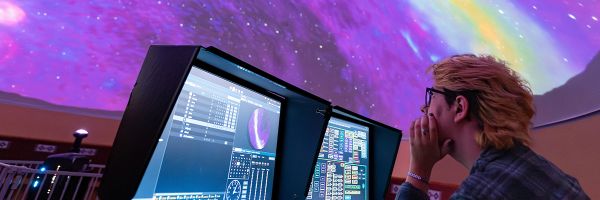
Astronomy students and faculty conduct live planetarium shows throughout the year at UM’s Planetarium, located in the Payne Family Native American Center on campus. State-of-the-art technology equips this Star Gazing Room, and students learn to build their own shows, operate the projectors and guide an audience through space. Learn more about UM’s Planetarium.
Undergraduate Research the Entire Way
Our undergraduate-only status for the astronomy degree lends to a specialized, experience-focused college experience. Our curriculum is entirely undergraduate, so we don’t teach intro-level classes as an “afterthought”— we teach them as the foundation of our students’ education. Our electives and labs are all undergraduate, so the undergraduate research and educational experiences are much richer than those of other institutions with grad-degree-awarding departments.
Find Your Path to the Final Frontier at UM
What’s happening here is remaking our understanding of the universe. Find out for yourself why the University of Montana is the best college for an undergraduate degree in astronomy.
Career Development for Astronomy Majors
Majoring in astronomy at UM means you get a first-rate education and the support you need to succeed in the classroom and your career. We’re a tight-knit and accepting community that works, learns and plays together – our students and instructors even compete together on intramural teams. It’s a program where your instructors will know your name, and you’ll spend more time collaborating than working on your own.
The undergraduate-specific curriculum and research opportunities are a great way to build professional connections and develop resume-building experiences to help you stand out to employers and graduate school programs. Student organizations, such as our Society of Physics Students and the Women and Gender Minorities in Physics Club, offer other great ways to get involved and network with people in your field.
Scholarships for Astronomy
Get extra help paying for your astronomy degree. Our department awards scholarships to incoming freshman and current physics majors each year. Learn more about scholarship opportunities in the astronomy program at UM.
Requirements for an Astronomy Degree
The physics degree focused on astronomy requires 69 credit hours to graduate, including lower and upper divisions astronomy and physics classes. Students also encounter computer science and math requirements, labs and physics electives.
View all classes for a bachelor's degree in physics focused on astronomy.