
WWI Quick Facts
36 countries
Involved in the combat
65 million
Soldiers involved in combat
9.7 million
Military casualties
6.8 million
Civilian casualties
World War I- 1914-1918
The Causes
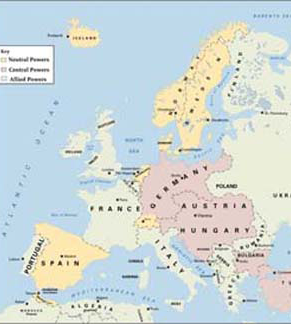
It is easy to pinpoint the event that finally touched off World War I, but it's much more difficult to explain the underlying conditions and events that were the underlying causes. As Europe entered the 20th Century, its countries were jockeying for power and trying to increase their territories. Britain and Germany were locked in an arms race. Industrialization had brought a growing feeling of nationalism and imperialism. And, small wars on the continent had led to shifting borders as countries lost and won territories, particularly in the Balkans.
The Spark
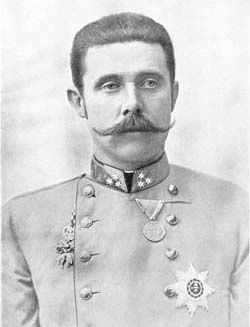
On June 28, 1914, a Bosnian Serb assassinated Archduke Franz Ferdinand during his visit to Sarajevo. Ferdinand was the heir to the Austrio-Hungarian throne. At the time, Europe was governed by two shifting and uneasy alliances of powerful nations. One alliance, including Great Britain, Russia and France, would become the Allies. While the other, including Germany, AustriaHungary and the Ottoman Empire would be known as the Central Powers. After Franz Ferdinand was killed, Austria-Hungary declared war on Serbia. That triggered a chain reaction of war declarations among the two alliances that plunged Europe into a massive conflict. Over four years, it would eventually draw in nearly 100 countries including the United States and Japan.
U.S. Isolationism
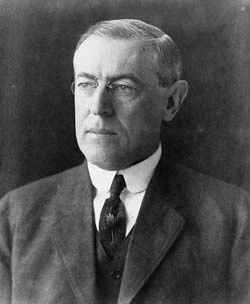
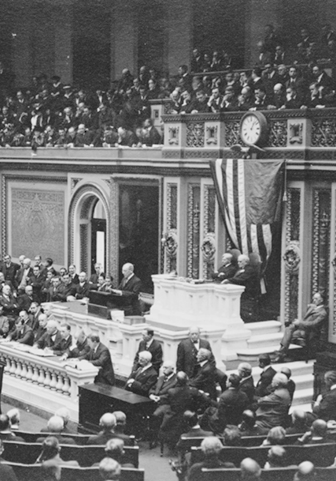
As the large-scale conflict broke out in Europe, U.S. President Woodrow Wilson was determined to stay out of it. But, in February 1915, Germany set up a submarine blockade around Britain, declaring the waters a war zone. Wilson maintained his neutral policy as the submarines attacked one or two U.S. ships. But, when 128 Americans died after a German U-boat sank the British ocean liner RMS Lusitania without warning, off the coast of Ireland, public opinion began to shift. Debate increased between the interventionists, who wanted the U.S. to enter the war, and the isolationists, who did not.
The Yanks Are Coming

The Selective Service Act
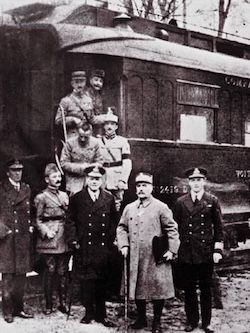
Armistice
With America entering the war, the Central Powers saw they could not win. Along the western front, thousands of German soldiers surrendered. Then, in October a revolt in the German navy finally collapsed the country's war effort. Kaiser Wilhelm II, the German emperor, abdicated and fled to the Netherlands. And, at 11 a.m. on November 11th 1918, Germany signed an armistice with the Allies.