From Curiosity to Care: UM Senior Channels Clinical Psychology Career
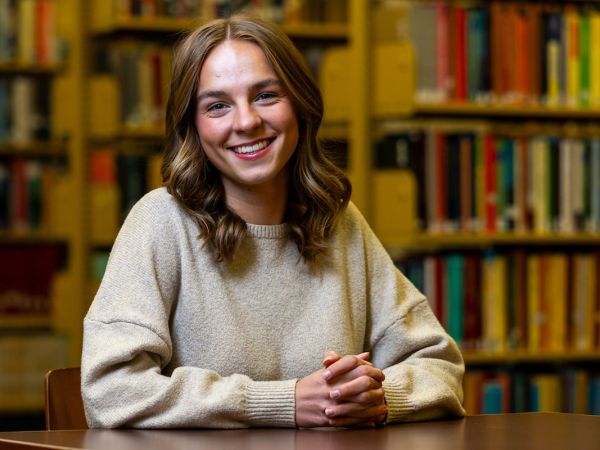
UM senior Lauren Schulte will graduate this spring with a psychology major and climate change studies minor after traveling a dynamic path through varied research opportunities across multiple subfields during her undergraduate experience. (UM photo by Marley Barboeisel)
By Abigail Lauten-Scrivner, UM News Service
MISSOULA – University of Montana senior Lauren Schulte is inherently curious about how people think, connect and behave.
That curiosity led the psychology major and climate change studies minor on a dynamic path through varied research opportunities across multiple subfields during her time at UM – ranging from studies on historical trauma of LGBTIQ+ individuals to how mental health providers are responding to climate change. Tying it all together is the urge to help people feel understood, capable and grounded.
“I just love listening to people, trying to understand what they’re going through,” she said. “This field sort of let me make that my career.”
Schulte, who grew up in Spokane, Washington, followed in her mother’s footsteps in becoming a proud Grizzly. Besides working in two campus labs, Schulte is a UM Advocate, helping students feel connected to the University in her role as a campus ambassador and leader. She’s also a wellbeing support coach at UM’s Curry Health Center, helping peers address concerns like stress, time management, sleep, nutrition and more.
“It's really cool to work with students one-on-one,” she said. “It's definitely challenged me in a lot of ways, and also gives me some really good perspective on what I want to do.”
On the cusp of graduating, Schulte will soon bring her innate inquisitiveness and the skills she honed through her UM education to the professional world. This fall, she’ll intern in Greensboro, Alabama with Project Horseshoe Farm, a nationally recognized service and leadership program for rural community health care.
“This internship will serve as an excellent opportunity for me to learn directly about health care struggles and experiences in the community before I pursue my Ph.D. in clinical psychology,” she said. “I am beyond excited.”
Schulte’s path to landing this vital internship began with her decision to leverage UM’s broad undergraduate research opportunities early. Sophomore year, she took an upper division psychology elective taught by Dr. Bryan Cochran, UM professor of Clinical Psychology and director of Clinical Training. Schulte enjoyed Cochran’s class so much that she applied to an undergraduate research position in his lab – despite having previously “sworn off” research.
“I was like, ‘I am not meant to be a researcher, I do not like research methods, I just want to sit and talk to people and be a therapist,’” Schulte said. “But learning how research can be incorporated into clinical practice, education and community work is really what kind of convinced me that I wanted to pursue clinical psychology.”
Cochran said Schulte stood out in his class of nearly 100 pupils as a humble but quietly brilliant student who was eager to work hard, learn and achieve her career goals. He was thrilled to have her apply those skills in his lab.
“She's someone who is already functioning at a level that actually many graduate students would aspire to be in terms of her intellectual capabilities, her dedication and ability to see a research project from the very beginning all the way through to completion,” Cochran said. “So it was very obvious from the beginning that Lauren was going to be a top notch student. I'm really, really lucky to recruit her to work in my lab.”
Cochran’s research examines how being part of a stigmatized minority group impacts health, specifically substance use disorders and other mental health conditions among LGBTIQ+ individuals. Schulte joined a project examining historical trauma among queer individuals. The group piloted a study in collaboration with the University of Nevada, Reno, assessing how much people know about the history of trauma and oppression toward the queer community.
“Her work is about breaking down barriers,” Cochran said. “It's about getting to know people who are different from you and reducing prejudice in society.”
Cochran said Schulte was involved in every step of the research process. She helped design the original study and survey, doing data analysis, formulating research questions, running statistics to answer those research questions and assisting in writing the study.
Schulte also established her own independent research project on intergroup contact between cisgender, heterosexual and queer individuals and how it might impact non-LGBTIQ+ folks. She found that having just one relationship to an LGBTIQ+ person significantly impacted others’ abilities to empathize with queer oppression and trauma. She presented her results at the UM Conference on Undergraduate Research and a cognitive and behavioral therapy convention in New Orleans.
Schulte also works in Dr. Rachel Williamson’s Existential Trauma Lab, tying in her interest in climate change to examine how mental health providers are responding to the issue. She joined a graduate student study about how counseling clients talk about climate change, how their feelings about it are expressed in therapy (through anxiety, grief and other emotions) and what therapeutic interventions are being used to quell those climate concerns.
“A lot of climate change mental health concerns are very existential in nature,” Schulte said. “It's about thinking into the future and the unknown, and how that's impacting some existential constructs like hope and death and meaning in life.”
Schulte presented the project at the Climate & Health in the 406 Conference in Bozeman, as well as UMCUR.
Her various experiences in research and other opportunities have confirmed to Schulte that she’s on the right path.
“I think one of my main goals for my career is to always keep in mind how research and practice are inherently connected, and how good practice doesn’t exist without research,” she said. “Specializing in a field where listening, connection and empathy are so inherent to diagnosing, treating and helping people function in their daily lives, I think I’ll hopefully make an important impact.”
Schulte plans to apply to clinical psychology Ph.D. programs and eventually work either in private practice or a medical setting, like a hospital or inpatient care.
Cochran said he looks forward to watching Schulte’s path continue and supporting her along the way.
“She's someone who I literally look forward to writing a letter of recommendation for,” he said. “I can't wait to let a lot of people who are on admissions committees know how amazing she is.”
###
Contact: Dave Kuntz, UM director of strategic communications, 406-243-5659, dave.kuntz@umontana.edu.