Rural Business Roundtables
Rural Business Roundtables are hosted by the University of Montana's Rural Entrepreneurship and Leadership Co-Lab (REAL Co-Lab). The focus is to bring together Montana business owners and experts to explore the impacts of policy shifts on rural economies.
We invite you to join any upcoming Rural Business Roundtables by registering on our events webpage.
April 2026: Tourism
Attendee Insights
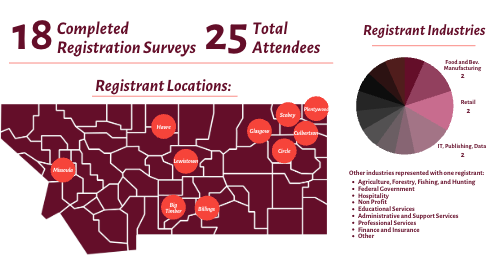
Important Takeaways
Rural Montana business owners are experiencing economic strain caused by shifting trade policies, restrictive state hunting regulations, and declining Canadian border traffic. The discussion highlighted how these overlapping challenges trigger a ripple effect across rural communities, underscoring the urgent need for state and federal leaders to support the state's frontier economies.
- Shifting Cross Border Traffic
While Canada remains Montana’s dominant international market, accounting for 80% of all international point-of-sale spending, cross-border traffic has plummeted. Rural business owners reported a sharp decrease in Canadian patronage. State data from Oxford Economics and Visa Destination Insights shared by the Montana Department of Commerce’s tourism data manager, Jacob Starner, validated this local downturn, revealing that overnight Canadian visits dropped from $276 million in 2024 down to an estimated $200 million in 2025. - Changing Recreation Regulations and Pricing
Changes to state licensing and recreation regulations are also directly reducing regional tourism. Bjorgen shared that local hunting traffic was down significantly last year, and is expected to worsen due to a new Montana Fish, Wildlife, and Parks regulation enforcing a 10-day delay for out-of-state hunters. Furthermore, the state has moved license sales online, which decreased the number of people who come into the store to purchase their licenses, ultimately decreasing additional product sales. In addition, Starner predicts a change in tourism patterns due to a steep increase in National Park entrance fees. - Community Economic Ripple Effects
The drop in seasonal travelers and out-of-state hunters creates an economic domino effect across entire rural communities. Bjorgen pointed out that their retail location sits directly across from a local hotel, where they have witnessed a substantial drop in room occupancy. This vacancy immediately trickles down to hit local restaurants and surrounding main street stores that rely on those visitors to survive, showing that tourism declines are shared across the entire local economy. Many rural Montana communities don’t have drive by traffic. Visitors have to intentionally choose to go there, making small tourism changes even more impactful.
Summary from Montana Department of Commerce:
Jacob Starner, Tourism Data Manager for the Montana Department of Commerce, provided a broader economic perspective that mirrored what our local owners are experiencing on the ground, sharing key metrics on shifting regional traffic and tracking the recent decline in Canadian tourism spending across the state. While overall headcount remained historically high, the real story lies in the shifting behavior of these travelers. The immediate concern for local economies isn't just the slight dip in visitor numbers, but the more significant drop in how much those visitors are actually spending while they are here.
Perspectives from Rural Business Leaders:
Enhance Predictability and Support for Everyone
Business owners need stable regulations, travel incentives, and fair marketing support for businesses and communities in all areas of the state.
Read the full PDF report here.
Feb. 2026: Tariffs & Trade Part Two
Attendee Insights
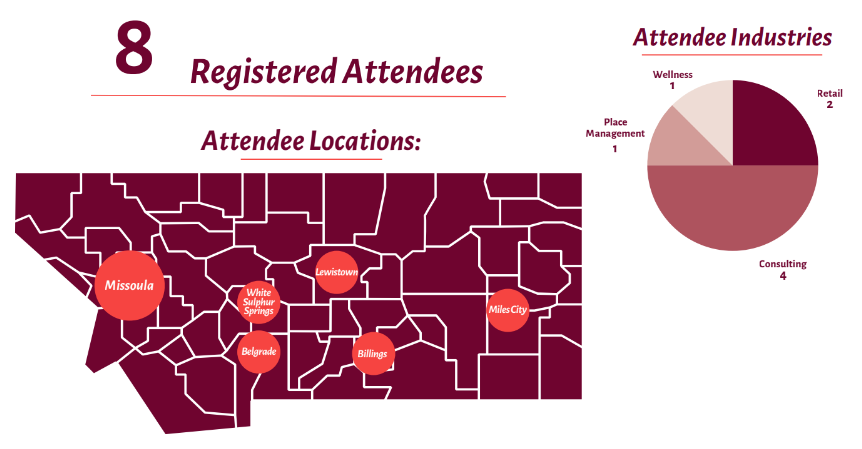
Important Takeaways
- Increased Input Cost
In the MWTC survey, Montana business owners indicated that a major pain point of navigating the changing tariff landscape was spending additional time adjusting to the changes instead of running and growing the day-to-day operations of their businesses. - Decreased Productivity
Miranda-Freer shared that the frequent federal changes cause partners in the global supply chain to gradually lose trust in US businesses, including those from Montana, leading to a loss of global market share. Almy, who explored manufacturing in the U.S. and determined he cannot do so, expressed concern for his manufacturing suppliers in Taiwan and how the U.S. tariffs are negatively affecting that business relationship. - Losing Market Share
With the uncertainty around the supply chain and the cost of goods, some business owners are making the difficult decision to lay-off employees to protect the capital they do have in case an unexpected tariff bill arrives, Miranda-Freer notes. Montana has yet to see the full impact of this. - Reduction in Force
With the uncertainty around the supply chain and the cost of goods, some business owners are making the difficult decision to lay-off employees to protect the capital they do have in case an unexpected tariff bill arrives, Miranda-Freer notes. Montana has yet to see the full impact of this.
Panel Recommendations to Support Rural Communities:
Enhance Tariff Stability and Predictability
Business owners can work to adjust to increased tax and tariffs, but only if they know what is coming.
Perspectives from Rural Business Leaders:
Panelists discussed the increased time and energy in order to meet the changing trade requirements. They also mentioned the expense of doing business abroad the sudden increases that are affecting their business. Some themes of treating their business suppliers abroad without respect.
Read the full PDF report here.
April 2025: Tariffs + Montana World Trade Center
Attendee Insights
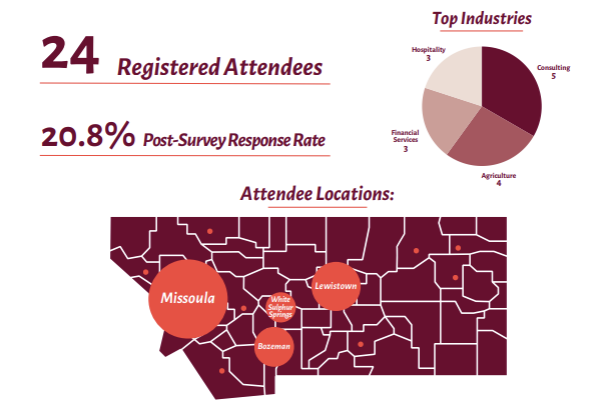
Important Takeaways
- Global Trade Volatility:
Montana’s economy is highly vulnerable to international trade disruptions. With over 16 executive orders affecting trade, businesses face unpredictable tariffs—especially with Canada, which accounts for over 94% of Montana’s imports. These changes have led to permanent market losses and strained relationships. - Local Business Challenges:
Rural businesses struggle with planning due to unstable federal programs and shifting regulations. Concerns include Medicaid coverage, cybersecurity mandates, daycare subsidies, and land management policies. These uncertainties hinder investment and daily operations. - Economic Impacts on Communities:
Tourism-dependent towns like Eureka are experiencing declines due to reduced Canadian travel and forest service unpredictability. Business owners report difficulty maintaining services and workforce participation without reliable federal support.
Panel Recommendations to Support Rural Communities:
- Ensure predictability in trade, regulation, and federal programs.
- Stabilize and sustain funding for essential services like daycare and Medicaid.
- Improve communication between policymakers and rural stakeholders.
- Support long-term planning through consistent policy frameworks.
Perspectives from Rural Business Leaders:
Panelists emphasized the need for reliable systems to support rural entrepreneurship. Without stability, businesses cannot confidently invest or grow. Voices from Eureka, Lewistown, and Missoula highlighted the urgency of addressing these challenges to preserve Montana’s rural vitality.
Read the full PDF report here.