Lab Members
Mark Hebblewhite, Earle and Pattie Layser Endowed Distinguished Professor in Conservation Biology and Policy
Born in Montreal and raised in Ontario by British parents awed by Canada's wilderness, my childhood love of wildlife was kickstarted into a career by a lucky park ranger job in Hudson Bay when I was 18. I've conducted research on wildlife from songbirds to bears, focusing on wolves and their ungulate prey across Canada, the US, eastern Europe and Mongolia. My main research objectives are to always combine strong empirical approaches to the conservation of terrestrial wildlife and the systems in which they live. To me, large ungulates and their predators are good entry points to understanding ecosystems because of their important roles and their conservation and management relevance. I love running, mountain biking, hiking and walks with my children Anna and Simon and our dog, Kintla.
mark.hebblewhite@umontana.edu | Google Scholar Profile | Hebblewhite CV
Tara Meyer, PhD student
Tara defended her PhD thesis in December of 2025.
Tara’s interests in science drove her to study ecology as an undergraduate at Colgate University, and afterwards, technician positions observing African elephants in Tanzania and grey wolves in Wyoming. In 2015 Tara earned her MESc from the Yale School of the Environment, examining snow leopards in western Tajikistan. After Yale, Tara supervised the region 5 wildlife conflict and private lands programs with the Washington Department of Fish and Wildlife, and then amplified conservation impacts with the Wildlife Conservation Network. She was named an Emerging Wildlife Conservation Leader in 2017, and during her two-year fellowship she contributed research towards monitoring Grauer's gorillas in the DRC. For her PhD, Tara is examining the effects of climate changes on top-down and bottom-up drivers of elk migration, parturition, and survival in the Canadian Rockies (part of the Ya Ha Tinda Long-Term Elk Monitoring Project). Tara spends her free time exploring the outdoors and traveling with her husband David and their two children.
Connor Meyer, PhD student
Connor grew up in western Washington where he gained an appreciation for the outdoors by exploring the Cascade Mountains and spending time on the water in Puget Sound. After graduating from the University of Washington with a degree in wildlife conservation, he found his way onto the Yellowstone Wolf and Cougar Projects. After five years in Yellowstone Nationa Park, Connor joined the Hebblewhite Lab for his PhD and migrates north to the Ya Ha Tinda Long-Term Elk Monitoring Project. He is interested in understanding the intrinsic and extrinsic factors influencing an individual’s decision to switch migration tactics, including predation risk, forage quality and the previous year’s reproductive success. When not working, Connor can be found attempting to stave off injury while running, hiking, biking and skiing.
Connor's website: https://connorjmeyer.weebly.com/
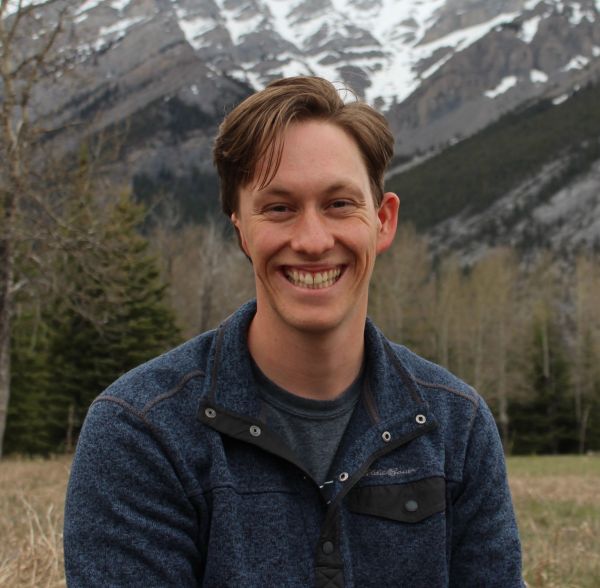
Jonathan Farr, PhD student
Jonathan was born in a small town at the edge of the Canadian Rockies in Alberta, Canada, and has always felt rooted to gravel bed rivers, wildflower-covered ridgelines, and shale slopes. Between semesters of his undergrad in Ecology at the University of Alberta, Jonathan landed a job as a park interpreter at Elk Island National Park. This led to working as a field technician in Banff National Park for several summers where he spent time whacking weeds, scoping out bighorn sheep, and finding feces from a variety of ungulates. Jonathan started his MSc at the University of Montana in 2022 and is studying the trophic ecology of Banff’s recently reintroduced Plains bison to understand how they may affect Banff’s bighorn sheep and the Ya Ha Tinda elk population. Constantly seeking the elusive balance between work and life, Jonathan enjoys volleyball, Nordic skiing, canoeing, and playing piano.
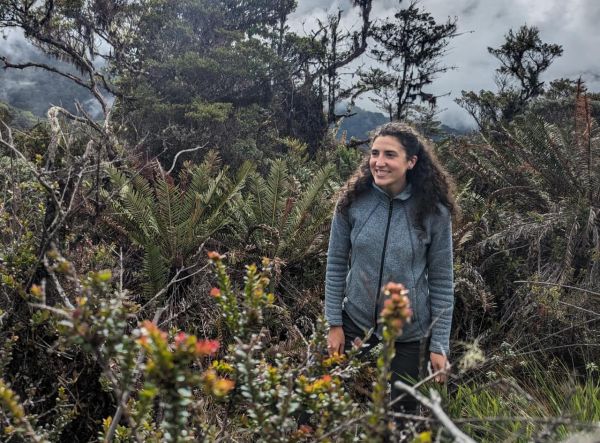
Amaia Autor, PhD student
Amaia’s passion for wildlife was sparked while growing up with close contact to nature in a rural area of Navarra, Spain. This passion motivated her to pursue a degree in Biology at the University of the Basque Country, followed by an MSc in Zoology at the Complutense University of Madrid. Her interest in wildlife and conservation has driven her involvement in diverse projects, from studying lizards in the Pyrenees Mountains to researching caracals in the fynbos of South Africa and monkeys in Costa Rica's dry tropical forests. Amaia’s interest in carnivore conservation led her to begin the project “La Huella del Tigrillo”, the focus of her PhD research on Central American oncillas in Costa Rica. As a part of this research, she seeks to investigate the impact of the Pan-American Highway on the oncilla’s spatial ecology to inform conservation efforts. Outside of her academic work, Amaia enjoys exploring the outdoors—particularly tropical forests—and traveling.
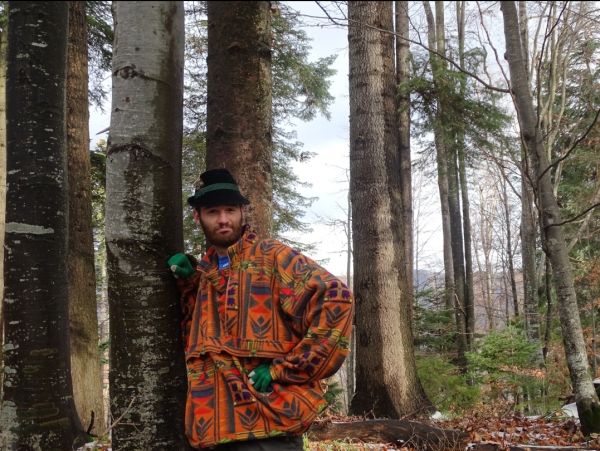
Andrei Dinu, MS Student
Translocated from the Romanian Carpathians to Montana, Andrei is now privileged to be pursuing an MS in the Wildlife Biology program. He holds a BS and MS in Ecology from the University of Bucharest in Romania. His journey as an ecologist began with studying birds in Romanian wetlands and intensive agricultural systems. Eventually, he had the chance to engage in large carnivore conservation by working on the LIFE Lynx project for about three and a half years. For his MS work, Andrei is dedicated to advancing large carnivore science in Romania, with a main focus on the spatiotemporal response of carnivores to human activities and the presence of prey species. Andrei is passionate about soccer and also enjoys walking, hiking, dancing, and values building lasting connections.
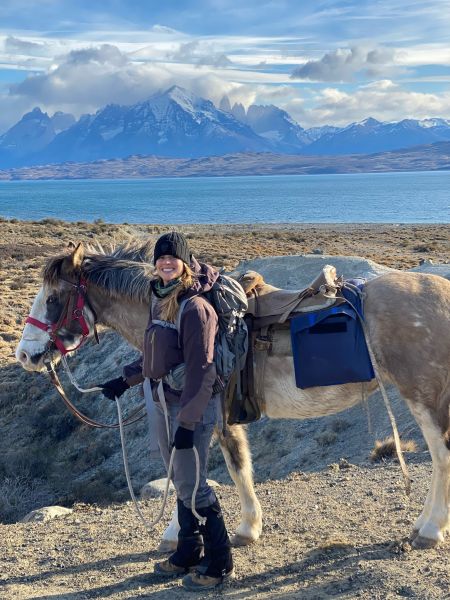
Caitlin Kupar
Caitlin grew up backpacking and camping in the Appalachian Mountains, where her interest in wildlife and field ecology began. She earned her BS in Wildlife Biology from the University of Georgia and subsequently worked on field projects across the United States, gaining experience studying and capturing pumas, bobcats, white-tailed deer, elk, and black bears. These positions sparked her interest in predator–prey dynamics and the continued development of safe capture and handling techniques using chemical immobilization. For the past decade, Caitlin has specialized in puma research, with work spanning multiple regions of the United States as well as Chilean Patagonia, where she led puma capture efforts near Torres del Paine National Park. Caitlin enjoys horseback riding, hunting, reading, and traveling to new places.