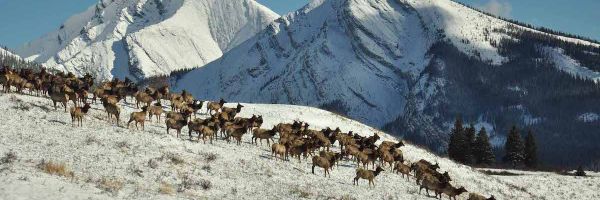
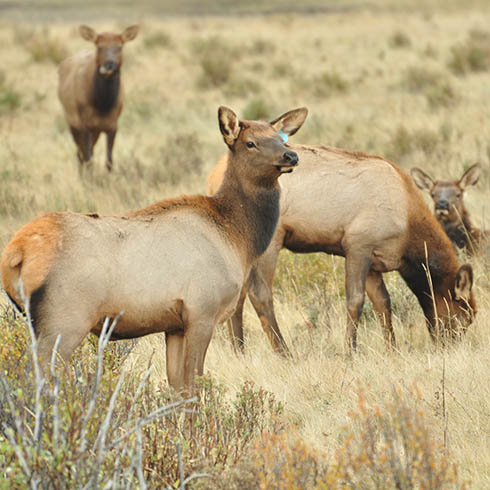
 Since 2000, researchers at the University of Alberta and University of Montana have worked collaboratively to investigate how changes in the Ya Ha Tinda elk population are affected by humans (harvest, habitat management), natural factors (predation, climate) and natural vegetation dynamics. We work to understand the changing migratory behavior of elk and the trophic dynamics within this predator-prey-montane grassland system and also a long-term perspective on grassland dynamics. Combined, our studies of the population at Ya Ha Tinda represent one of the longest elk population studies in a system with intact natural predators, including wolves and grizzly bears and human hunting.
Highlights
New YouTube video highlighting our research produced by Birch Gano!
Tara Meyer defended her PhD thesis "Climate change and behavioral plasticity: migration, parturition and phenological mismatch in northern rockies elk" in December, 2025.
Birch Gano defended her MS thesis "Feral horses and native ungulates: evaluating the potential for competition in predator-prey communities of Alberta’s upper foothills" in October 2025.
News coverage of our recent Global Change Biology paper in the Rocky Mountain Outlook, "I was blown away”: study shows climate change dramatically shrinking Banff’s alpine meadows", September 4, 2025.
The Ya Ha Tinda Elk Herd: Long-term Insights into Predator-prey Ecology and Conservation with Mark Hebblewhite. Bow Valley Naturalists, February 2021. Available on ZOOM here https://bowvalleynaturalists.org/public-programs/
June 2021: Four-year Final Report released!
May 2021: New paper in Science on the need for a Global Initiative on Ungulate Migration in partnership with the UN Convention on Migratory Species (CMS)