Summer 2026
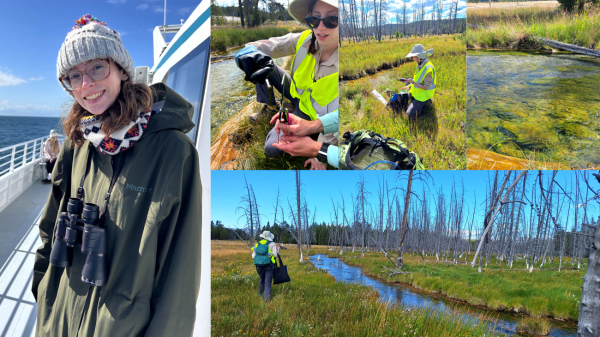
Mikaela Hoellrich
Program: Ecology & Evolution
PI: Scott Miller
"Plasticity under pressure: Exploring the limits of far-red photoacclimation in thermophilic Fischerella."
Far-red light photoacclimation (FaRLiP) is a cyanobacterial photosynthetic strategy induced under conditions where visible light is depleted, utilizing light outside the visible spectrum (>700 nm). Within the genus Fischerella, we find that, while FaRLiP capacity is retained in most strains, there have been multiple independent partial or complete FaRLiP losses. Notably, within a Fischerella population in Yellowstone National Park, FaRLiP loss is more common at sites >50°C, near their thermal limit. Given the energetic costs associated with initiating FaRLiP and that it produces less efficient photosystems, we suspect that loss of FaRLiP is selectively favored under consistently stressful conditions.
Mikaela's UM profile page
Miller Lab website
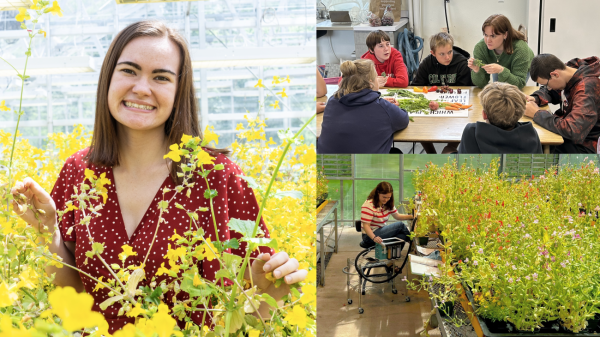
Natalie Dietz
Program: Ecology & Evolution
PI: Lila Fishman
"Escape, endure, or both? An investigation of drought resistance strategies in Mimulus."
The fields of ecophysiology and evolution have historically operated in isolation, yet their integration is essential for a complete understanding of plant adaptation. My dissertation work sits at this intersection, combining plant ecophysiology with evolutionary genomics to ask how plants strategically respond to drought using Mimulus as a model system. Preliminary comparisons between thermal and nonthermal genetic lines derived from Yellowstone National Park suggest that drought escape and drought avoidance are not mutually exclusive in this system, challenging the long-standing assumption of a trade-off between contrasting strategies.
Natalie's UM profile page
Fishman Lab website
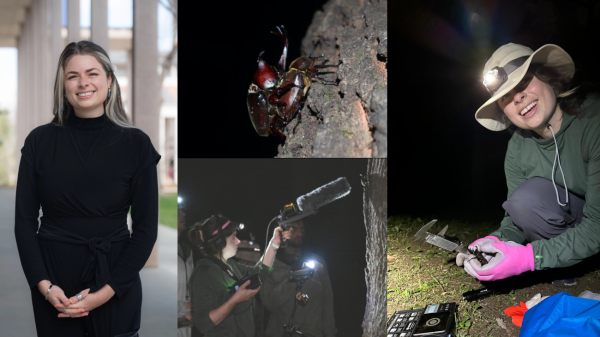
Sophie Fitzgerald
Program: Ecology & Evolution
PI: Doug Emlen
"Mechanism and function of courtship songs in Japanese rhinoceros beetles."
Japanese rhinoceros beetles are a unique model to study how competition and mate choice impact fitness. Males use their large horns to fight over females, yet still perform ritualized songs before mating. I investigated the proximate mechanisms of sound production, and discovered that songs are made via stick-slip friction of elytra and abdomen stridulation and appear to function only as close-range signals used directly between males and females. Data from my lab experiment suggest that male songs correlate with short-term body condition, a potentially important trait for mate choice. Moreover, field data suggest that physiology and fight performance, rather than weapon size, directly predict mating success. By studying JRB, we can determine what information these additional signals convey that weapons do not, and whether selection for courtship traits reinforces or counteracts selection for weapons.
Sophie's UM profile page
Emlen Lab UM website
Last updated on October 8, 2026