Montana Climate Scientist Co-Authors Report on Drought in a Changing Climate
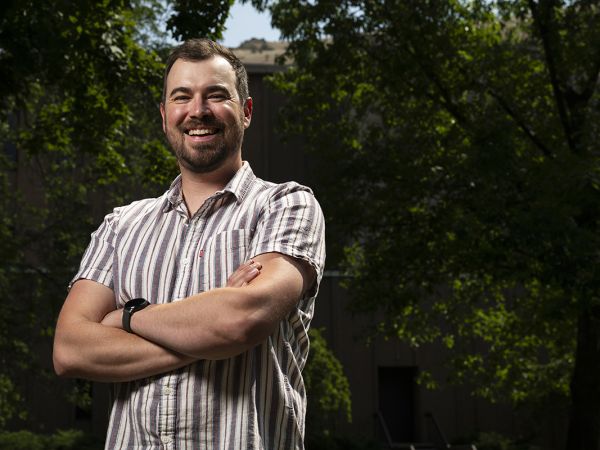
Zachary Hoylman, assistant state climatologist with the Montana Climate Office, helped write a prominent national report about the future of drought in the United States. (UM photo by Tommy Martino)
MISSOULA – Dr. Zachary Hoylman, assistant state climatologist with the Montana Climate Office, is co-author of a new report examining the future of drought assessment in the United States.
The University of Montana research assistant professor helped produce the report for the National Academies of Sciences, Engineering and Medicine. Hoylman was one of 12 researchers selected nationwide to serve on the National Academies committee, which evaluated how drought assessment should evolve as climate conditions continue to change.
The committee examined how to distinguish temporary drought from longer-term climate-driven drying, assessed the strengths and limitations of current drought monitoring approaches, and developed recommendations for improving drought assessment and preparedness across the country.
The report, “The Future of Drought in the United States,” concludes that many existing drought assessment methods were developed under assumptions of a relatively stable climate. As temperatures rise and hydroclimatic conditions change, the committee recommends new approaches that better account for changing drought risk while continuing to support operational drought monitoring, emergency response and long-term planning.
“This isn't just a science problem,” Hoylman said. “Drought has become an economic and societal issue that affects agriculture, water resources, ecosystems and communities across the country. As our climate changes, our methods for assessing drought need to evolve as well.
“By improving how we characterize drought, we can provide farmers, ranchers, water managers and communities with better information to understand risk and make informed decisions,” he said.
Hoylman’s appointment to the committee builds on his research into how climate change is reshaping drought assessment. In 2022, he led a study published in Nature Communications titled “Drought assessment has been outpaced by climate change: empirical arguments for a paradigm shift.” The paper demonstrated that many traditional drought indices rely on historical climate conditions that may no longer represent today’s climate, potentially leading to different interpretations of drought severity in regions experiencing long-term change.
For example, in parts of the American Southwest, where long-term drying has altered baseline climate conditions, drought assessments based solely on historical reference periods may classify the same physical conditions differently than assessments based on contemporary climate. The committee’s report recommends new approaches that explicitly account for these changing conditions while preserving the consistency and transparency needed for operational drought monitoring.
“Adaptation begins with understanding risk,” Hoylman said. “If our drought assessments don't evolve with the climate, we’re asking communities to prepare for tomorrow using yesterday's information.”
Hoylman also co-authored a companion paper published in Earth’s Future, “Prioritization of Research on Drought Assessment in a Changing Climate,” which identified key research priorities for advancing drought science. Together, these studies helped shape ongoing national discussions about the future of drought assessment, leading to invitations for Hoylman and his colleagues at the Montana Climate Office to present their research to National Oceanic and Atmospheric Administration leadership, Department of Commerce economists and scientific audiences across the country.
Hoylman works to bridge climate research and operational drought monitoring. As Montana’s assistant state climatologist, he helps produce the state’s official drought assessments while conducting research on climate change, hydrology, remote sensing and machine learning. This combination of operational experience and scientific research provided an important perspective during the committee’s deliberations.
“It was a tremendous honor to be part of this National Academies effort,” Hoylman said. “One of the greatest strengths of the National Academies is bringing together experts from many different disciplines to build scientific consensus around complex national challenges. I hope this report provides a strong scientific foundation for improving drought assessment and helping communities prepare for a changing climate.”
The Montana Climate Office, is housed in the W.A. Franke College of Forestry and Conservation at UM. The office is the state’s official source for climate information. It provides timely, science-based information on climate, drought, water resources, and weather to support decision-making across agriculture, natural resources, emergency management, and communities throughout Montana.
###
Contact: Zachary Hoylman, UM research assistant professor, Montana Climate Office assistant state climatologist, 406-499-8118, zachary.hoylman@umontana.edu.