$5M STEM Grant to Boost Graduate Student Education at UM
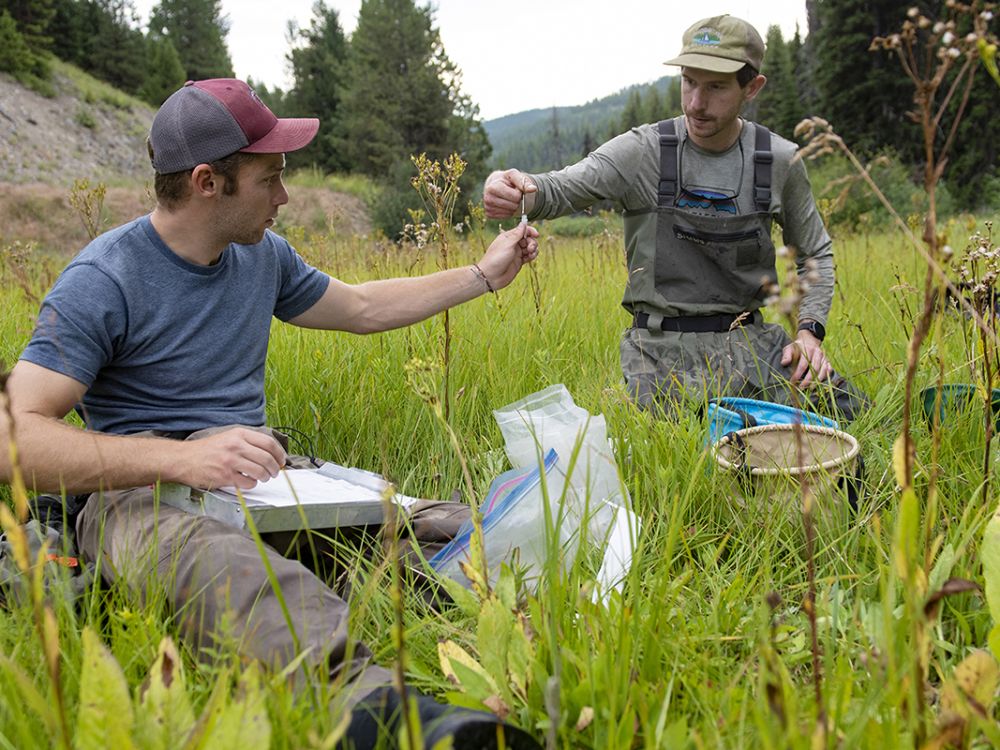
A new National Science Foundation grant will bolster STEM graduate education at the University of Montana. (UM photo by Tommy Martino)
MISSOULA – The National Science Foundation recently awarded nearly $5 million to the University of Montana and its partners to fund scholarships for low-income graduate students studying engineering or natural resource fields.
Montana industries that rely on science, technology, engineering and mathematics graduates are growing faster than national competitors, creating a need for skilled labor to facilitate the state’s economic growth.
UM graduate programs are poised to address this need for workforce growth by helping low-income students – who make up a quarter of Montana’s university population – succeed in their pursuit of advanced degrees by providing financial support, as well as structured mentoring to address barriers faced by students in rural areas.
The scholarship program is titled S-STEM: Supporting Talented, Low-income Graduate Students via Internships while Completing their Degrees. It aims to support students while they attain a graduate degree in eligible fields and move into the workforce, as well as understand and distribute information about factors influencing students’ decisions to pursue STEM careers in a low population-density state.
The program also aims to strengthen institutional, business and community support for low-income students to succeed in STEM graduate education and careers.
The NSF award will support senior students in natural resource fields at UM as they transition to graduate school, internships and research work. The scholarships are expected to cover about $13,000 to $14,000 per student per year, according to Ke Wu, UM Graduate School dean and a co-principal investigator on the grant proposal team. The program expects to fund four cohorts over six years, each with up to 16 students, for 64 students total.
“At the end of the three-year experience – one year as a senior and two as a graduate student – we hypothesize students who take advantage of our S-STEM offerings will graduate as highly skilled STEM professionals ready to immediately engage in the workforce,” Wu said. “We expect them to gain a combination of technical and professional skills that will be demonstrably above their peers at a similar point in their careers.”
Studies show that individuals from lower-income backgrounds are less likely to enroll and complete STEM graduate degrees. Only 39% of the lowest-income quartile enrolled in graduate or professional programs within four years of earning a bachelor’s degree, compared with 45% from the highest quartile, according to a 2017 Baum & Steele study. Different completion rates also compound this gap, with only 64% of low-income students completing graduate degrees, compared to 76% in the highest-income quartile.
Barriers to graduate school for low-income students include insufficient finances, concerns about student debt and pressure to work full-time after completing an undergraduate degree. They may also have less access to social and cultural capital and limited knowledge of the “hidden curriculum” of graduate school.
“Our combination of academics, hands-on experiences and mentoring offers strategies to address these factors,” said Libby Metcalf, dean of UM’s W.A. Franke College of Forestry and Conservation, and a co-principal investigator on the proposal team. “We believe that by offering greater financial stability, hands-on experience and network building, combined with focused mentoring, we can increase graduate enrollment and provide low-income students with the tools they need to succeed in Montana’s growing STEM industries.”
###
Contact: Jess Abell, UM director of marketing and communications, W.A. Franke College of Forestry and Conservation, 406-243-5554, jessica.abell@mso.umt.edu.