UM Students, Researchers Take to the Air to Study Pollution Over Salt Lake City
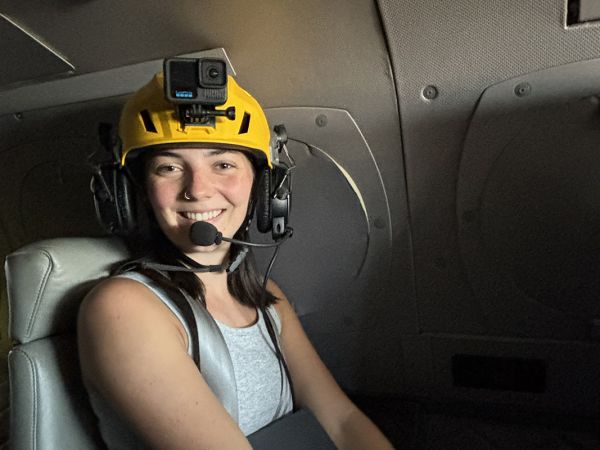
University of Montana doctoral student Amity Deters works aboard the King Air research plane. (Photo by Daniela Guevara)
An enhanced version of this story with additional video and imagery is available.
By Naomi DeMarinis, UM News Service
MISSOULA – Thousands of feet above Salt Lake City, chemistry students from the University of Montana spent this summer tracking air pollution. They collected airborne data over seven weeks as part of a major research campaign to understand factors driving poor air quality in Western cities.
They are working to support efforts to make air cleaner and healthier for those living there.
Dr. Lu Hu, a UM associate professor of environmental and analytical chemistry, leads the Atmospheric Chemistry Group. In July 2026, his lab took part in the Salt Lake City Summer Ozone Study – SLC-SOS – a field campaign that uses research flights over Salt Lake City to measure air pollution emissions and their contribution to ozone production.
Project partners included the University of Wyoming, Colorado State University, the University of Utah, Weber State University, NASA, the National Center for Atmospheric Research and the Utah Department of Environmental Quality.
The UM team includes Amity Deters, a doctoral student originally from rural Oregon. This is her first major leadership opportunity. Other UM team members included research scientist Dr. Wade Permar, postdoc researcher Dr. Logan Forshee and graduate students Lexie Rhodes, Emily Cope and Matthew Yim.
EPA regulations have improved air quality in major U.S. cities, but some still face challenges. The problem is especially pronounced in the arid West, where heat and mountains create stagnant air and trap pollutants.
More than 50 years after the passage of the Clean Air Act, Salt Lake City still struggles to meet the Environmental Protection Agency’s ozone air quality standard. The city is growing, the nearby Great Salt Lake is evaporating and industrial and other urban pollutants mix with the lake breeze. Additionally, the city’s high altitude – over 4,300 feet – and infusions of wildfire smoke add more unknowns.
Bringing the city into compliance will require reducing emissions, but first, researchers and regulators need a better understanding of where ozone-forming pollution originates and how it moves around the valley. That’s where SLC-SOS comes in.
Hu said getting reliable data out of a moving airplane takes more than good instruments – it takes a flight team and a science team working in constant coordination. They often improvise solutions in real time.
He said their aircraft team drilled several holes in the body of the airplane to install sampling inlets. During a flight, sampling pumps pull the air from outside into measuring instruments, sometimes with the help from aircraft’s aerodynamics.
After air samples are gathered, the UM team uses a mass spectrometer to identify air molecules based on their mass-to-charge ratio and quantify the concentrations of organic air pollutants in the air.
“Deciding when to fly is its own daily challenge,” Deters said. “Hot, sunny days with no smoke are ideal, but the unexpected often occurs. Clouds and moisture interfere with sampling and can delay flights.”
The science team plans to take 100 flight hours to gather enough data. Each flight can last for between 50 to 100 minutes and is limited by temperature and the success of cooling efforts.
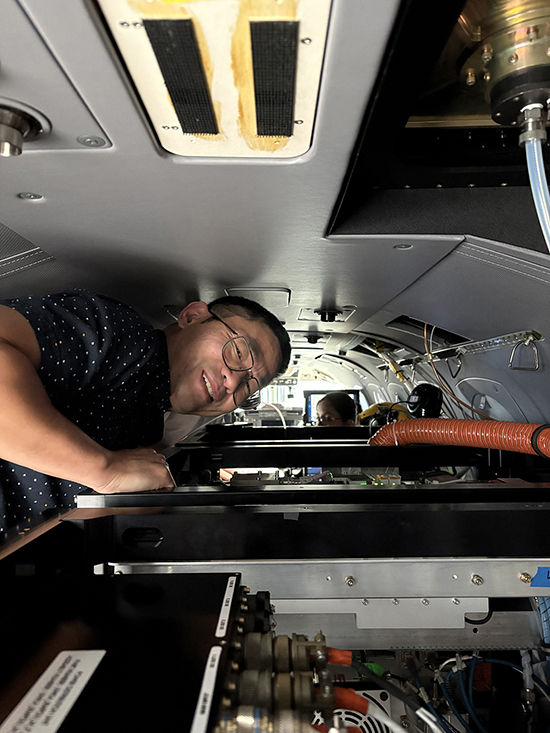
One of the biggest challenges of the SLC-SOS project was keeping instruments cool during the sampling flights – especially when Salt Lake City temps soared above 100 degrees. Hu said all instruments generate heat, and the small plane traps it. This means the team developed creative strategies to cool the instruments down to keep them from shutting off.
They installed fans, removed the instrument casings, directed air conditioning tubes at specific parts of the instruments, turned off the cabin lights and even strapped ice packs onto instruments.
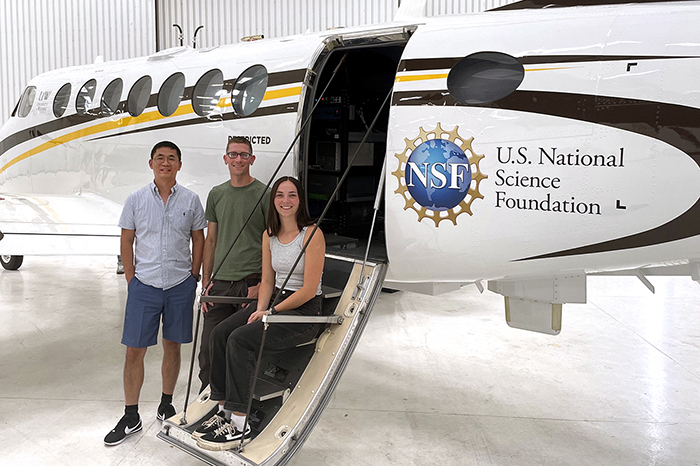
The project uses the University of Wyoming’s King Air, and that flight team is responsible for safety and logistics.
In the hangar, aircraft instruments receive power from a ground connection. But once the plane is pulled onto the tarmac, the aircraft engines take over. The flight team ensures a seamless transition, which is critical. If the instruments lose power, data can be lost.
Inside the plane, space is at a premium for the instruments, and there is room for only four people, including the pilot.
After a day of flying, the science team would return to their hotels and begin processing the data, Deters said.
The instruments on the plane report the raw electrical signals from the collected air samples. The science team uses calibrations to convert these raw signals into concentration data, which tells them how much of each substance is present in the atmosphere.
The data will help Utah DEQ better understand air pollution sources. It will also generate insights that can help other cities across the West develop their own mitigation strategies to improve air quality.
Achieving those goals depends on the expertise and dedication of the scientists involved in the project, including researchers such as Hu and Deters.
Hu was born and raised in China, where air pollution was so present he barely noticed it. He just thought the gray sky was another cloudy day. With constant haze and smoke, the air became a conversation starter because, as Hu puts it, “No matter your socioeconomic status, everyone has to breathe.”
That realization shaped his career. “The thing we study matters for everybody,” he said.
Hu earned his Ph.D. at the University of Minnesota before completing a postdoctoral fellowship at Harvard. He later joined UM and began studying wildfire, flying aboard research aircraft through smoke plumes using a mass spectrometer to measure and analyze their chemical composition.
His research on volatile organic compounds earned him a National Science Foundation CAREER Award, and he has since become a leading voice on wildfire smoke and other forms of air pollution.
Hu has published studies showing that atmospheric models underestimate harmful acids in the air and that wildfire smoke can contain hazardous pollutants at unhealthy levels. He’s traveled across the country, measuring atmospheric composition to learn how wildfire and urban pollutants affect human health.
Deters, the Ph.D. student, sought out a place where her research would be directly applicable to helping make the Earth healthier.
“What excites me most about this project is getting to the end of the day, processing the data and seeing where the pollution hot spots are,” she said. “One thing we’re finding is that they’re not where we’d expect. They show up in strange pockets of Salt Lake City, maybe due to wind patterns. That’s the fun part of science: When your hypothesis isn’t supported, it’s a little frustrating, but it’s also exciting, because you’re seeing something no one’s seen before.
“I’m looking forward to digging into the data after the campaign to figure out where those hot spots are actually coming from,” Deters said. “They’re not just appearing out of nowhere – something's driving them. I want to find out what they are and how they contribute to ozone pollution.”
###
Contact: Lu Hu, UM associate professor of environmental and analytical chemistry, 406-243-4231, lu.hu@mso.umt.edu.