UM Student’s Path to Public Health Grows From Science, Service and Community
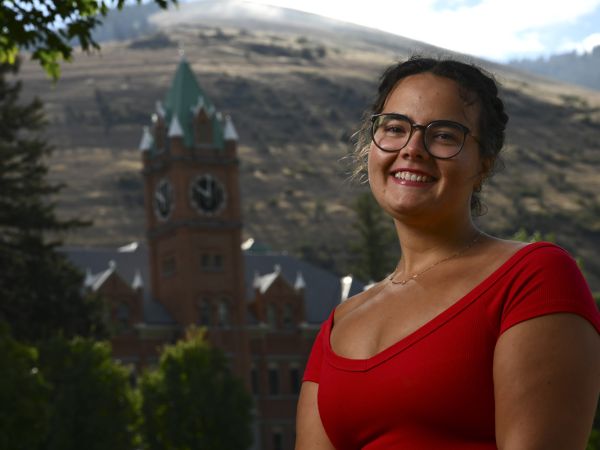
Ava Heintzelman started at the University of Montana as a freshman studying biology, but relationships with faculty led her to earn dual degrees in biochemistry as well as cellular and molecular neuroscience. (UM photo by Ryan Brennecke)
By Skylar Rispens, UM News Service
MISSOULA – After moving between several states and attending about 12 schools by the time she reached high school, Ava Heintzelman thought she knew one thing was for certain when she graduated from Big Sky High School: She did not want to stay in Missoula for college.
That perception changed after she toured the University of Montana with her brother, who earned his bachelor’s and master’s degrees at UM. When Heintzelman returned for her own tour while college shopping, she began to see the University differently.
“The sense of community I felt that I could make for myself here was unmatched,” Heintzelman said. “I went from being a no to thinking, ‘My gosh, there’s something so unique here.’”
At UM, Heintzelman found a campus that felt small enough for professors to know her while still providing opportunities and resources she associated with larger universities. That dichotomy allowed her to fully explore all of her passions.
She started as a freshman studying biology, but relationships with faculty helped her discover connections between her interests in neuroscience, chemistry and healthcare, leading her to earn dual degrees in biochemistry as well as cellular and molecular neuroscience.
Heintzleman completed her coursework in four years and routinely enrolled in more than 20 credits a semester as a student with the Davidson Honors College while simultaneously working full time, participating in research and joining student leadership.
“I don’t think I ever would have figured out those were my passions unless I had that faculty and that backbone of UM behind me to show me that was an option,” Heintzelman said. “I had so many people behind me that helped me make it happen.”
Her interest in neuroscience developed in part through her developmentally disabled uncle and her mother’s work in special education. Chemistry entered the picture after she began peer-leading for a general chemistry course during her sophomore year. By her junior year, Heintzelman was asked to take over the peer-learning program for the department. She taught other students how to teach the course before eventually teaching it herself as an adjunct instructor.
Her time at UM also gave Heintzelman opportunities to explore healthcare outside the classroom.
She earned her EMT license in June 2024 and spent her senior year working Friday night shifts in the emergency room at Community Medical Center. She said the experience showed her the patient-care side of healthcare, as well as some of the challenges within the larger system.
“Pursuing my EMT license is one of the best decisions I’ve ever made,” Heintzelman said. “It showed me the patient care side of things and the flaws within the system.
“It was difficult to juggle everything, but I never would have gone through everything I did if I didn’t find happiness in the things I was doing,” she continued. “I had a passion. I was happy with everything I was doing, and the thought of not doing one of them made me sad.”
Around the same time, Heintzelman was becoming increasingly interested in health advocacy.
“I want to be a part of the health policies that are getting developed,” she said. “I want to be a part of like making a bigger change in not necessarily just the U.S., but the world and getting my perspective out there and helping where help is needed.”
Those experiences led Heintzelman to pursue a Master of Public Health at UM rather than immediately applying to medical school, which was her previous plan after completing her undergraduate education.
Her interest in public health comes from two sides. She enjoys the science behind how the human body works, but she also has a strong interest in helping people.
“Hard science-wise, I love knowing why,” Heintzelman said. “Why things happen, how they happen, what mechanism inside you is going on.
“Healthcare on the other hand, I have a passion for people,” she continued. “I love helping people.”
Academic excellence has always been top-of-mind for Heintzelman throughout her journey in higher education. She was recently named a Mortar Board National Foundation Fellow, earning a $5,000 award from the Mortar Board Honors Society. Only two students receive this recognition each year.
During her graduate education, Heintzelman became involved with the Missoula City-County Health Department and worked on a research project with Missoula Villages, a pilot program built around neighbors helping neighbors.
The program connects older adults with volunteers who can help with tasks such as computer assistance, lawn mowing and transportation. Heintzelman designed a research study examining whether the program can help address loneliness and self-isolation among older adults.
“The big bubble on top of it all was loneliness,” she said. “So everything came back to loneliness and self-isolation.”
The project brought together many of the interests Heintzelman had developed throughout her education, including research, public health and her background in science.
Now, as she finishes her graduate degree this semester, Heintzelman is continuing to build on that foundation. She is working with the chemistry department to redesign labs, pursuing a group fitness certification and preparing for two medical missions in the spring, including trips to Costa Rica and Punta Cana.
Her longer-term plans are less certain.
Heintzelman is considering both medical school and a Ph.D., with interests ranging from global health to cancer research. She is particularly interested in Ph.D. programs that would allow her to conduct research abroad, and she is currently leaning toward pursuing a doctorate beginning in fall 2027.
For Heintzelman, deciding what comes next is possible in part because of the community she found at UM.
After years of moving and searching for a place to call home, she said Missoula and the University gave her a sense of belonging she had not experienced before.
“I never really had a community,” she said. “Until I got to campus, I really was just a butterfly flying around. I’ve now found my home here, and I think high school-me would be so glad to know that.”
As she considers leaving Missoula for the next chapter of her education, she feels ready to take what she has learned with her.
“I think I have found my community, and I found my home, and that will forever and always be Missoula and University of Montana,” Heintzelman said. “I’m ready to step out and see what more I can do with everything I got from this campus and this community.”
###
Contact: Dave Kuntz, UM vice president of marketing and communications, 406-243-5659, dave.kuntz@umontana.edu