UM Program Puts High School Students on Rural Healthcare Career Pathway
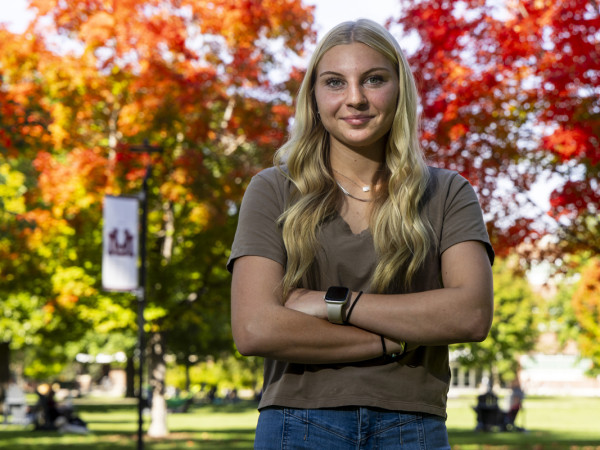
Kaycee Eubanks took dual enrollment classes at Corvallis High School to complete UM’s Rural Healthcare Career Pathways Program. (UM photo by Marley Barboeisel)
By Kyle Spurr, UM News Service
MISSOULA – Before enrolling at Missoula College this fall, Kaycee Eubanks already earned a healthcare degree from the University of Montana.
Eubanks, who graduated from Corvallis High School in the Bitterroot Valley this past spring, took dual enrollment classes to complete UM’s Rural Healthcare Career Pathways Program. She is one of six Corvallis students to complete the program this year and among five to earn a pre-health professions certificate of technical studies degree, which opens the door to a variety of healthcare careers.
For Eubanks, the degree gives her a huge leap forward in the Missoula College pre-nursing program and gets her closer to being accepted to nursing school.
“Instead of having to take the initial two years of prerequisites, I’ll be able to apply for nursing school next spring,” Eubanks said.
The Corvallis students were the first group to complete the Rural Healthcare Career Pathways Program, which launched two years ago through a $1.8 million grant from the U.S. Department of Education. The program is overseen by UM’s Office of Health Research and Partnership and is offered in 10 high schools across Missoula, the Bitterroot Valley and the Montana Hi-Line.
Lily Apedaile, the UM Office of Health Research and Partnership director, said the program combines health science dual enrollment coursework with a healthcare industry-recognized credential to prepare students for in-demand careers.
The program also addresses the critical need for more healthcare providers across Montana, especially in rural communities like Corvallis. A main goal of the program is to train rural students for healthcare careers in their own communities and fill the workforce shortages in the state, Apedaile said.
“If you get students from rural areas interested in healthcare, they are more likely to stay or get training and come back,” Apedaile said. “Someone from a rural area is more likely to practice in a rural area.
“Hopefully we will see these students come back to practice as a healthcare professional or go and work in another rural community in Montana,” Apedaile added.
Kristina Berger, UM Bitterroot College director, worked with Apedaile to establish the program. She sees the need for more healthcare providers in the Bitterroot Valley and hears from employers of all local industries about the importance of having trained healthcare professionals working in the region.
Berger is establishing other pathway programs, including for nursing careers and for existing healthcare professionals to upskill and train for new roles.
“Our employers down here are excited,” Berger said. “It doesn't matter where you are starting from, you can jump into a pathway and become a healthcare professional.”
The high school students in the Rural Healthcare Career Pathways Program are drawn to several career options such as nursing and radiologic technologist. The program is designed to give students flexibility in their career choices. The credits they earn are all prerequisites for nearly every health profession program at Missoula College and many UM programs and align with other prerequisites for health professions across the state.
“We want to foster their exploration of all healthcare careers,” Berger said. “The pre-health profession certificate gets them ready for pretty much any path they want in healthcare.”
To complete the program, Eubanks had to take a mix of classes ranging from college writing and psychology to human anatomy and physiology.
Eubanks’ favorite classes in the program were psychology and medical terminology. She was able to take each class as an addition to an existing high school course or online.
“The medical terminology class was definitely the most interesting to me,” she said. “It built on everything I learned in anatomy and it helped me make those connections.”
Eubanks encourages other students in Corvallis and around the state to consider taking the program. It has saved her a significant amount of money and time to reach her goal of becoming a nurse, she said.
“It was worth it,” she said. “It was really helpful to get a lot of credits done ahead of time.”
###
Contact: Dave Kuntz, UM vice president of marketing and communications, 406-243-5659, dave.kuntz@umontana.edu