UM Launches Montana’s First ‘Human-Centered’ AI Career Certificate
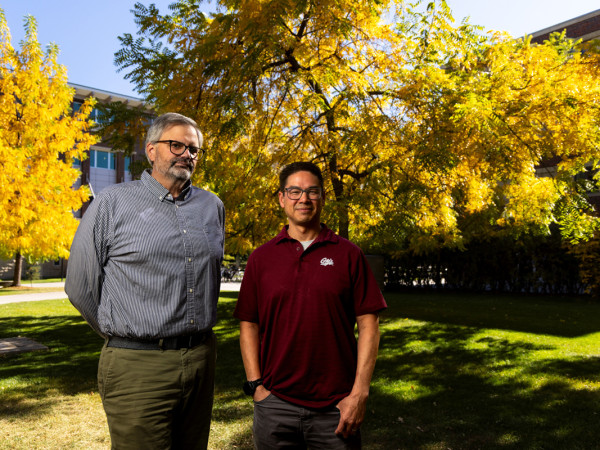
UM Associate Professor Michael Cassens (right) spearheaded the development of the University of Montana’s new Human-Centered AI Certificate alongside School of Journalism Director Lee Banville. (UM Photo by Marley Barboeisel)
By Austin Amestoy, UM News Service
MISSOULA – Artificial intelligence is reshaping our world – fast. That’s why the University of Montana this year launched the state’s first-ever career certificate designed to help students keep up.
But learning what AI can do is only part of the mission. UM’s Career Certificate in Human-Centered AI challenges students to think critically about this emerging technology.
“This certificate is about making sure humans aren’t just in the loop, but in the driver’s seat,” said Michael Cassens, a UM associate professor of game design and interactive media.
The nine-credit series takes students on a journey from learning how to interact with and understand generative AI – like OpenAI’s ChatGPT or Anthropic’s Claude – to testing the limitations and biases of chatbots. Students also discuss and debate the technology’s ethics, from AI-generated images to data centers and beyond.
For Cassens, a certificate focused only on mastering generative AI wasn’t the right move. He said UM faculty think every day about what students will face after they leave campus.
“At UM, we think about humans and how important we are together,” Cassens said. “Everything we do is about preparing our students for the future – and not just to get a job, but to be leaders wherever they go.”
Any UM student can obtain the career certificate by passing three courses. The first, Creatively Exploring AI, dives deep into the technology through a personal lens. Students are tasked with evaluating how AI is impacting their own fields of study, pushing chatbots to their limits to understand how they work (and how they don’t) and considering ethical issues like copyright, labor, misinformation and environmental impacts.
The second course goes by a more head-turning name: Calling Bullshit in the Age of AI. Lee Banville, director of the UM School of Journalism, said the title is straightforward for a reason.
“When AI is wrong, it’s still 100% convinced it’s right,” Banville said. “You can’t turn off your critical thinking just because Claude gave you an answer.”
The class began as a news literacy course several years ago, until Banville and Cassens recognized an opportunity to fold in artificial intelligence literacy, too.
“The goal is not to sell students on AI or make them terrified of it,” Banville said. “It’s to make them smarter, more skeptical consumers of content shaped by AI.”
The certificate concludes with a course focused on developing students into leaders in an AI-centered world. All three classes are offered online and are asynchronous, meaning students can access this education at their convenience.
Second-year game design grad student Grace Smith is about halfway through completing the certificate. Hailing from Three Forks, Smith came to UM after its strong arts programs caught her eye. But it was a game design expo and a meeting with Cassens that captured her imagination.
“Game design feels less like getting a degree and more like self-exploration,” Smith said.
Smith started noticing students in her undergrad creative coding class turning in AI-generated code. She realized she needed to brush up on the technology herself to be a more confident teacher – and to help her students use it as a tool, not a solution.
“I’m much more hands-on now as a teacher,” Smith said. “I make changes week by week to see how my students react.”
Cassens said his goal is to eventually open the Career Certificate in Human-Centered AI to anyone, including those outside the Montana University System. He says UM is setting the example for thoughtful discourse about a technology that often feels too big to understand.
“I think people feel a loss of agency right now, and we want them to reclaim that,” Cassens said.
###
Contact: Michael Cassens, UM associate professor of game design and interactive media, 406-243-5677, michael.cassens@umt.edu; Austin Amestoy, marketing and communications manager, UM College of the Arts and Media, 406-690-2783, austin.amestoy@umt.edu.