Visionary $1M Gift Spotlights UM’s World-Class Ecology and Evolution Program

Lana Richards Batts and Joe Batts have donated $1 million to support UM’s nationally recognized Ecology and Evolution program. (UM photo by Ryan Brennecke)
MISSOULA – The University of Montana’s Ecology and Evolution program has long been considered one of the University’s hidden gems.
Though it typically receives little mainstream fanfare, the program has quietly established itself among the world’s leading institutions in ecological and evolutionary biology research and education. Its faculty members consistently produce groundbreaking work, and the program competes for top-caliber graduate students alongside some of the best-known universities across the globe.
Now, a visionary $1 million commitment from alumni and longtime UM champions Joe and Lana Richards Batts of Lakeside will elevate the renowned program even further, bolstering the resources needed to continue building on its success.
The Batts’ generous gift, made to the UM Foundation, establishes the Joe and Lana Batts Graduate Student Support Fund, which will provide $100,000 each year for the next 10 years to support graduate student tuition, stipends and other high-impact priorities in ecology and evolution.
For the Batts – who have consistently given back to UM with support to a variety of academic programs, as well as the Bird Ecology Lab and the Montana Museum of Art and Culture – the decision to invest in one of the University’s leading centers of research and scientific exploration was an easy one.
“We believe in science,” said Lana Batts, who graduated from UM with a bachelor’s degree in history and political science in 1968 and received an Honorary Doctorate of Humane Letters in 2025. “We started to meet more and more of the scientists and researchers at the University, and, when you put that caliber of people together, you have to sit back in awe of what they’re doing and what that research means.”
In 2026, the Ecology and Evolution program, part of the Division of Biological and Biomedical Sciences in UM’s College of Science, ranked in the top 15 nationally and top 30 worldwide, according to Research.com’s university research rankings. That places UM among the top 3% of 876 institutions evaluated.
With more than 1.4 million acres of wilderness surrounding UM’s campus, the program is one of the most field-rich in the country, providing students with unparalleled opportunities to study in a diverse and extraordinary region of North America.
The program is recognized as a leader in the study of population genetics and genomics, animal behavior, aquatic ecology, conservation and organismal physiology. Among other areas, UM’s internationally acclaimed faculty investigate how species adapt, evolve and diversify; how invasive species affect the health of freshwater ecosystems; and how animals and plants respond to changes in the environment.
According to UM statistics, ecology and evolution faculty have published more than 800 papers during the past decade, including more than 50 in leading journals such as Nature, Science and the Proceedings of the National Academy of Sciences.
“The ecology and evolution program is a bright spot at the University and in the country,” said College of Science Dean Leslie Rissler. “It’s a premier graduate program, and we rank higher than Stanford, Harvard and Michigan. It’s an obvious place to invest, and we’re so thankful to Joe and Lana Batts for making this gift.”
Rissler, an integrative biologist who became the inaugural dean at UM’s newly reorganized College of Science after serving in leadership roles at the National Science Foundation and a biology professor at the University of Alabama, said the Batts’ investment will be transformative on several levels.
The gift further strengthens the already excellent program’s research capabilities and expands its ability to recruit and retain more outstanding graduate students. That added capacity, in turn, will contribute to UM’s status as an R1 research university, which places the University among the top 3.7% of the nation’s research institutions. The R1 classification is based on a university’s overall research activity and annual number of doctoral graduates, requiring continued investment in both.
Much of the hands-on work involved in the University’s research is accomplished by graduate students, whose contributions are central to UM’s standing as a trailblazer in research and innovation.
“Graduate students are the soul of the University,” Rissler said. “They bring energy and new discoveries, and it’s essential for a research institution to have the best and brightest graduate students. This gift allows us to do that.”
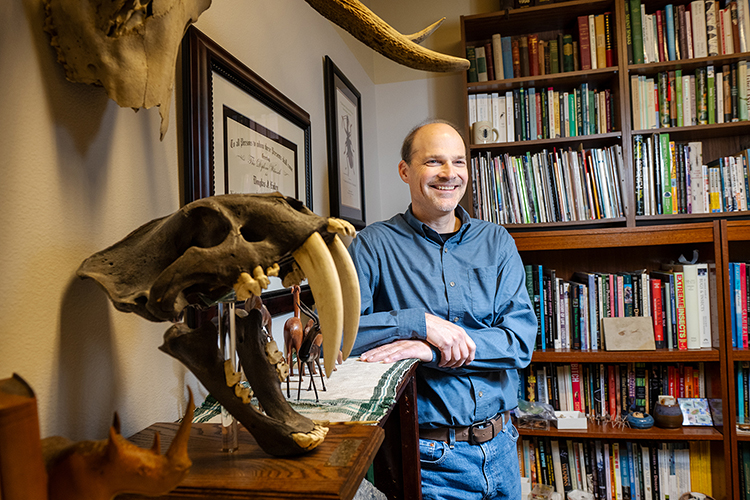
Doug Emlen, a longtime UM Regents Professor of Biology who is one of two UM professors to be elected to the National Academy of Sciences, said graduate students are also essential to UM’s broader science mission. They teach many of the active-learning components of undergraduate courses, including molecular biology labs and fieldwork, as well as leading discussion sections.
Emlen’s election to the National Academy of Sciences represents one of the highest honors a scientist can receive. He said much of his own research wouldn’t be possible without the help of talented graduate students.
“These are passionate, driven people who want to change the world, and they’re the engines that actually do the research,” he said. “The reason I have research to publish – which I can then use to secure additional grants – is that I have graduate students who are incredibly good and productive.”
One of the most notable aspects of the Joe and Lana Batts Graduate Student Support Fund is its unique structure, Emlen said. Recruiting doctoral students in ecology and evolution typically requires a commitment of five years of financial support. Because the Batts’ gift spreads its funding over 10 years, UM will be able to assure prospective students that their work will be funded throughout their time at the University.
Stipends frequently help offset costs of living and other expenses, allowing graduate students to focus on their studies, research and teaching responsibilities. Keeping graduate stipends competitive with those at comparable institutions can be critical in helping students choose UM.
By providing flexible graduate support and added continuity to the process, the Batts’ gift will amplify the momentum of UM’s nationally competitive Ecology and Evolution program. It will help the program recruit exceptional students, advance ambitious research and seize opportunities that further elevate its national standing.
“That safety net is game-changing,” Emlen said.
Joe and Lana hope their gift inspires others to support the Ecology and Evolution program, and to continue to lend added early momentum to the College of Science, which the University separated from its College of Humanities and Social Sciences to create two new academic units in fall 2025.
“We already have the faculty. We already have the place. We have the chemistry and the critical mass, the vibrancy you get from an amazing program,” Emlen said. “Now, thanks to Lana and Joe, we have the additional resources to keep playing the game at the highest level.”
To learn more and support UM’s Ecology and Evolution program, contact Alison Schultz, the UM Foundation’sassociate vice president of development, at 406-243-7449 or email alison.schultz@supportum.org.
###
Contact: Dave Kuntz, UM vice president for marketing and communications, 406-243-5659, dave.kuntz@umontana.edu.