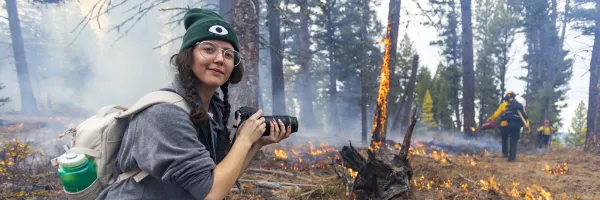
Our Mission
The mission of the University of Montana School of Journalism is to provide students with a professional education in journalism; to teach them to think critically, act ethically and communicate effectively; to help them understand the challenges and changes in the news media; and to inspire them to use their talents to improve journalism and enhance a diverse and democratic society. (Adopted by the faculty March 2008, readopted in 2012, 2013, 2016, 2022 and 2023.)
A School Built to Last
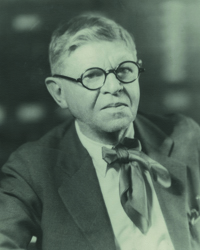
The University of Montana School of Journalism was founded in 1914 — in surplus army tents on the edge of the Missoula campus — by Arthur L. Stone, one of the most respected journalists and educators in the American West. It is one of the oldest journalism programs in the country and, more than a century later, still the only one in Montana.
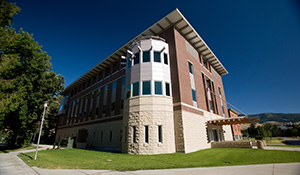
The School moved into its first permanent home in 1936. As the program grew, sequences in radio and television were added in 1958, reflecting the School's consistent instinct to meet journalism where it was going, not where it had been. The Department of Radio-Television operated separately for two decades until, in 2007, a $14 million campaign — $10 million from private donors, $4 million from state and university funds — united the entire School under one roof in the opening of Don Anderson Hall, a four-story facility in the heart of campus that houses 11 classrooms, TV and audio production studios connected to Montana PBS and Montana Public Radio, still photography studios, professional editing suites, and the Montana Media Lab.
The School was first accredited by ACEJMC in 1948 and has remained continuously accredited since. It has had only nine permanent deans in its history.
Where We Are Now
The School's founding commitment — professional training grounded in critical thinking, ethical practice, and strong writing — has never changed. What has changed is the scale and reach of what students produce.
In 2025–2026, the Hearst Journalism Awards ranked UM 10th overall among 104 accredited programs nationwide, 1st in the nation in photojournalism, and awarded the School more than $40,000 in prize money. Maddie McCuddy won the national photojournalism championship. Claire Bernard finished second in the country in writing. These results follow years of consistent national recognition: SPJ Mark of Excellence awards, Northwest Emmys, Broadcast Education Association prizes, and Online News Association honors.
Faculty achievements have kept pace. Professor Lisa Krantz, who joined the School in 2024, was part of the Washington Post team that won the Pulitzer Prize for coverage of gun violence. In 2026, professor Jule Banville co-launched The Obit Project — a nationally distributed podcast on NPR, Apple Podcasts, and Spotify, co-hosted with Radiolab founder Jad Abumrad — that began as a classroom assignment. The Pollner Distinguished Professorship, which brings a working journalist of national distinction to campus every semester, recently expanded to two professors per year through private philanthropy.
The Native News Honors Project — now in its fourth decade — sends student journalists to Montana's seven tribal nations every spring to report, photograph, and produce coverage that reaches tribal councils, tribal colleges nationwide, and state and federal officials. The Montana Media Lab trains rural and Indigenous high school students across the state to report on their own communities, supported by a new three-year, $475,000 Arthur M. Blank Family Foundation grant. Students travel internationally every year on faculty-led reporting trips, with recent destinations including Scotland, Bangladesh, South Korea, and Northern Ireland.
Nearly $7 million has been raised from individual donors over the last accreditation cycle. The School awarded $426,000 in scholarships in 2026 alone.
Still the Only Journalism School in Montana
The School's distinctiveness has always been rooted in place. Montana is not a media hub — it is a state where journalism is genuinely scarce and genuinely needed, and where the stories students cover have real consequences for real communities. That proximity to public-interest journalism is not incidental to what we teach. It is the curriculum.
Forty-eight School of Journalism graduates have received UM's Distinguished Alumni Award over the decades. Alumni hold Pulitzers, Emmys, and senior positions at outlets from the New York Times to public radio stations across the West. More than 94% of graduates are working or in graduate school immediately after leaving Missoula.
The army tents are long gone. The mission is the same.