What Sets UM Journalism Apart
Founded in 1914 in surplus army tents on the edge of the Missoula campus, the University of Montana School of Journalism is one of the oldest journalism programs in the United States — and still the only one in Montana. More than a century later, the core principle hasn't changed: You learn journalism by doing it, for real audiences, on real deadlines, from your first semester.
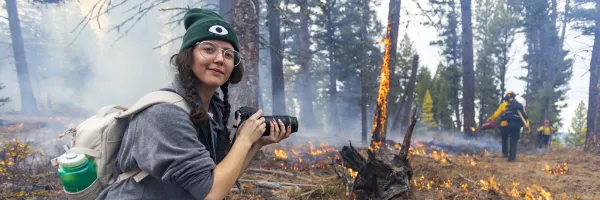
This is a small, intensely professional school. Our students don't simulate journalism — they practice it. They cover the state legislature, file from abroad, produce documentaries for Montana PBS and report on and from tribal nations while still undergraduates. The result is a program that consistently competes with — and regularly beats — schools many times its size.
Nationally Ranked. Student-Driven.
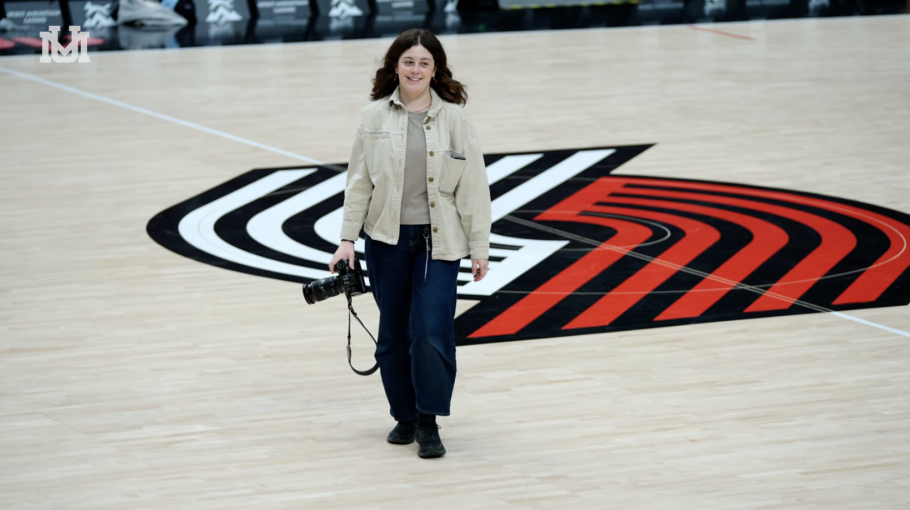
In the Hearst Journalism Awards — widely called the college Pulitzers — UM ranked 10th overall among 104 accredited programs in 2025–2026 and 1st in the nation in photojournalism. It earned more than $40,000 in awards. Maddie McCuddy won the national photojournalism championship outright. Claire Bernard finished second in the country in writing, then began an internship at Bloomberg News in Washington, D.C.
Students also won big with the Society of Professional Journalists. In 2026, students earned 20 regional Mark of Excellence awards in the largest enrollment categories, including In-Depth Reporting, best Feature and Best Independent Online Student Publication. Our magazine, Byline, went on to win best student magazine in the nation. Northwest Emmy Awards, Broadcast Education Association prizes and Online News Association recognition complete a record of student work that is genuinely national in reach.
These aren't anomalies. This is what students produce here every year.
Faculty Who Are Still Working Journalists
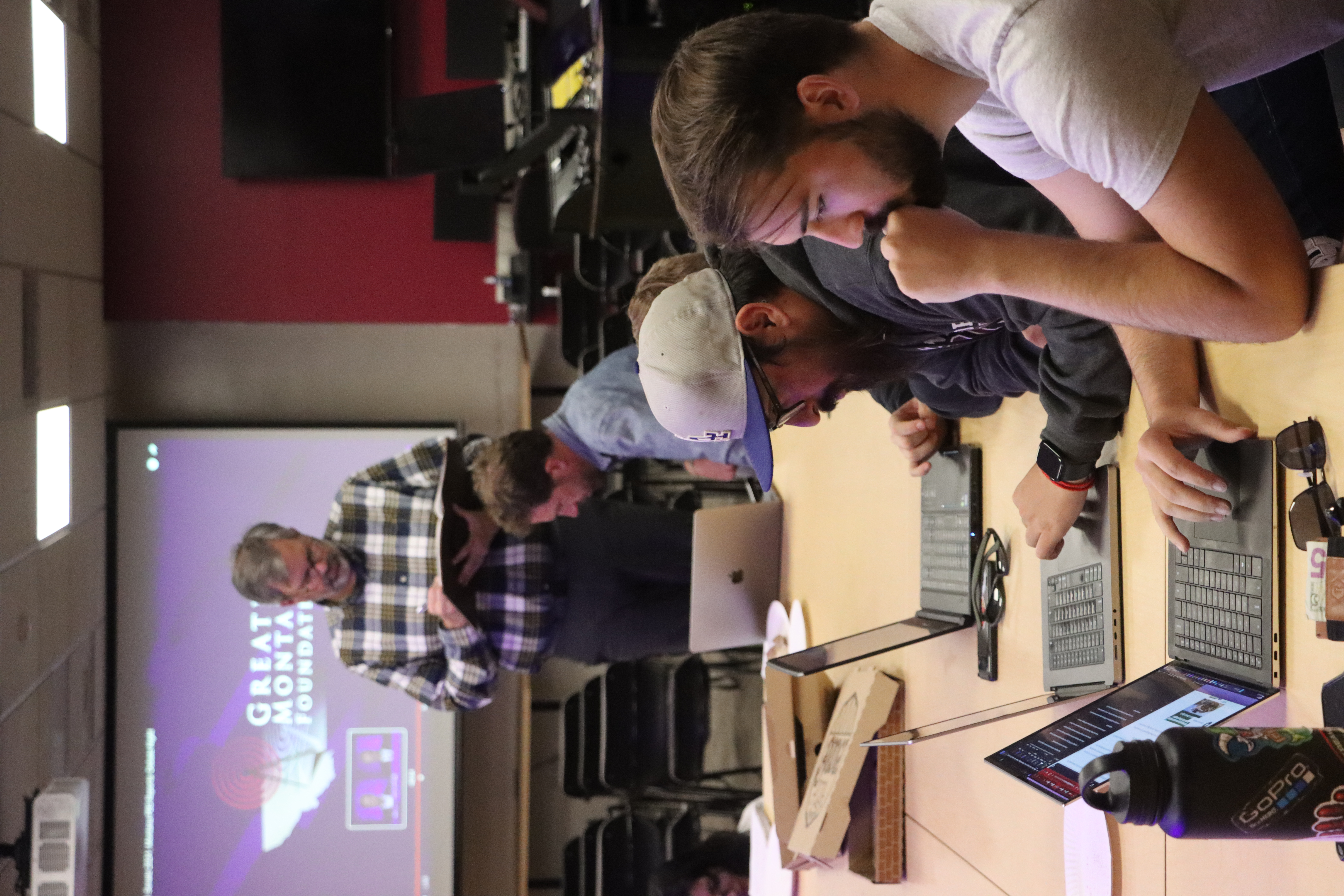
The research is clear: Faculty expertise is one of the most influential factors prospective students consider when choosing a journalism school — and it's one of UM's greatest strengths. Our full-time faculty are practicing journalists as much as they are teachers. Their recent work includes nationally recognized podcasts, published books, documentary films, features in the Guardian, Emmy-nominated television and Pulitzer Prize–finalist photography.
Professor Jule Banville co-hosts The Obit Project with Jad Abumrad — MacArthur Fellow, three-time Peabody Award winner and founder of Radiolab — on NPR and Spotify. Professor Jacob Baynham, a National Magazine Award-winning writer, teaches many of our beginning and advanced writing classes. The Pollner Distinguished Professorship brings an additional working journalist of national distinction to campus every semester, now expanded to two per year through private philanthropy.
These are professors who know your name, answer your questions and are still actively shaping the field they're teaching.
Montana Is the Story
Most journalism schools put students near a media hub and let them orbit it. UM puts students inside the story. Missoula is one of Montana's largest cities and a genuine working beat: tribal nations, the state legislature, wildfire, public lands, housing issues, rural poverty. Montana contains community journalism disappearing other places, but very much alive here, thanks to our alumni and students.
Every year, students travel abroad on faculty-led international reporting trips — to places like Scotland, Bangladesh, South Korea, Northern Ireland and Nepal — filing professional journalism from the field. Every two years, the Legislative News Service sends students to Helena for the entire spring semester to cover the Montana Legislature for 150-plus news organizations statewide. The Native News Honors Project has sent student journalists to Montana's seven tribal nations every spring for more than three decades.
This place is not incidental to your education. It is your education.
Real Work from Day One
Hands-on learning in the field is the single most important factor prospective journalism students say they look for in a program. At UM, it isn't a feature — it's the structure of the entire curriculum.
From your first year, you'll report for real news organizations, produce audio that airs on public radio, shoot photography that competes nationally and publish writing in professionally distributed magazines and websites. Capstone projects include a full-length documentary for Montana PBS, legislative coverage distributed to 150 outlets and an international reporting course that takes you abroad to file real stories in a foreign country.
You won't graduate with a transcript. You'll graduate with a portfolio.
A Top-10 Program. Not a Top-10 Price Tag.
Affordability is the number-one factor prospective students name when choosing where to apply for a bachelor's degree. A UM Journalism education — at a program ranked in the nation's top 10 — costs a fraction of what comparable programs charge at large private or other state universities.
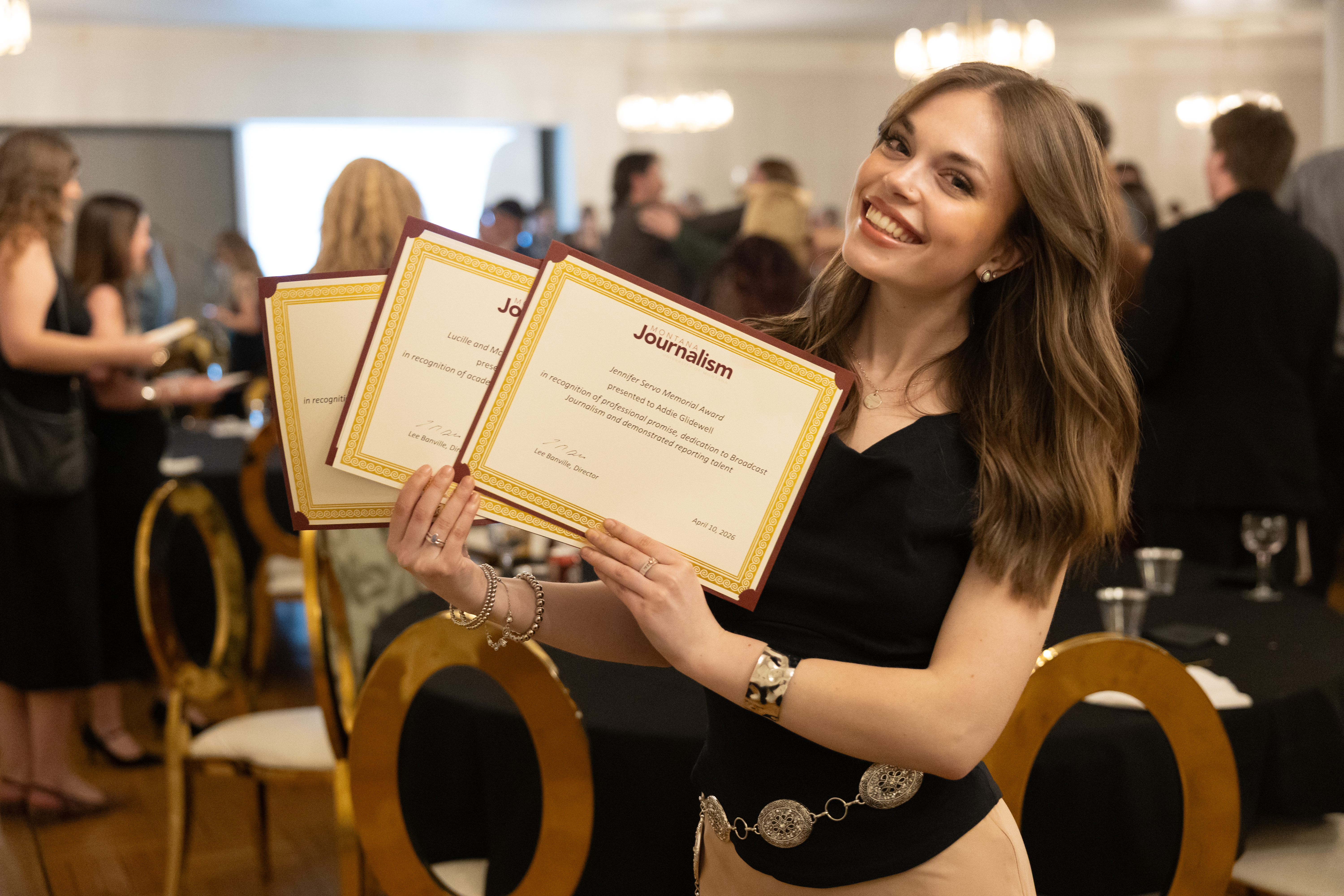
And we invest back in our students. In 2026, the School awarded $426,000 in scholarships to current students, funded by a community of alumni and donors who believe in this program. First-year students may be eligible for the Director's Scholar Program, which provides up to $5,000 in additional support.
Explore scholarships and financial aid →
Small by Design. Connected for Life.
One of the most consistent things UM Journalism graduates say about their time here is that they felt known — by faculty, by peers, by a program that treated them as individuals. Director Lee Banville meets personally with every incoming student before their first semester begins. Classes are small. Faculty doors are open. The Montana Kaimin, KBGA College Radio and the School's capstone projects create a community where students work alongside each other and alongside faculty on real journalism, every semester.
That community doesn't end at graduation. Forty-eight UM Journalism graduates have received UM's Distinguished Alumni Award. Our alumni hold Pulitzers, Emmys and senior positions at outlets across the country — and they stay connected to the program, giving scholarships, returning as Pollner professors and hiring the next generation of UM graduates.
Connect With Us and Get More Information:
One Trailblazing Student's Journey
Request more information here or in the form above and don't hesitate to give us a call or send us a message with any questions. Also, follow us on Instagram and Facebook to get a peek behind the scenes at the school.
Phone: (406) 243-4001
Email: journalism@mso.umt.edu