E-Bikes in the Wild: UM Doctoral Student Studies Growing Trail Trend
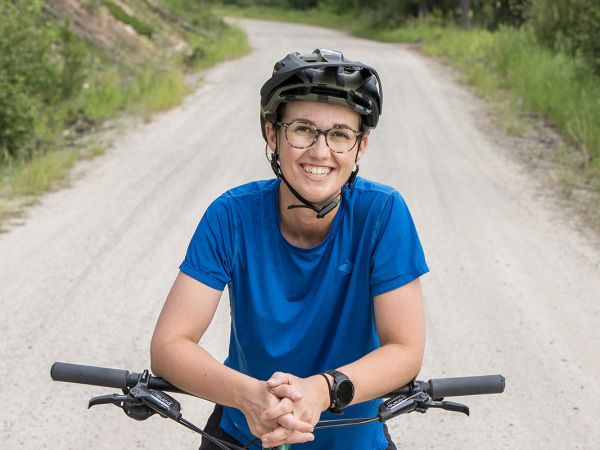
Abi Fuesler, a UM doctoral student, studies public perception of mountain e-bikes and their role in recreation. (Photo by Jason Marquardt)
NOTE: An enhanced version of this story with video is available online.
By Cary Shimek, UM News Service
MISSOULA – Terms like “e-mountain bike” are fighting words to some folks.
University of Montana doctoral student Abi Fuesler learned that firsthand this summer while studying public land trail use at Thompson Park south of Butte. As she surveyed a middle-aged group of female hikers, another woman – a mountain biker using the trail – joined the discussion.
Tempers flared. Not everyone appreciated sharing the outdoors with mountain bikes – especially those motorized e-bike “cheaters.” The biker informed the other women she had helped create and maintain the trail. At one point a hat was thrown on the ground in disgust.
Fuesler, who is earning her Ph.D. in forest and conservation sciences, is fascinated that the topic of e-bikes on public lands sparks such passion.
“What was interesting to me is that the people who were fighting were the same demographics – age, race, gender and ability level,” she said. “But for some reason, they have had different experiences that lead them to have wildly different perspectives on e-bikes.”
Questions regarding the role of technology in outdoor spaces lured Fuesler to study at UM, where she works in Dr. Will Rice’s Wildland and Recreation Management Research Lab, a unit that provides park and land managers with data to improve visitor experiences while preserving the ecosystems that provide those experiences.
In her studies and in-progress dissertation, Fuesler doesn’t pass judgment on whether e-bikes should be allowed on public land trails. Instead, as a social scientist, she’s trying to create a snapshot of the current situation, identify who is involved in the conversation and describe the challenges faced by land managers during a sometimes-fraught dialogue.
“What is the role of technology in outdoor spaces, and how much impact are we comfortable with before it becomes too extreme?” she said. “There also is this broader social conversation about who is invited to be outside and participate in recreation.”
Fuesler also said e-bikes are an exciting new product that are here to stay, whether we like them or not.
“So there is this element of learning how to live with them,” she said, “and I want to help be a part of that solution, whatever it looks like.”
Fuesler grew up in southern California before spending a big chunk of her life in North Carolina, where she attended college and grad school. She also became a dedicated mountain biker and worked for Ride Kanuga, a private bike park offering class 1 e-mountain bike rentals. (Class 1 e-bikes are pedal assisted with a top speed of 20 mph. They have no throttle.) She also became a mountain bike trail advocate while serving on the board of directors for an off-road bicycle association.
Becoming engrossed in the topic of e-bikes, she soon learned most scholarship focuses on commuting and safety in urban settings, with only a few researchers worldwide study e-mountain biking.
“There really isn’t much empirical knowledge surrounding electric mountain bikes – especially the social world surrounding them,” Fuesler said.
Feeling she had found her research path, Fuesler started seeking a college for her Ph.D. that would allow e-bike studies. She knew UM has an incredible history with public land research, and then Rice, an associate professor with Montana’s W.A. Franke College of Forestry and Conservation, shared a job description looking for a student interested in studying public lands access.
Rice is a national leader for research of recreation and access on public lands, and when they connected over Zoom, Fuesler said he seemed patient, knowledgeable and “laughed at my jokes.” She had found her mentor and next college.
“It also didn’t hurt that Missoula is surrounded by a diversity of public lands,” she said. “Besides mountain biking, I also rock climb, paddle and fly-fish. I want those sports wherever I live, and Missoula definitely meets those criteria.”
Fuesler is using the lens of e-mountain biking to study issues such as: What boundaries does society set on technology in outdoor sports? What do e-bikes say about who is invited outside for adventures?
In the first part of her dissertation, Fuesler is working to understand how people use their identities to argue for or against the BLM e-bike reclassification as nonmotorized vehicles in 2020.
Identity strongly influences feelings about e-bikes. For instance, Fuesler learned of people who argue they should be able to use e-bikes in outdoor places because they are veterans. She’s also met older adults who want e-bikes so they can recreate with their younger family members with more ease. Some feel you should only have access to e-mountain bikes if you have a physical disability.
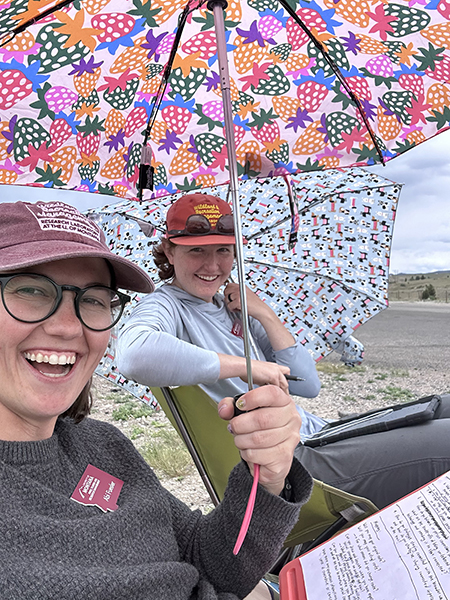
As part of her dissertation studies, Fuesler spent the summer of 2025 examining recreation at Marshall Mountain Park near Missoula. She analyzed visitation using intercept surveys, trail cameras, trail counters, vehicle counters and GPS units recreationists volunteered to carry.
“There is a broad methodological diversity of what I’m learning to use,” she said. “I’m using whatever tool is most appropriate to answer the research question.”
She said many of those interviewed agreed with this statement: An e-bike remains a bike until you put a throttle on it.
For one chapter of her dissertation, Fuesler is working with a local bike-packing group in Missoula called Slow Spokes. She has provided members with cameras so they can take pictures of where they witness community, confidence and adventure during their overnight trips.
“Then I gather everyone for a focus group,” she said. “We talk about the definition of adventure or what Slow Spokes is doing to create opportunities for confidence and community building.”
When she encountered the heated women near Butte, Fuesler was gaining experience as a survey tech for UM’s Institute for Tourism and Recreation Research on a project led by Adalyn Vergara, another UM doctoral student in the Wildland and Recreation Management Research Lab.
So after all she has learned from recreators in Montana, does Fuesler believe using an e-mountain bike is a shameful act committed by cheaters?
Fuesler laughs and admits for years she was firmly in the analog, human-powered mountain bike camp. However, the more conversations Fuesler has had with various stakeholders, the more merit she places on their viewpoints. Her studies have opened up her mind to the possibilities for additional access for more people.
“I now don’t feel like I need to tell every single person that they have to want the same thing I want out of recreation,” she said. “So you probably won’t catch me on an electric mountain bike until I’m much older, but you also won’t hear me saying nobody should be on them.
“If that’s what somebody wants to do, I can let them have that experience. For now, it just won’t be my experience.”
###
Contact: Abi Fuesler, UM doctoral student in forest and conservation sciences, abigail.fuesler@umontana.edu.