Bearing Witness: One UM Graduate’s Road to the Pulitzer
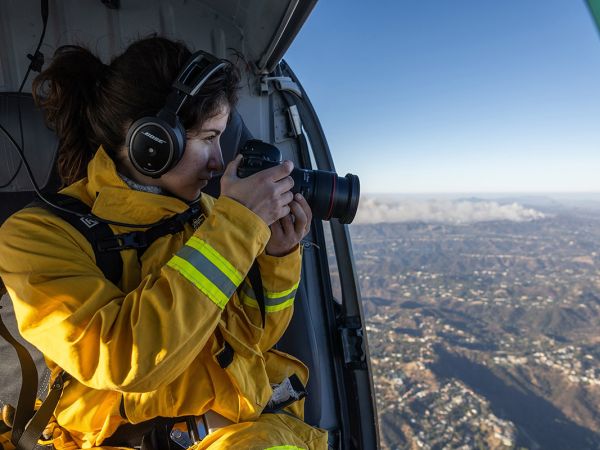
Brontë Wittpenn photographs the Los Angeles wildfires for the San Francisco Chronicle. (Courtesy of Myung Chun, Los Angeles Times)
By Bowen West, UM News Service
MISSOULA – On a spring afternoon in San Francisco, surrounded by peers, Brontë Wittpenn entered a small and uncommon circle: University of Montana journalism alumni who helped carry a project to journalism’s highest rung.
The San Francisco Chronicle’s Pulitzer Prize for explanatory reporting went to reporters Susie Neilson, Megan Fan Munce and Sara DiNatale. But Wittpenn produced the visuals and short film for “Burned,” an investigation into how wildfire survivors can be left adrift by the insurance system meant to protect them.
For the Chronicle, its first Pulitzer in 20 years felt like a new beginning.
Wittpenn didn’t arrive at college with a clear plan. Growing up in Billings, she spent a brief stint on the newspaper staff at Billings Senior High School and struggled to find her footing in the classroom.
“I wasn’t the best student,” she said. “I really struggled to find what I was good at.”
She knew she could write and had an artist’s eye, but she also heard, repeatedly, that such strengths wouldn’t pay the bills. Journalism offered a chance to use those skills. Working in restaurants while in school, she learned to talk with people from every walk of life. The ability to ask questions without flinching and to meet people in their hardest moments became her guiding principle.
At UM, Wittpenn wasn’t the student with the most technical polish.
“I wasn’t one of the strongest students,” she said. “I wasn’t like a great photographer. I didn’t really have that ‘it factor’ like some other students going through the program.”
But she had grit and an instinct for stories in places others overlooked. She traveled across Montana to cover reservations, veterans, unhoused neighbors and the communities that made the state feel singular.
The years in Missoula were complicated. Wittpenn worked late shifts in bars and restaurants, sometimes getting home near the witching hour before driving to Heart Butte on the Blackfeet Reservation the next morning to shoot a story for a UM documentary class. Personal losses stacked up, too: Her stepbrother died in a drunk-driving crash, and a friend nearly lost her life in a rock-climbing accident.
“The grind really prepared me for the actual realities of what this job entails,” she said, noting the running and gunning, the pivoting, the adapting.
By the time she graduated in 2016, Wittpenn had a degree, a portfolio and a readiness to see what the country looked like through a camera lens.
After graduation, Wittpenn took an internship at the Billings Gazette that became her first staff job. Two years later, inspired by a photojournalism workshop in Colorado, she made a risky choice: She left a staff position for a six-month internship at the Flint Journal in Michigan.
“It was the best decision I ever made,” she said.
Flint placed her in a community she had never known, working during the city’s continuing water crisis. One assignment became a turning point. She met a man waiting in line for bottled water for his elderly mother, who needed full-time care. He invited Wittpenn into their home, where she saw the daily burdens created by contaminated water: cases of bottles on the patio, the mother’s need to wash her hair with bottled water and the sores caused by harsh tap water.
“It was a really hard image because she did get emotional while showing me this,” Wittpenn said. But she also understood the purpose of the work. “I’m meant to photograph, through this really beautiful collaborative process, what people should see.”
From Flint, Wittpenn moved to the Tampa Bay Times, where she covered a Category 5 hurricane and protests. She later worked in the Middle East and Austin, Texas, before joining the San Francisco Chronicle in 2021.
Months after her arrival, the Caldor Fire erupted in California, jumping from the Sierra Mountains into the Lake Tahoe Basin and forcing evacuations of more than 50,000 people. While much coverage centered on South Lake Tahoe, Wittpenn kept hearing about Grizzly Flats, a smaller logging community that suffered devastating damage.
She searched social media for displaced residents, spent time in local businesses and built relationships with people who had lost their homes. Years later, those relationships became the foundation for “Burned.”
The Pulitzer-winning series began with a question: Why were so many communities unable to rebuild after catastrophe? The Chronicle’s reporting revealed how major insurers left homeowners under covered, underpaid and, in many cases, unable to return home.
The reporting team found a pattern stretching beyond California, from hurricanes and floods in the Southeast to fire-ravaged communities in the West. For Wittpenn, returning to Grizzly Flats carried weight. One of the project’s central sources was someone she had photographed after the Caldor Fire.
“I already know who these people are,” she remembered thinking when the story came across her desk.
What she found years later was sobering. Many residents still couldn’t afford to rebuild; others were living in trailers. Homeowners had paid premiums for years, then confronted hidden rules, opaque calculations and claims processes after disaster struck.
Six months into the investigation, the Eaton and Palisades fires erupted in Los Angeles County. The team expanded the project in real time, and Wittpenn reworked the documentary’s opening to reflect the new disaster.
The project’s success came from making an abstract subject visible. “Burned” wasn’t just about policies and payouts. It showed people caught in a system that failed them when they were most vulnerable.
When the Pulitzer was announced, Wittpenn thought first of the people whose losses animated the series.
“They lose their home,” she said. “Then they’re told they all have enough money to rebuild.”
Journalism has tested Wittpenn, but she stays because the people, stories and colleagues keep drawing her back.
“It takes a lot of courage to keep showing up in this industry,” she said. “It takes a lot of courage to make that decision to stay in this.”
She also has learned not to make the job the whole of her identity. She runs ultras, participates in her running community, spends time with her dog and leans on family and friends.
“You need to be a whole person outside of journalism,” she said. “You just have to have that balance or else you’re going to burn out.”
That perspective now informs her work with the next generation of visual journalists. For the past three years, Wittpenn has returned to UM’s School of Journalism as an instructor for the Montana Photo Workshop, an intensive, four-day program for college student photojournalists and early-career photographers. Participants report local stories in teams, receive critiques and mentorship from working visual journalists, and share their work in a public showcase.
Visual journalists, she said, are more than photographers and videographers.
“We are journalists too,” she said. “A lot of the times we’re the only ones out in the field. A lot of the times we’re the only ones finding sources and really making big issues human.”
A more detailed version of this article is online.
###
Contact: LeAnn Layton, UM associate vice president for alumni and community Relations, 406- 406-243-5258, leann.layton@umontana.edu.