Beyond the Lab: UM Grad Fuses Wildlife Biology With Community Advocacy
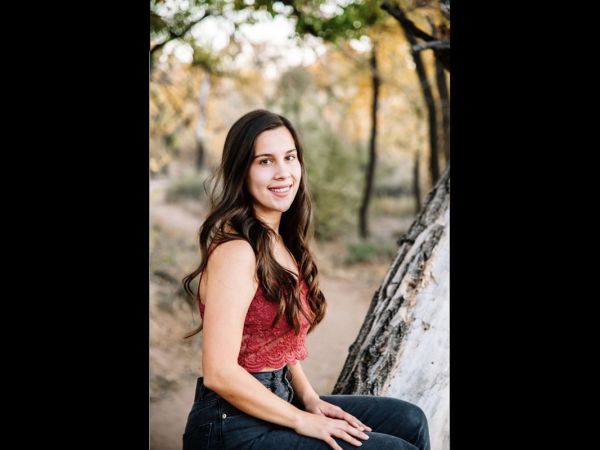
Recent UM graduate Katia Chavez transformed her career path by participating in service and volunteering opportunities alongside her academic pursuits while at the University. (Courtesy of Katia Chavez)
UM News Service
MISSOULA – When University of Montana graduate Katia Chavez first arrived on campus, she envisioned a traditional scientific path: graduating with a degree in wildlife biology and working as a field biologist for the federal government.
But throughout her time at UM, Chavez chose to look beyond the lab and the lecture hall. She dove into local volunteer work spearheading community diversity initiatives. The work transformed her career trajectory.
“I found the most meaning in service-related activities throughout college,” Chavez said. “These experiences brought opportunities to build skills like self-reflection, empathy, cultural sensitivity, professional growth and fostering strong, collaborative relationships.”
Graduating last spring, Chavez blended her passion for wildlife science with deep community advocacy to curate a resume that is uniquely her own and synthesize her love for science, service and storytelling. By the time she donned her cap and gown, Chavez had pursued a variety of experiential learning opportunities to launch a career in the nonprofit and environmental education sectors.
“I have witnessed just how impactful these small, yet deeply invested, communities are to the city and beyond,” Chavez said. “It was an honor to become a part of these communities in the short amount of time that I was here.”
Originally from Albuquerque, New Mexico, Chavez grew up learning about her family’s Hispanic roots and became fluent in Spanish. She also discovered a knack for wildlife biology after researching Mexican spotted owls in high school. But her upbringing showed her science isn’t always accessible to all demographic groups. That’s something she hopes to use her education and career to help change.
“I think learning to communicate science in Spanish is a great route for accessibility,” she said.
Recognizing the need for UM students to celebrate their culture, diversity and passion for STEM, Chavez founded UM’s chapter of the Society for the Advancement of Chicanos/Hispanics and Native Americans in Science. She formed the club after attending a national conference. The club hosts a variety of speakers who discuss how their identities influenced their STEM careers, allowing students to meet with professionals who share similar cultural experiences and an excitement for science.
Chavez furthered that work after taking a documentary class her senior year. She was inspired to independently make another documentary featuring five international students and faculty. Filmed entirely in Spanish, it highlights both the challenges they face in their STEM fields and the important research they are doing despite additional barriers.
“This film is entirely in Spanish and was intended to capture their incredible stories of resiliency,” Chavez said.
Chavez also cited her volunteer work with Soft Landing Missoula – a local nonprofit that helps refugee and immigrant families build new lives in Missoula – as one of her most meaningful experiences. She dedicated extensive time volunteering at their youth tutoring nights to provide one-on-one teaching in reading, writing, math and biology.
“I built reciprocal relationships with these youth, and I came to realize that I had just as much to learn from them as they had to learn from me,” she said.
Immersing herself in Missoula’s service-related activities altered Chavez’s career goals – and following her passions paid off immediately. She already secured a job in eastern Montana as a songbird technician, where she will spend several months identifying the same bird species that was the focus of her senior thesis.
She’ll then return home to New Mexico to work for the Institute for Applied Ecology, a nonprofit organization dedicated to habitat restoration. She said volunteering with UM’s MONTU Herbarium directly helped her land the position.
By intentionally seeking out community-focused opportunities at UM and around Missoula, Chavez used her time at the University to position herself to directly apply her degree after graduation and pursue a career that is both important and fulfilling.
“During the past four years, I have sought out volunteering opportunities in the community to develop the skills of relationship building, cross-cultural communication, working with youth and planning activities with other volunteers,” Chavez said.
“If you are interested in nonprofit work, these experiences can lead to potential jobs,” she said, "but they are also just great opportunities to make friends, learn from others and feel connected to Missoula.”
###
Contact: Dave Kuntz, UM vice president of marketing and communications, 406-243-5659, dave.kuntz@umontana.edu.