UM Doctoral Student Studies How Living Systems Respond to Stress
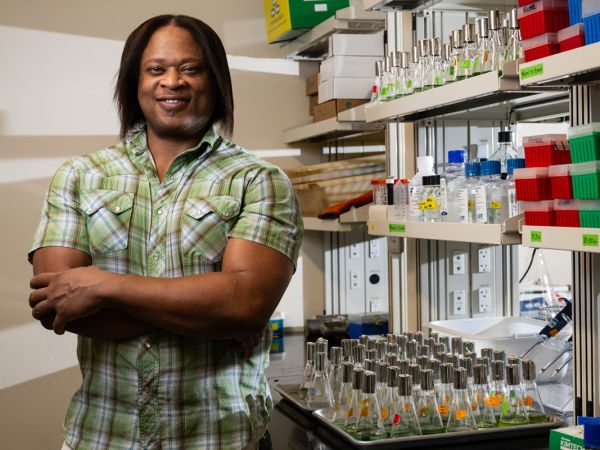
UM doctoral student Jaymes Mozingo is researching biological anthropology, genetics and ancient DNA. (UM photo by Ryan Brennecke)
UM News Service
MISSOULA – Doctoral student Jaymes Mozingo returned to the University of Montana by a unique route that carried him across the world and back.
After broad undergraduate studies in the humanities, languages and music at UM, he pursued graduate studies from 2010 to 2012 in a Master of Engineering in Technical Japanese program in Wisconsin. Afterward, he continued to study languages, traveled widely and spent years as an applications engineer and business development engineer with chemical, mechanical and electrical engineering firms based in Japan, Germany, China and the United States.
Now at UM once again, this time to pursue his doctorate, Mozingo is researching biological anthropology, genetics and ancient DNA. The work explores how living systems such as cells and bacteria change in response to stress over time.
“This research opens up a new way to think about evolution as a dynamic process involving stress, repair, survival and adaptation,” Mozingo said.
A cell is a system made of components like membranes and organelles – structures that interact through molecular pathways to keep the cell alive. Part of staying alive means repairing damage to DNA. Some of that damage comes from outside the cell, such as radiation or exposure to certain chemicals. Some of it comes from the cell itself.
Every time a cell divides, it must copy its DNA, and it can make mistakes. Cells detect and fix these errors, but repair is not always perfect or neutral. Alongside natural selection, this can drive genetic change.
His work already resulted in two peer-reviewed publications. In “Epigenetics Communications,” Mozingo proposed a lineage-specific framework for understanding how long-term environmental stress, DNA repair and biological constraints may contribute to genomic change. In “Infection, Genetics and Evolution,” he reconsidered the early ecology of Yersinia pestis, the single-celled bacterium responsible for plague.
Because scientists can now recover Y. pestis DNA from people who died during ancient outbreaks, they can compare ancient and modern strains and investigate how the pathogen, its transmission pathways and its relationships with human populations changed over time. Mozingo’s research uses this evidence to ask broader questions about disease evolution, environmental pressures and biological adaptation.
Mozingo also is interested in how genetic evidence can be interpreted responsibly when it connects to ancestry, identity and descendant communities. For Mozingo, the importance of this work is both scientific and human. Ancient DNA comes from someone’s ancestors, and acquiring ancient DNA means destroying a part of an ancestral body.
“DNA is not just data,” Mozingo said. “It is connected to bodies, histories, families and communities.”
Alongside his doctoral work in anthropology, he is completing a Master of Business Administration, which has helped him think about how research can move beyond academia through public communication, scientific partnerships, biotechnology and research-based entrepreneurship.
Mozingo was inducted into the Honor Society of Phi Kappa Phi in fall 2025, recognizing his academic achievements in the MBA program.
His long-term goal is to help build research models that are rigorous, ethical and accessible, while asking new questions about how genomes change, how organisms persist and how the past continues to shape the present.
###
Contact: Jaymes Mozingo, doctoral student, University of Montana Department of Anthropology, jaymes.mozingo@umontana.edu, Naomi DeMarinis, associate director of Research Development, Communications, 406-243-5303, naomi.demarinis@umontana.edu.