UM Professor’s Global Study Indicates Widespread Permafrost Degradation

Anna Klene, a University of Montana geography professor, stands surrounded by aufeis while collecting active layer thickness data in Alaska. Aufeis, a German word meaning “ice on top,” is a continuous sheet of layered ice that forms along streams and rivers in arctic, subarctic and some alpine environments. It can cover the entire channel or form large sheets that extend across floodplains. (Photos courtesy of Anna Klene)
MISSOULA – Decades of research data compiled by University of Montana Geography Professor Anna Klene recently contributed to a first-of-its-kind global study pointing to evidence that permafrost is thawing across much of the planet.
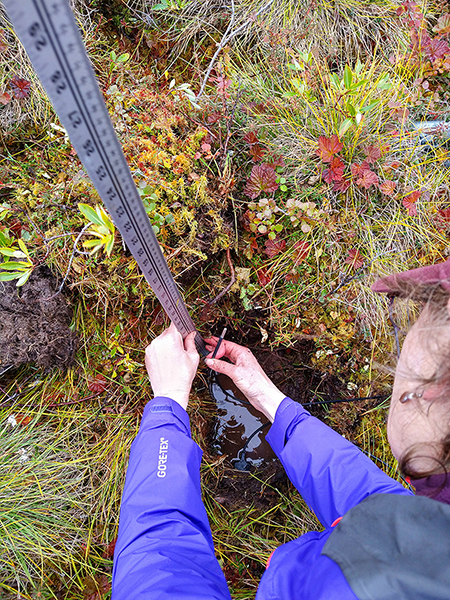
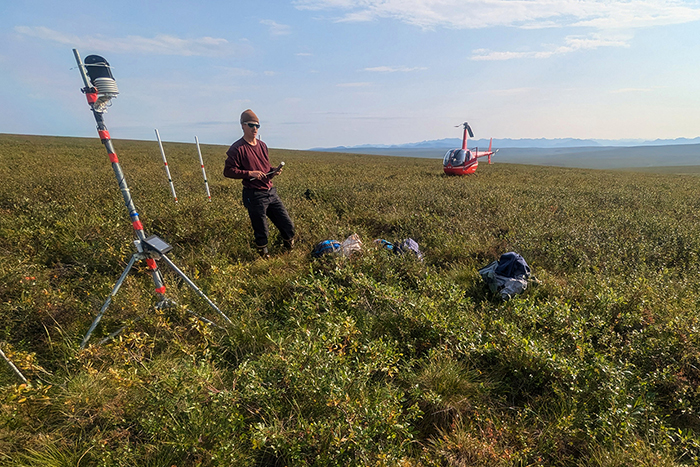
Klene has spent 30 years traversing the vast landscape beyond Alaska’s Brooks Range on the North Slope, probing the frozen earth with metal rods to collect data on the terra firma below.
She visits dozens of locations each season, driving a metal rod into the ground until it hits the permafrost below. She then records the depth of the thawed ground above the frozen layer of dirt and ice – a measurement scientists call active layer thickness.
“It’s not super sophisticated,” she said from her home in Missoula. “You push down on the probe, put your finger on the rod and you can measure how many centimeters into the ground it went. We also measure air and soil temperatures, vegetation, surface elevations and soil moisture at some sites.”
Permafrost is ground made up of soil, rock and sediment bound together by ice that remains frozen for at least two consecutive years. Active layer thickness refers to the depth of the ground layer directly above permafrost that is subject to annual freezing and thawing. If the active layer becomes thicker over time, it signals the permafrost deeper in the ground is thawing.
The study, of which Klene is a co-author, was published in Nature Communications Earth & Environment and examines over 20 years of active layer data from more than 156 sites in the Arctic, Antarctic and high-mountain regions. Compiled by the Circumpolar Active Layer Monitoring program, it is the first global assessment of long-term active-layer monitoring data.
The data show that active layer thickness has increased significantly at 55% of Arctic sites, 38% of Antarctic sites and more than 90% of high-elevation sites in Europe, Asia and South America. Modeling based on the data projects a substantial reduction in Earth’s permafrost by the end of the 21st century.
Permafrost is estimated to underlie nearly 20% of the exposed land surface in the Northern Hemisphere and nearly all Antarctic ice-free areas. According to the study, mountain regions experienced the fastest changes, with several high-elevation sites seeing the active layer double in thickness, making mountainous permafrost regions among the most rapidly changing environments.
Klene said thawing permafrost threatens infrastructure built on frozen ground, including roads, railways, airports, pipelines, buildings and utility systems, causing economic and safety challenges for impacted communities. In addition, scientists estimate that the top three meters of permafrost contain around 70% of the organic carbon stored in permafrost soils. As the ground thaws, that carbon is released into the atmosphere as carbon dioxide and methane. Both are greenhouse gases known to accelerate climate change.
“One of Earth's most important indicators of climate change is permafrost as it directly reacts to rising temperatures,” said Dmitry Streletskiy, geography professor at George Washington University and lead author of the study. “The significance of this study lies in the fact that we’re not just looking at isolated hotspots anymore. The collaborative efforts of the involved sites show a pattern that spans continents and climate zones, telling us that global permafrost degradation is already well underway.”
While more monitoring is needed worldwide, expanding long-term observations in Antarctica and mountain regions will improve scientists’ ability to understand regional drivers of permafrost change.
“It’s hard to see that the first frost and the first snow are shifting by a day or two a decade,” Klene said. “It’s hard to see that kind of change and really appreciate that it will have a big impact over time. But with these long-term monitoring sites, we can see that this gradual change is happening, and it’s going to affect the whole system.”
###
Contact: Dave Kuntz, UM director of strategic communications, 406-243-5659, dave.kuntz@umontana.edu; Jessica Abell, marketing and communications director, W.A. Franke College of Forestry and Conservation, 406-243-5554, jessica.abell@mso.umt.edu.