UM Researchers Study Hidden Lives of Small Cats
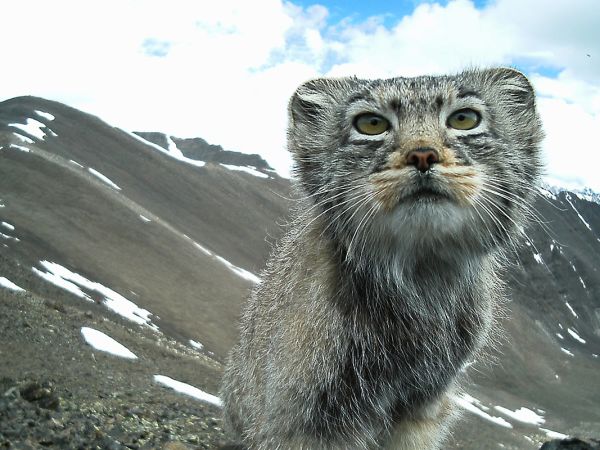
A manul – also called a Pallas’s cat – roams a mountain ridge used by snow leopards in Altai Biosphere Reserve in south-central Russia. (Credit: S. Spitsyn)
By Libby Riddle, UM News Service
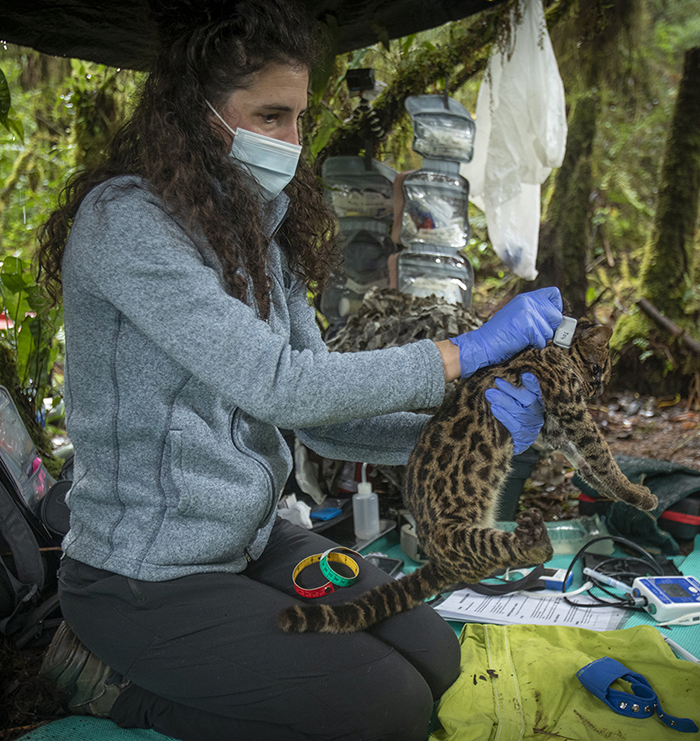
MISSOULA – In the cloudy mountain forests of Costa Rica’s Cordillera de Talamanca, University of Montana researcher Amaia Autor tracked one of the world’s smallest cats. For three months, she saw neither head nor tails of it.
On the verge of giving up, she got a notification that something had triggered one of her traps. She raced through the trees from her field station to the trap’s location and there it was: a tiny black cat with white feet. She named him “calcetines,” the Spanish word for “socks.” The GPS collar was too long for calcetines – Autor had to guess what size to order since so little is known about the species – so she poked a new hole in it like a belt. With the collar fitted around his neck, she set calcetines free, hoping she would hear from him again through her GPS tracker.
She is likely the first researcher to ever capture and collar this species.
Big cats like lions and tigers are icons of wildlife conservation, but their smaller relatives get much less attention. Many small wild cats are poorly understood and difficult to study, leaving scientists unsure of how to protect them. At UM, researchers are investigating two of these overlooked felines by asking fundamental questions about where they live, how they survive and what threats they face.
Autor grew up in a small village in the northeast of Spain. Her dad was well-known in the community for loving wildlife. She remembers people bringing injured animals to their house, where she and her dad would keep them safe until a local rescue center could come collect the animal. Throughout her undergraduate and master’s studies in Spain, she looked for opportunities to learn more about wildlife conservation. She worked with lizards, birds and monkeys, but she fell in love with wild cats in South Africa. She set her sights on a career in cat conservation, which eventually led her to UM.
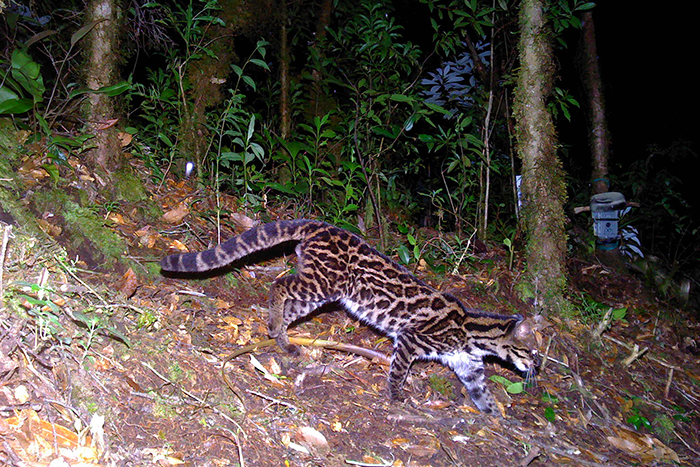
Now a Ph.D. student in UM’s Wildlife Biology Program, Autor studies the oncilla, one of the smallest wild cat species in the world. Oncillas, also known as tigrillos in Spanish, live in alpine forests in Central and South America. Very little is known about this elusive cat. Scientists are unsure of the oncilla’s range, its population size and its relation to other cat species. Earlier this fall, scientists described a new cat species, the tilcayo, which was previously classified as the same species as the oncilla.
Autor is particularly interested in the oncilla’s movement and habitat use. Using GPS collars and wildlife cameras, she’s learning where oncillas like to hang out and what barriers are preventing them from moving freely. She found that the Pan-American Highway, one of the only roads that spans all of Costa Rica, seems to fragment the habitat they can use. According to Autor’s GPS data, oncillas often approach the road but cross it only occasionally.
“One thing that surprised me a lot was that their territories were a lot bigger than I expected,” Autor said. Oncillas are roughly the size of a house cat, but Autor found their home ranges can be nearly eight square miles. These findings allow conservationists to identify where habitat restoration and wildlife crossings could help oncillas move across the landscape.
On the other side of the world, another UM researcher is studying a small cat adapted to some of the harshest landscapes across Asia: the manul, or Pallas’s cat. With their low-set ears and broad, flattened face, manuls have a perpetually grumpy expression. The manul lives in Asia’s high grasslands from the Caspian Sea to Siberia, but little is known about specific populations.
Ehsan Moqanaki, a postdoctoral researcher also in the Wildlife Biology program, is part of a team that’s trying to better understand regional populations of manuls and update their conservation status.
“They are vulnerable to human modification of the landscape,” Moqanaki said. Manuls live in grassland habitats known as the steppe, where they hunt pikas and rodents. But as climate change has led to poor grazing conditions in the lowlands, herders with their livestock and dogs are moving into higher-elevation steppe regions, where they compete for space with manuls.
Moqanaki’s team identified free-ranging dogs as one of the greatest threats to manuls. Changing snowpack conditions and pest control measures also affect where manuls can live and hunt.
“No one has really quantified the impacts of these threats,” Moqanaki said. “We know they exist, but we don’t really know what their impact is on these populations.”
Understanding the manul at smaller scales is important because population estimates determine the species’ conservation status and the protections it receives, which can vary from country to country. Thanks to large populations in Mongolia and China, the manul as a species is not considered threatened. But little is known about the small, isolated populations in other parts of Asia which may be struggling.
Using a large network of wildlife cameras typically used for monitoring big cats like snow leopards, Moqanaki’s team has identified places where scientists were unsure if manuls even existed. Combined with genetic data from scat and interviews with local communities, these data allowed Moqanaki’s team to make recommendations for places where the manul could use more protections. Moqanaki also published a book of guidelines to help scientists monitor manuls in the future.
Autor and Moqanaki study different species on different continents at completely different scales. Autor is investigating the movements of individual animals, while Moqanaki’s work spans the distribution of an entire species. But both researchers are working toward the same goal: giving scientists the knowledge they need to protect the world's smallest and least-understood wild cats.
###
Contact: Jess Abell, director of marketing and communications, W.A. Franke College of Forestry and Conservation, 406-243-5554, jessica.abell@mso.umt.edu.