FAQs
-
It is a graduate degree housed in UM's Department of Mathematical Sciences that combines rigorous grounding in data science foundations — statistics, machine learning, and mathematical modeling — with practical application through industry partnerships, faculty-guided consulting projects, and real-world team problem-solving. The program sits within the same department that produced the first data science textbook.
-
Candidates should have coursework equivalent to an undergraduate mathematics minor and at least one course in computer programming. Students must also meet the general requirements of the UM Graduate School. Each admitted student is assigned a faculty advisor who must approve their individual course of study.
-
Data scientists work across industries including technology, finance, healthcare, environmental science, and public health — in roles including data scientist, machine learning engineer, research analyst, statistician, and quantitative analyst. The national median annual wage for data scientists is $103,930 (BLS), with the field projected to grow 35% through 2031 — seven times faster than the average for all occupations.
-
The undergraduate programs (Statistics and Data Science B.A. and Computer Science - Data Science B.S.) provide foundational training for industry entry. The M.S. develops deeper mathematical and methodological expertise, research capability, and the advanced applied skills that position graduates for senior data science roles, doctoral study, or leadership in quantitative research. The M.S. is offered through Mathematical Sciences; the undergraduate CS Data Science concentration is offered through Computer Science.
-
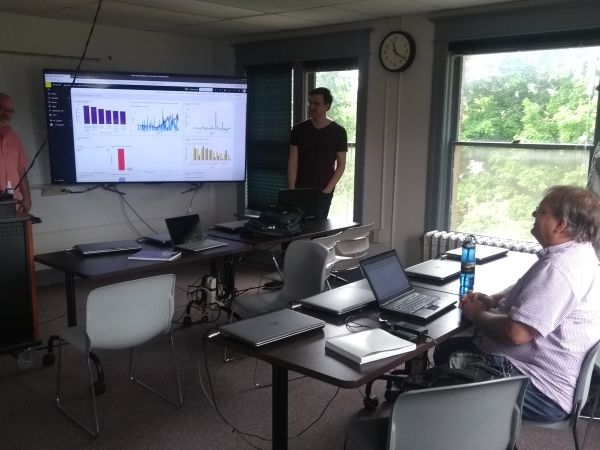
The program features industry partnerships across the U.S. that provide team-based consulting projects, internship access, and career opportunities — embedding students in real-world data problems before they graduate. These connections are a deliberate part of the program design, not an add-on.
-
Both programs are offered through UM's Department of Mathematical Sciences and share a common curricular foundation in data science methods. The Big Data Analytics Certificate is an undergraduate-level credential available alongside any UM major. The M.S. is a full graduate degree. Students interested in graduate-level study should apply to the M.S.; the certificate is best suited for undergraduates seeking to add data science credentials to a primary major in another field.
Jump To
1
Data Scientist has been named “Best Job in America”- Glassdoor
# 1
state for startup activity - The Kauffman Index
1st
Our program was one of the first in the nation
Careers
- Data Scientist
- Data Analyst
- Financial Analyst
- Machine Learning Engineer
- Applications Architect
Virtual Internship Projects
Industry partnerships across the US provide meaningful team projects, as well as internship and career opportunities.
Professor Brian Steele
The founder of the program in Math wrote the first data science textbook, which is used in our courses. It will introduce you to the blend of math and statistics used to study large data sets and the more nitty gritty techniques used in "data cleaning”.