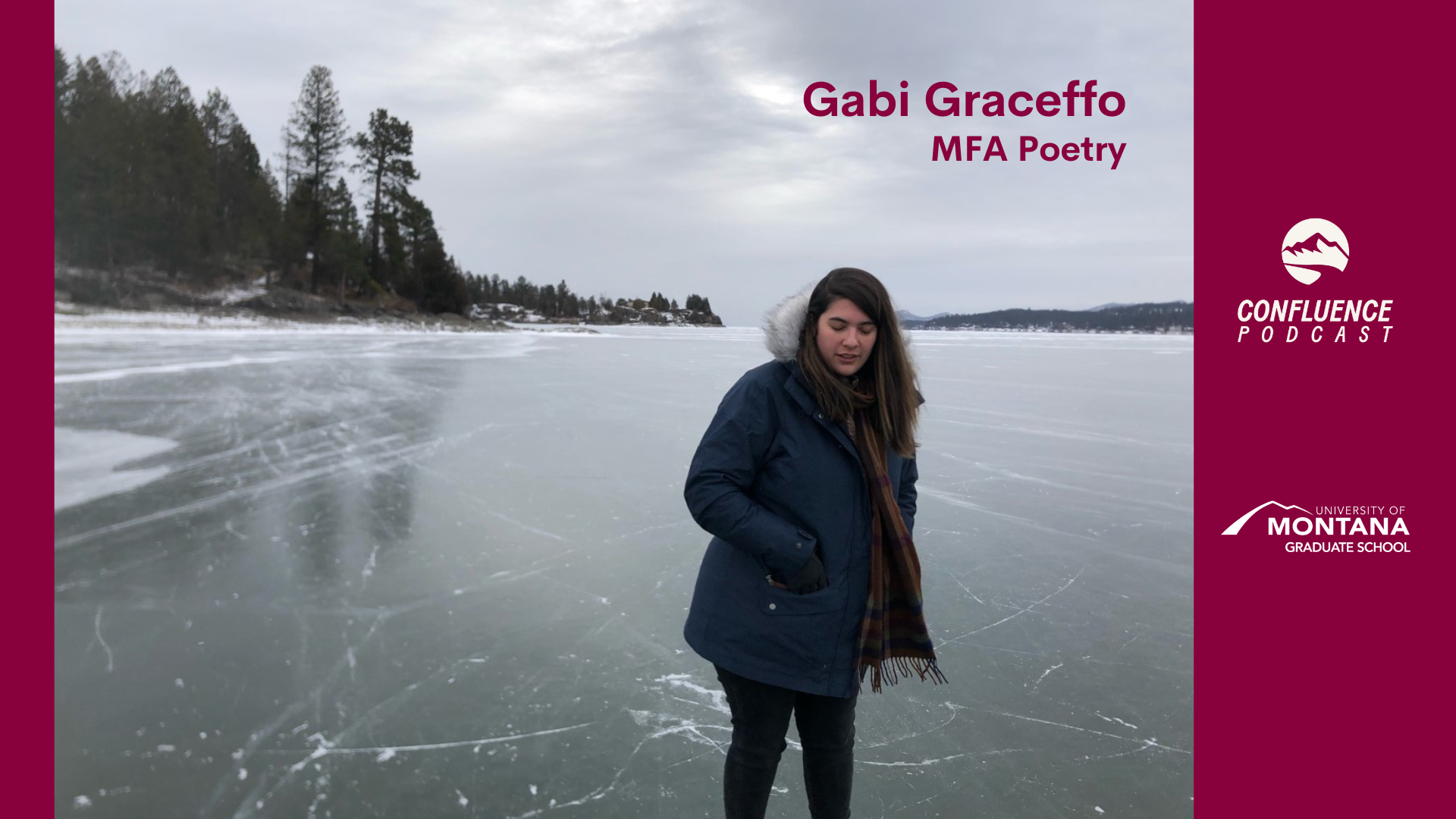
In this episode, Confluence talks with Gabi Graceffo, an MFA student studying poetry and simultaneously finishing an MA in English literature. Her fascinating background includes both work in photography and art history. Graceffo's art blends media including original photography, narrative writing, and poems that respond to images and sites, especially hospitals that she researches.
Story Transcript
[00:00:00] Ashby Kinch: This is Confluence where great ideas flow together.
This is Confluence where great ideas flow together. The podcast of The Graduate School of the University of Montana, I'm Ashby Kinch, Dean of the Graduate School. On Confluence, we travel down the tributaries of wisdom and beauty that enrich the soil of knowledge on our beautiful mountain campus.
[00:00:34] Chris Dombroski: She's, she's a fearless writer. I think that's the one word I would use to categorize her, and she's also extremely generous and selfless, uh, as a person and a member of the community. I just think her work is, is undaunted and she's just the kind of person that is capable of saying in the words of Czeslaw Milosz, “what's worse, yet true.”
[00:01:00] AK: You just heard the voice of Chris Dombroski talking about his student, Gabi Graceffo. Gabi is completing dual master's degrees here at UM, an MFA in Poetry and an MA in Literature. On Confluence, we like to highlight graduate student accomplishments. In this episode, we celebrate Gabi as winner of this year's Best in Conference Award at Grad Con for Oral Presentation and Visual and Performing Arts open to all graduate students.
GradCon is hosted by UM’s Graduate and Professional Student Association, providing an opportunity for students to present their research and creative activity and compete for awards in five categories. Gabi won for “Under The Skin: Queer Trauma and the Medical Sphere.” Research that began when she was granted a Ridge Scholarship by the Institute of Health and Humanities.
She's an MFA student studying poetry and simultaneously finishing a master's in English literature. But her background and interests include both work in photography and art history, and her work blends media including original photography, narrative writing, and poems that respond to images and sites, especially hospitals that she researches.
Listeners will get a treat at the end of the episode as they hear Gabi read one of her poems from her project.
Welcome to Confluence where the river is always with us!
AK: Welcome to Confluence, Gabi!
Gabi Graceffo: Thank you for having me.
AK: Thanks for coming by. It's great on Confluence to sort of celebrate winners and you won this Grad Con award, which is why you're here. But you and I know each other and we've interacted a lot of different ways, and so we're gonna kind of talk broadly about your graduate career, why you came here and I'm especially interested in listeners hearing your story about the Ridge Scholarship and how that connected to the win, uh, in that award, the, the presentation. So talk a little bit about that. Why were you inspired to apply for the Ridge and, and, you know, what was your project grounded in?
[00:03:04] Gabi: Sure. So, just as a little bit of family background, my father is a cardiologist and so he had some interesting ideas whenever I decided to become a...
But also was still very supportive of me. Um, I've always had kind of the medical sphere close to me because of my father, and with that comes a particular language, part of growing up. Um, we would always get into conversations, me and my dad, where he, I would have to limit him on giving his lectures and espousing different ideas for medical jargon and talking doctor, as I would say,
AK: Talking doctor! That is so good.
Gabi: And I like had started coining that term at like five years old because I did not understand how, if I like scuffed my knee, he wanted to explain every part of that and so I would understand it. He was very much about teaching me, which was great, but also not great for a five-year-old.
But around I would say like 10 years old, I started really becoming interested in language. And that's when I started like reading voraciously and then I also just started understanding how having grown up in the South, my language is different from other people, more than just accents, but how I speak, the kinds of subjects that I use and how I like, diplomatically will move through to sensitive topics. And this kind of background was already priming me for being interested in the medical sphere and the language and doctor talk that exists there, and then how that kind of combines with discussing trauma. And so obviously within the past few years since being an undergrad and moving into grad.
I'm very, very engaged with this idea of the language of trauma and how sometimes doctors speak or doctor talk, sometimes disregards that where I know my father kind of explains that sometimes you speak in this way so that you can, as the doctor discuss something with a nurse in the room without the patient being aware of the weight of what's happening.
AK: Yeah. Kind of talking around the patient.
Gabi: Exactly and all of that kind of skirting and going around the circumference of topics has been very interesting to me. Whenever I came here, um, I came here unfunded for my MFA program and because of that I was very engaged with any scholarship opportunities that I could find, and so I ended up figuring out that there's this amazing thing called the Ridge Scholarship, where they offer you a thousand dollars and you just have to somehow create a creative or research project, or both as I did, um, that has an intersection of health and the humanities. And so, with my own kind of personal background and history with this, I decided I wanted to talk specifically about language and how the language we use to discuss trauma. Abut the language of doctors and medical spheres, particularly within the queer female gaze that I personally have.
So then I ended up kind of making this giant plan to go out to the middle of nowhere, eight hours from here in Glasgow, Montana, where there's an abandoned Air Force base. Um, I got in contact with the owner of the hospital and basically the base is kind of divided up into different owners. So, Boeing owns the, uh, runways.
If you go anywhere near them, they will arrest you on site pretty much. Um, and then if you go to the houses, it's fine. It's owned by like the HOA of Glasgow and then there's other smaller. That are owned individually, and so the hospital is one of them. So I got in contact with the owner and she essentially did not want me to go alone as an unaccompanied young woman.
And then I ended up connecting with a photographer that lives in Glasgow, and he became my chaperone essentially, cuz he had been through, uh, the hospital before. So he actually helped me connect with the owner and then was more than willing to help me do it, which was very kind of him.
AK: So had he photographed it before?
Gabi: Yeah, he had photographed it for, I think it was the Great Falls Tribune.
[00:06:58] AK: I see. But you had kind of a different thing, you had more art in mind?
[00:06:59] Gabi: Very much so. So, he was doing a lot of digital work and I much prefer to work analog with film photography. Um, that's just kind of my own personal preference, but also particularly looking at abandoned spaces. I think it's important to have some of that physicality that exists within like the dirt and grime and moss and mold that was in this hospital. I found that it was also important to have a material to capture those images that also has intense, uh, physicality and materiality. I've always liked film because I can very much control it in a different way. Like I am there in the dark room using my little wiggly things to make sure I have any like burning or dodging that I need to do. And it's made me feel much more connected to the image rather than just taking a digital picture where essentially the camera is doing most of the work for you.
In no way am I saying that digital photographers are not like equally valid. They are. It's just personally for me, I really, really appreciate the physical aspect and I think for something that was so physically charged, whenever I moved through this hospital as I was exploring and photographing it, I needed to have the process when I got back home to also have that intense physicality.
[00:08:17] AK: Yeah. And the embodiment part of that is really important to your work in general. That, that you're, again, from your identity position expressing in the art practice, your physicality, your bodied experience.
[00:08:27] Gabi: Exactly. And so the photographs don't have any humans, and I find myself, when I photograph things much more com comfortable in basically people-less spaces. Then, I mean, some of it is just, you don't have to worry about some child with an ice cream cone running through. The other part of it is I just tend to feel much more comfortable and I feel like I'm not being seen taking the image in that moment, and I feel much more able to just simply exist within myself, within this space, within my body.
And that also kind of translates to what I do back home once I got home from. Where I'm working on creating a series of poems and then also a narrative nonfiction essay, um, where I'm really trying to think about my body and how it felt in that space, and then also how that has kind of different like light bulb moments to other previous things that I've experienced, or sometimes some traumas that I have like held within my body that it's a house for.
[00:09:31] AK: Yeah and so, so the project, uh, “Under the Skin: Queer Trauma and the Medical Sphere,” I had the lucky opportunity to see you present it at Grad Con. Um, what was that like for you presenting that work? I mean, it's very vulnerable work. It's very intense work, uh, to, not just to an audience, but like an in-person audience. You know, we've been in COVID and most that has been away. What was that experience like for you to share that work with a community?
[00:09:56] Gabi: Sure. So I, up until that day, had absolutely hated presentations. Like I was very much always the over-prepared. Presentation person, but when I got up there, if it was supposed to be 15 minutes, I probably finished it in seven. I am a fast talker and it gets very bad when I'm nervous, and basically I just kind of get very in my head about things and. When I walked up onto the stage for Grad Con, I don't know exactly what happened, but something kind of switched and I don't know if it was that I hadn't really presented anything because of Covid and I'd had time to really hone my like different speech skills, but also my confidence in my own work.
But I also had seen, just like the previous week, my mentor, Keetje Kuipers, who was the faculty affiliate for the Ridge Project. For me, I'd seen her give a reading and also give a craft talk and just watching her and being in awe of how she would seamlessly move through giving recitations of poems. Then going over to talking about like the meaning behind them and also the craft elements of not just how they came to be, but why they're important to be exactly as they are somehow kind of.
Made everything more real and I was somehow able to be like, that is what I wanna do. That is how I want to access talking with an audience. It's how I want to be able to be comfortable on stage because it's not just that I am doing this for an assignment. It's that I'm doing this because I really love what I've done with this project and then I wanna share it with people.
A big part of why I was okay with doing Grad Con, because that was not planned originally, within the Ridge program you typically have a Ridge Symposium where you kind of just present altogether. I was also, because I was the only one doing a creative project within the arts, I was not able to be on the Ridge Panel.
And so that also made me extremely nervous cuz I, like the people that I don't know, but at least are doing the same things as me in terms of the project for the Ridge Scholarship. I just kind of knew I was alone, but. The work I'm doing is important and I wanna share it. And so I got up the stage and I had practiced a couple times.
I took a deep breath because I typically don't take deep breaths when presenting and just kind of let it flow. And then I read my poems and I stumbled maybe twice, but was able to. Perfectly move on, which was a very big deal for me.
[00:12:32] AK: Nobody noticed. Trust me. It was a mesmerizing performance, and obviously, you know, you had pre-recorded the video, and that's on the basis of which you won the award. Congratulations that great accomplishment, Listeners will have already noticed, just the way you're talking about how broad the range of your interests are, right? That you are a poet. You came here to write poetry, but you have this really strong and developed artistic, uh, background. You're also doing coursework for an MA in, in English literature as well. How do you see that sort of playing out and, and how do you bring these different disparate fields together and the way you think about the work you're doing?
[00:13:08] Gabi: Sure. So I think for me, I, my mother is a professor over at Southern Methodist University, and having her as my other parent, I kind of saw how important it was, particularly in her field of sociology, to have connection with her students and have connection with communication in terms of how do you convey these things that are so important to our everyday lives that we kind of either skip over or just like take for granted that it's very, I.
That we talk about them and that we convey them in a way that isn't distancing. And so for me, While I absolutely love going to JStor and Muse and all of those to look up these wonderful articles, I find that a lot of them tend to be pretty insular where they're going to be quoting other people, but the general population won't ever really like access them unless they're in a class and forced to read it or they have a particular interest, which is great, but that's pretty rare.
So for me, I think. My dual master's degree with the MFA in Poetry and the MA in Literature is really important that it's not just that I'm getting two masters, it's that I'm trying to combine them as much as I can because I do really think that having a creative kind of vehicle allows for more people to understand what I'm studying and to also connect with it and have it be able to be taken in.
I think if you use all this academic jargon, as in also Doctor Talk, if you use that too much, you really can distance and shut down connection with people. And for me, I think connection with people is what I'm always striving for, and I've just found different ways that I can. Sometimes that is taking a class with Dr. Katie Kane, where we're talking about auto theory, which is a fusion of the personal and the theoretical within literature. That also particularly applies to feminist scholarship.
[00:15:05] AK: And listeners who haven't listened to episode 66 with Dr. Katie Kane should go back and listen to it. She talks quite a bit about that class in particular, that auto theory. Just had to throw that little plug in there.
[00:15:16] Gabi: Sure. So, yeah, I think for me, Sometimes it's within a class structure. Sometimes it's when I'm within my masters in literature, I'm specifically looking at Intermedial. So I'm looking at how we can read novels that are pros in contemporary function, typically, like within the last 10 to 20 years, how we can read them as completely other media.
So for instance, you can read, at least I argued, you can. Jennifer Egan’s, A Visit from the Goon Squad as a concept album, and not just that it has musical qualities like in terms of lyrical nature of the pros, but specifically it's divided into A and B sections. It works through memory in a very different way and the way that when you listen to a concept album, each song is distinct, but each is trying to convey a similar theme that builds on itself and starts almost collapsing. Because it's not the standard where everything is like perfect. It's often pretty rough. And I think that particularly in Egan's work, you can look at memory in such a vastly different way because it's being told backward.
And then we start to understand how trauma can exist within the form is being conveyed. So not just that this is talking about trauma, but the actual form is kind of a somewhat traumatic reading. It's not, uh, it's uncomfortable. It's not a typical way to move through literature in the way that we've all been practiced.
And so, sometimes it's like that, where I'm looking at specifically a book where I'm talking about it for a seminar paper. Sometimes it's just that I start to gab a lot and I just like to talk about all of these different things and trauma and intermediality, and how creativity and creative production can fuse so intimately because it's based on language and how that immediately does convey trauma.
And so I think it happens in a lot of different ways for me.
[00:17:08] AK:. Uh, Egan's new novel?
[00:17:10] Gabi: I have not yet. Okay. But I'm planning on it.
[00:17:11] AK: You're in for a treat there. I mean, she takes that, that trope of the intermedial and kind of jumps up a level so we won't get into it cuz it would be a digression. But so now that you're, you're, you're in year two of this project, next year, you'll be kind of fusing the two, kind of finishing out the MFA while pushing toward the ma uh, literature. What, what comes next for you?
[00:17:36] Gabi: So, I'm not sure. So I just received an internship with Copper Canyon Press, so I'll be working that internship this summer.
But then I also really love just having time to continue to work and have more grants and do all these. Interesting projects that, um, has been very, very gracious about in terms of funding me. So I think my ideal would be trying to find a PhD where I can work on my creative and scholarly research that would be fusing again, either within auto theory or maybe in something completely new that I kind of start to stumble upon in the next couple months I hope
And I would hope that I would just have some really dedicated time to try to explore that while I'm also looking at publishing, because again, Whatever I do is wonderful and I can share it with my friends and I can just talk about it ad nauseum to anyone who will listen. But it's a very different thing to have it specifically communicated.
Like at GradCon where I had two young women come up to me after the presentation and one of them was crying and she was saying how moving the entire project was with the presentation and how she was so happy that someone had talked about these things that I use language that isn't typically okay, for poetry, at least in a traditional sense.
And I'm also using forms that aren't common for it, and I'm trying to be as open and communicative as I can within my writing and then to share it and read it aloud. And so she was just so thankful for that. And I think that is one of the core reasons I'm so interested in publishing because I think right now we're in a huge shift within the publishing world.
Um, a lot of diversity and equity plans are in place, which is wonderful, but I think at the same time what needs to be happening too is to address how specifically forms are also kind of contributing to those abuses and how we can try to move beyond them, or at least really, really articulate what's going on.
And also promote stories from minority communities like the queer community that I'm a part of, or just in any way trying to open up not only existing lines of communication, but to create new ones as well. And I think that's why I'm so invested in Intermedia, cuz I can try to uncover how there's new things going on, there's new methods of communicating and connecting and talking about these things that 20 years ago, 30 years ago, even then we couldn't really openly discuss. And so that's my goal. It's kind of a little wishy-washy cuz that's just so broad.
[00:20:08] AK: But I think it sounds idealistic, which is what I like. And and I, and uh, you know, from the graduate school perspective, it just of course makes me happy to hear people talking about interdisciplinarity and thinking about tapping into talent ranges of their own, but also the communities they live in. Right? That is exchanging across those talent ranges. You, you and I had the opportunity to interact recently, kind of self-forming, independent study, sprung up this semester, and that's a good example of what, what we wanna see in a graduate school.
Can you talk a little bit about that? I mean, so we, we interacted around, I've, I've a particular book because I, my research is in death and the kind of history of death studies. But this whole semester you've been reading with a group of other graduate students on topics in sex and death. So, 20th century critical theory and ideas about sex and death and how they've sort of contributed, uh, especially to the problematization of identity in the, in the 20th century, let's say. Uh, how did that evolve and how, what was that process like?
[00:21:03] Gabi: Sure. So there were several students. Um, that were my classmates within Dr. Kane's auto theory class and that we all loved that class immensely and found that we had similar ideas. And we're also with, we're all MFA students as well, so we were kind of, some of them felt a little bit fish outta water within the LIT program just because it is a big shift from a creative workshop.
And we ended up just finding that we got along really well and we all. Similar interest in sex, death, and religion. And so my classmate, Shay Watson ended up creating this proposal for an independent study on that topic with Dr. Kane. And we ended up just kind of running with it. And so we had a large book list that had basically started with Bataille, and then we went down through the end to talk about a lot of different theorists and then also to read some very difficult to read, um, books including like Necrophiliac, which we pretty much just trashed in terms of our discussion. But also, uh, Shy was not there to try to have a little bit more salvation for that book and it's reasonings and reason for being and being read. But yeah, it was kind of just, we would go in on Wednesdays and we would talk about, uh, whatever book was assigned for that week.
And then halfway through the semester we had a creative response due since we are MFA students. Um, we worked with basically trying to look at a creative vision that was inspired by the text we were reading. And then also at the end of the semester, we had a critical response that was due. And so for my creative response, I worked with creative nonfiction, looking at specifically my dealings with anorexia and how that very much is infused with Catholicism and kind of, there's something called anorexia mirabilis, which is when female saints would starve themselves, um, to be closer to God, and that's a whole rabbit hole. But I then also kind of built on that with my critical response where I looked at Bataille and Annie Ernaux [RECENT NOBEL PRIZE WINNER], to understand how different books can be read almost as like cinematic or movie or based on images and how that very much changes how we look at it because the language becomes different kinds of signifiers for basically, the eye, the sun, testicles and, this is very interesting, eggs. So it's a long story in terms of that critical response.
[00:23:33] AK: I think the, the bigger story I'm really trying to elevate is how important that kind of intellectual community is to grad school and how, uh, so much of our best work comes when we do intellectual collaborations that are kind of unpredictable. Like that, they come together in a, in a, in a ad hoc way, and students to have a drive and a passion to go explore a topic. Yeah. And, you know, my, whatever it was, two and a half hours with that group. Mm-hmm. was really delightful discussion. You know, you could feel the energy of a group that had spent a, a whole semester kind of thinking together. And that's something we really like to elevate in the grad school, that there are these spaces that lie outside the classroom that are just as important to graduate education, in the long run, as the specific curriculum.
[00:24:15] Gabi: Yeah. I think that for us, like it's absolutely not a slam on the lit classes cuz they're lovely and we absolutely engage with them and they're great. But I think one of the best parts of our program here at um, um, is that we are really encouraged to try to not just think about something for an assignment, but to try to follow that interest and to take it as far as it will go.
And also to take it in multiple ways cuz. Having the creative and the critical response was perfect for us because we kind of were primed with our more creative impulse at the beginning to think about how we can write. But then at the end, we were really forced to think about the theory and to really nail down ma, not only what it is, within one book that we're looking at, but also how it is that we as writers are being extremely shaped by these theories and also by language.
And so talking about it as a group, I'd know that when we first talked about Bataille’s Erotocism, we kind of all came to class, uh, in Shy’s office and all were like, I don't know what the hell I just read. We're gonna try to figure it out. And we ended up like just scouring the internet looking for like advice so that we could try to understand this wacky guy.
And then in the course of the two to two and a half hours that we talked, by the end of it, we came out, we were like, okay, he's still weird, but we get it. We got a handle on it. We got it. Yeah. So I think having that community has been extremely important to me, um, this past semester. And I definitely wanna continue it in the.
[00:25:49] AK: Well, thank you so much for joining us on Confluence, Gabi.
[00:25:52] Gabi: Thank you for having me.
[text of poem read by the author]
“La Periscopy”
or a half birth at Pleasure Pier two girls plunge into the sea, the Gulf swallowing the pink skin, the little pills of their bodies as I sand my calves. Watching the slash of polka dot tween bikinis disappear in graywater. A little high on propofol. I explore the arcade of myself, the paddles and pinball lights and openings.
Three key holes, a surgeon cut to reach the cyst in my left ovary. A mouth that trapped sound like a billiard pocket that trapped the answer to want to keep it. As the nurse presented the clotted mass in plastic, naked with milk, teeth, and hair staring out like it wanted something. Was it a birth or a child made only of myself?
I flip the answer over and over in my hand like a beach stone. Never quite deciding which side feels best to touch. The two girls surface squawking, frigid delight, and when they dive back into the water's throat, I realized that this is how loss can feel. Not the slow suck of stomach acid through a straw with a cocktail umbrella, someone placed out of.
But a blue after image that bites the retina with its gums, no teeth, not even dentured, borrowed from some other grief, just a wet reminder of something suddenly gone.
[00:27:33] AK: If you like what you've heard, you've got Kate Lloyd to thank. She's a student in our MFA program in Media Arts, her deaf ear, and keen editing. Have created the sonic landscape through which you're. We'd like to thank UMS, college of Arts and Media for providing studio space and talent to support this production.
Confluence is brought to you by the Graduate School of the University of Montana, innovation, imagination Intellect, to serve the state, the region, and the world. You can subscribe to our podcast on Apple, Stitcher, Spotify, and Google by searching Confluence University of. Or click a link at the Confluence website, www.umt.edu/grad on the telling our story tab.
You'll find podcasts, videos, and other media that help us share with the world the groundbreaking research and creativity happening at the University of Montana. Enjoy the Float Wallace and say it and say it from Pride and Prejudice.