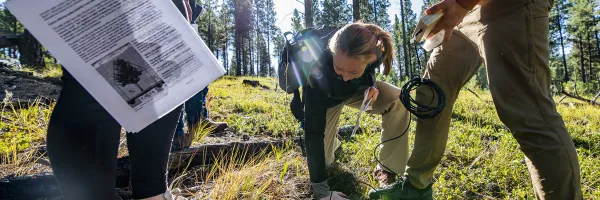
Recent studies include ecosystem studies to understand plant and animal ecological relationships and hydrological studies to look at ground and surface water recharge. Numerous silvicultural studies have been installed on the forest to measure effects of stand management treatments on timber production and other multi-resource values. Other research taking place at Lubrecht is expanding knowledge in ecology, genetics, fire, timber management, and forest recreation.
Research Areas
-
Early beginnings: The use and outcomes of prescribed fire for restoring forest and managing fuel loads has a rich history at Lubrecht Experimental Forest. In his PhD research, initiated in 1972, Rodney Norum used 22 prescribed fires at Lubrecht to study the impacts on characteristics of mature forest stands of Douglas fir and western Larch. Since that time, the use of prescribed fire to manage the forest has grown substantially. Annually, the National Center for Landscape Fire Analysis utilize both Lubrecht and Bandy to develop, synthesize, and deliver scientific products, applications, and geospatial technology that improves fire and forest management in Montana and beyond.
SMART FIRES: Sensors, Machine Learning, and Artificial Intelligence in Real Time Fire Science is a partnership among Montana State University, University of Montana, Salish Kootenai College, Little Big Horn College, Montana Technical University and Flathead Valley Community College. This project addresses knowledge gaps for prescribed fire usage and to understand prescribed fire’s impact on individuals and communities. SMART FIRES seeks to answer two questions: 1) How do prescribed fire energy and emissions depend on fuel properties, topography, and environmental conditions? and 2) How do the smoke emissions from prescribed fire affect individuals and communities?” This project has been using prescribed fires ignited at Lubrecht to better understand the production of remotely detectable fire radiative energy, prescribed fire emissions, and the air quality impacts at local to regional scales to improve management practices that protect people and the natural resources on which they rely. This work is led by Lu Hu (UM), Carl Seielstad (UM), Loyd Queen (UM), Robert Yokelson (UM), Robert Walker (MSU), Xiaobing Zhou (MTU).
Fire and Fire Surrogate Study: In 2002, Lubrecht became home to one of the 13 sites of the national Fire and Fires Surrogate (FFS) Study. Twelve of the FFS utilized a factorial design with treatments of prescribed fire, mechanical fuel treatments, and their combination to test their ability to restore fire-suppressed forests and reducing wildfire risks (Stephens et al. 2012). In the short term (one year after treatment), mechanical treatments were more effective at reducing overstory tree density and basal area; prescribed fire treatments were more effective at creating snags, killing seedlings, elevating height to live crown, and reducing surface woody fuels. Overall, fuel reduction treatments were generally maximized by the combined mechanical plus burning treatment. The FFS Study was renewed, with support from the JFSP, by a second round of prescribed fire and mechanical treatments in 2023 and 2024. This study remains active today.
-
In mountain landscapes like Lubrecht Experimental Forest, water availability and sunlight shape tree growth. A tree’s position—by elevation, slope aspect, and topography—affects snow accumulation, melt rates, and summer temperatures, influencing annual growth. Research by Fin Malone and the Montana Climate Office found that Douglas-firs at high elevations, north-facing slopes, and hollows benefited from cooler, wetter conditions, extending their growing season. However, in the wettest areas, waterlogged soils led to earlier growth cessation. This study underscores how microclimates drive forest growth patterns over time. See Fin’s paper.
-
Wildlife is central to the management and activities that take place on Lubrecht Forest and Bandy Ranch. Numerous research projects, particularly those led by undergraduate and graduate students, have been completed on these properties.
In her 2024 thesis, Sophie Morris and her advisor Will Rice studied the influence of cross-country skiing and off-leash dogs on wildlife habitat use in Lubrecht Experimental Forest. This work compared the daily activity patterns of three focal wildlife species between times of high and low recreation over two winters. White-tailed deer exhibited significant changes in their daily activity between these two levels of recreation, while coyotes and foxes became more active later at night during periods of high recreational use. Due to a stronger temporal avoidance than spatial avoidance of humans and dogs, limiting human and dog use to daytime hours could reduce stress caused by human interactions, especially during times of high snow depth and low temperatures.
-
In his 2023 undergraduate thesis, "Out of the Frying Pan and Into the Fire: How Hunting Affects the Diel " by Shawn M. Parsons, Shawn investigates how rifle hunting influences the daily (diel) activity patterns of ungulates—primarily white-tailed deer—within the Lubrecht Experimental Forest in western Montana. Using infrared camera traps deployed before, during, and after the Fall 2022 hunting season, Parsons examines temporal overlap among deer, human hunters, and pumas to assess whether hunting pressure alters ungulate behavior.
The study analyzes more than 41,000 camera-trap images to evaluate shifts in activity timing and species overlap. Results suggest that white-tailed deer show limited temporal avoidance of hunters, with only modest changes in female activity patterns and minimal shifts in males. Findings also indicate that human activity may indirectly influence predator–prey dynamics by altering the timing of deer and puma activity.