Fight for the Rights: UM Law Grad Takes on Water Master Role
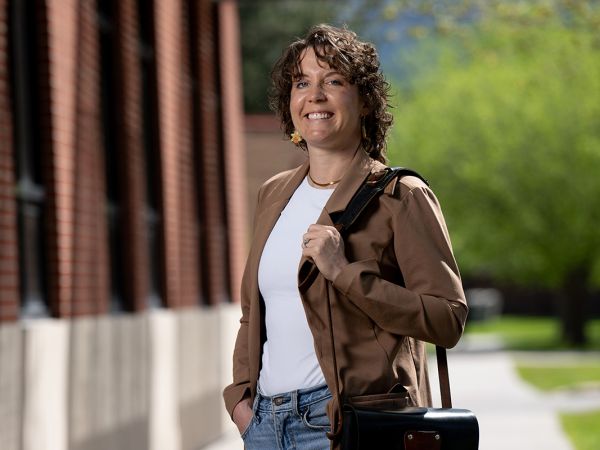
Lori Blumenthal will help adjudicate water rights claims across Montana after she graduates on May 16 from UM’s Alexander Blewett III School of Law. (UM photo by Ryan Brennecke)
By Phil Stempin, UM News Service
MISSOULA – As Western states grapple with water scarcity and competing demands, a graduating law student at the University of Montana will step into a role that sits at the center of it all.
Lori Blumenthal, who graduates May 16 from the Alexander Blewett III School of Law, has been appointed as a water master, a quasi-judicial position responsible for helping adjudicate water rights claims across Montana.
The appointment reflects both Blumenthal’s focus on environmental and natural resources law and a broader trend of UM law graduates securing meaningful, in-demand positions across the region.
“I’m looking forward to developing a deep understanding of water law,” Blumenthal said. “This will serve me into the future as Western water law continues to evolve.”
Blumenthal’s role traces back to the Montana Water Use Act, which established a system for adjudicating pre-1973 water rights. Water masters assist the Montana Water Court by reviewing claims, gathering evidence and making recommendations on how water should be allocated.
“We work basin by basin to review existing water-right claims,” Blumenthal said. “We make sure each right reflects the amount and priority it’s legally entitled to.”
Montana has over 240,000 state-law-based water rights, plus additional tribal and federal reserved water rights. The process Blumenthal is involved with is expected to take years.
“The Water Court isn’t meant to last forever, just until all of the 1973 rights are adjudicated,” she said. “This process is expected to run into the late 2020s, but could take longer.”
Blumenthal described the position as a unique entry point into the legal profession.
“It’s a chance to do important, hands-on legal work,” she said. “I’m excited about actually practicing and getting paid to do the work that I love.”
Originally from Wallingford, Connecticut, Blumenthal’s path to law school was anything but traditional. She attended college in Vermont before heading west to Colorado, where she spent time working and skiing.
She later became a high school science teacher, a role that shaped her interest in environmental systems and public resources. This interest ultimately led her to Missoula and UM’s nationally recognized Natural Resources and Environmental Law program.
At UM, Blumenthal immersed herself in opportunities both inside and outside the classroom. She served as editor-in-chief of the Public Land and Resources Law Review and co-chair of the Environmental Law Group, competed in Native American Law Students Association moot court and was active in the law school’s natural resources clinic.
Blumenthal also gained hands-on experience through the school’s land use and natural resources clinic, working on real-world legal issues under faculty supervision.
Those experiences, she said, were critical to preparing her for practice.
“The school has taught me how to think like an attorney,” Blumenthal said. “It feels like I’m now a part of something much bigger.”
Blumenthal credited the tight-knit nature of Montana’s legal community with helping her secure the position.
“There are tons of networking opportunities that happen between law students and the Montana legal community,” she said.
This connectivity is a hallmark of the UM law experience, where students often build relationships with attorneys, judges and agencies across the state before they graduate.
In fields such as environmental and natural resources law, demand for lawyers continues to grow as states navigate shifting climates, population pressures and evolving regulatory frameworks.
Blumenthal’s new role will place her at the intersection of those challenges, helping to resolve disputes and clarify rights that affect farmers, ranchers, tribes, municipalities and industries across Montana.
For her, the opportunity is both professional and personal.
“It’s a chance to do meaningful work in a field I care about,” she said.
As she prepares to graduate, Blumenthal is looking ahead to the impact of her work and the expertise she will build.
For students considering a similar path, she has a simple message.
“Do it,” Blumenthal said. “I haven’t regretted law school for a second. If your heart is telling you to become a lawyer, do it. You’ll find work that is satisfying and important.”
Her story underscores the value of a legal education rooted in practical experience and regional need.
As Montana continues the complex process of adjudicating its water rights, Blumenthal will be part of the team helping shape that future – one basin at a time.
###
Contact: Phil Stempin, director of events, marketing and communications, UM Alexander Blewett III School of Law, 406-243-6509, phil.stempin@umontana.edu.