Innovative UM Aphasia Program Advances Recovery for Stroke Survivors
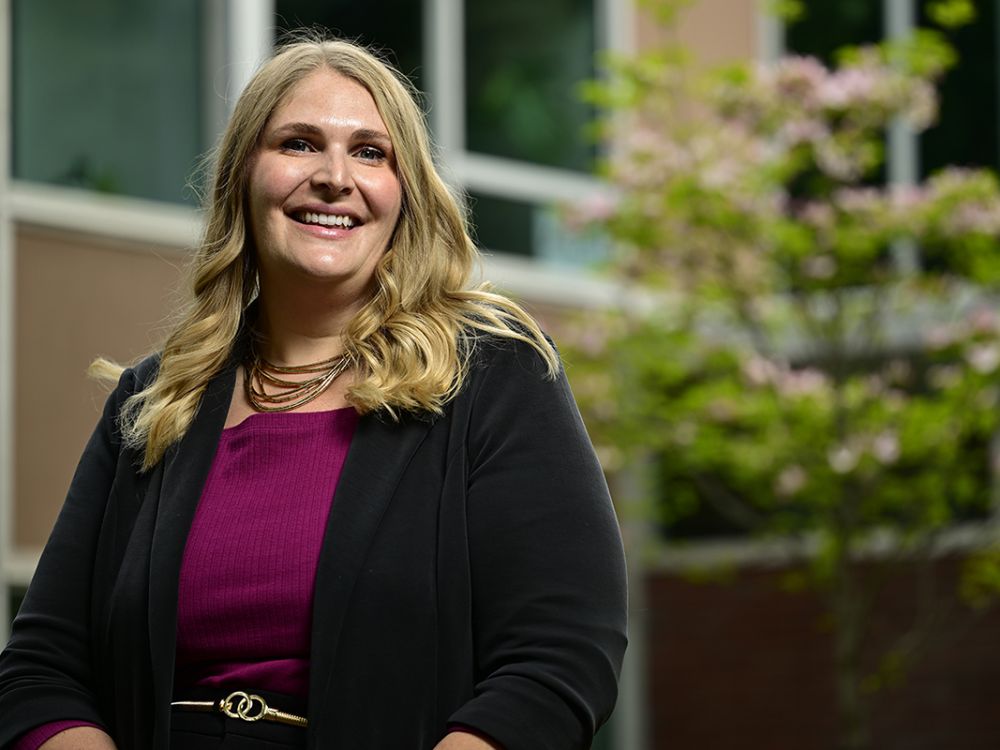
Dr. Jenna Musick, a UM assistant professor, leads research into behavioral interventions for the aphasia language disorder. (UM photo by Tommy Martino)
MISSOULA – June is Aphasia Awareness Month, and the University of Montana’s Big Sky Aphasia Program provides high-quality, research-driven speech and language therapy to people with language deficits caused by brain injury.
Aphasia is a language disorder that affects a person’s ability to speak, read, write and understand language, often as a result of a stroke or other brain injury. An estimated 2 million to 4 million people in the United States are living with aphasia each year, and about 180,000 acquire aphasia annually, according to the National Aphasia Association.
“Our research explores the impact of high-intensity behavioral interventions for aphasia,” said Dr. Jenna Musick, an assistant professor in UM’s School of Speech, Language, Hearing and Occupational Sciences. “BSAP is a community aphasia program, internationally recognized for its clinical innovation, research productivity and accessibility and focus on providing aphasia treatment to rural residents.”
BSAP also serves as a training clinic for graduate students in speech-language pathology, providing a specialized training context for future clinicians who will serve the state. In Montana, 52 of the state’s 56 counties are federally designated as “Health Professional Shortage Areas” where access to speech-language therapy is especially limited.
“A big part of our mission is to make aphasia treatment available for people in rural areas where treatment options are scarce with little to no access to specialized post-acute aphasia rehabilitation,” Musick said. “And people need to understand that those with aphasia are still intelligent and still themselves, they just struggle to communicate.”
BSAP will support the needs of rural Montanans by hosting a summer Intensive Comprehensive Aphasia Program, which runs from May 28 to June 25. It’s one of fewer than 25 such programs in the world, and Musick and her colleagues lead an international collaborative of over 55 researchers studying the efficacy and effectiveness of the ICAP model. Researchers in the collaborative hail from across the U.S., Canada, Brazil, the United Kingdom, Australia and Hong Kong.
The UM program provides cutting‑edge treatment in a small university clinic. Eight families will participate on site this year. Throughout the year, rural stroke survivors who cannot make the trip to UM also will receive treatment through telehealth, an approach Musick and her collaborators are studying to assess its feasibility and effectiveness.
“The onsite and telehealth components address a significant need in Montana, where rates of cardiovascular disease are high,” Musick said.
An estimated 30% to 40% of stroke survivors have aphasia, she said, and in some Montana counties, up to 2.6% of adults have experienced a stroke, according to data from the National Institutes of Health.
In addition to serving the needs of stroke survivors with aphasia, the BSAP summer intensive program provides a unique opportunity to train graduate students in innovative aphasia care. Students and faculty from a wide range of UM majors in the health professions will be integrated into various aspects of BSAP.
“This is UM’s approach to experiential learning,” Musick said. “Interprofessional relationships take education to the next level for these students. They will learn from one another while helping to improve quality of life for people with aphasia.”
Long-term, the goal is to change how stroke survivors with aphasia are treated in Montana and beyond.
“Montana currently lacks a coordinated, statewide approach to identifying aphasia during hospitalization and ensuring people receive speech language pathology services after discharge,” Musick said. “That gap can have lasting consequences for communication and quality of life, and through our research, clinical programs and student mentorship, we are working to address it.”
###
Contact: Jenna Musick, assistant professor, UM School of Speech, Language, Hearing and Occupational Sciences, 406-243-2375, jenna.musick@umontana.edu.