UM Scientists: World’s Highest-Dwelling Mammal Could Boost Cancer Treatments
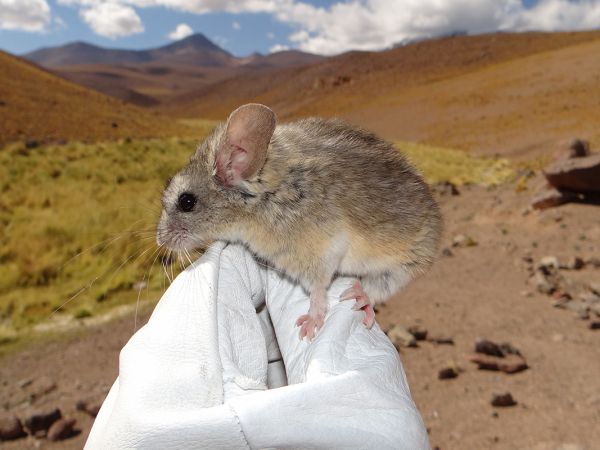
Mighty mouse: This Andean leaf-eared mouse lives at higher elevations than any other mammal. (Photo by Marcial Quiroga-Carmona)
By Naomi DeMarinis, UM News Service
MISSOULA – A team of University of Montana scientists shares a curiosity about how animals survive at extreme altitudes, leading them to follow a remarkable species to the edge of the “death zone” in the Chilean Andes.
Having analyzed their samples, they believe studying a mouse that thrives in a low-oxygen environment may pave the way for improved drug and chemotherapy treatments for tumors in human bodies.
“Andean leaf-eared mice live at altitudes of up to about 22,000 feet, on the summits of the highest volcanoes in the southern Andes,” said Zac Cheviron, a UM integrative biologist. “Before their discovery, we thought the upper limits of mammalian life topped out at 17,000 to 19,000 feet.”
Such elevations are incompatible with long-term human exposure and can cause serious health effects like cerebral and pulmonary edema in mountaineers that occupy them for short periods of time. Cheviron said the discovery of these mice has reshaped scientists’ understanding of where mammals can live and what they can tolerate.
The UM team published a paper in Science, a premier peer-reviewed journal, on how these mice can tolerate such extreme elevations.
Basic research begins with a question, and the question these mice posed was simple: How do they do it? The interesting thing about Andean leaf-eared mice is they don’t just live at high elevation – they also live near sea level on the coast of Chile. This led to a National Institutes of Health-funded study of the physiological and genetic mechanisms that allow this species to occupy such a broad range of elevations.
Jeff Good, a team member who directs UM’s Genomics Core facility, said by studying how high-elevation species adapt to low-oxygen environments, they may gain insight into new therapies for hypoxia-related illnesses such as chronic obstructive pulmonary disease.
With their research question in hand, the team traveled to the Andes to study the mice up close. UM researchers in their group included bioinformatics data scientist Schuyler Liphardt and postdoctoral researcher Dan Shaw. What they found surprised them.
Despite the genetic similarity between highlander and lowlander mice, the highlanders have much better aerobic performance under hypoxia than lowlanders, and this difference in aerobic performance was associated with several cellular physiological traits that influence how their muscles use oxygen. This suggests that there is some genetic variation between the two populations that underlies the unique physiology of highland mice. The team used cutting-edge genomic approaches to find these areas of difference in the genome.
The researchers expected parts of the genome containing genes related to hypoxia tolerance and aerobic performance would differ between highland and lowland mice – and they did. But they also found some of the strongest genomic differences were associated with detoxifying defensive plant compounds. These compounds deter animals and insects from eating them, yet across much of their elevational distribution these toxic plants seem to be a major food source. That result was unexpected.
But perhaps the most surprising finding was that some of these biotransformation genes – key to diet adaptation – also play a role in oxygen-sensing pathways. These same genes are involved in the metabolism of cancer drugs in humans. What does that mean?
“These mice are dealing with environmental challenges similar to the conditions found in tumors, which are also hypoxic environments,” said Cheviron. “Low-oxygen conditions affect the cellular metabolism and effectiveness of some cancer drugs, so understanding how these mice have adapted to these dual stressors may provide key insights into dosing of existing chemotherapies or the development of new drugs.”
Future work, he adds, will flesh out these molecular and genetic details, and the discoveries highlight the unexpected value of curiosity-driven, basic research.
“We started this work fascinated by how these mice could survive in such an extreme place,” he said. “That curiosity has now led to insights that might have real benefits for cancer patients. We couldn’t have anticipated that outcome when we started the work.”
###
Contact: Zac Cheviron, UM biology professor, 406-243-4496, zac.cheviron@umontana.edu; Jeff Good, UM biology professor, 406-243-5771, jeffrey.good@mso.umt.edu; Schuyler Liphardt, UM bioinformatics data scientist, schuyler.liphardt@mso.umt.edu.