Western Painted Turtle Study Becomes a UM Classroom for Future Scientists
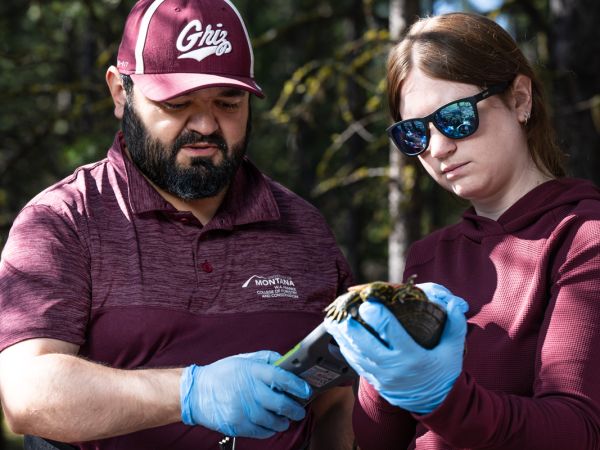
Erim Gómez, an assistant professor of wildlife biology at the University of Montana’s W.A. Franke College of Forestry and Conservation, works with student Kylie Mathews on scanning a western painted turtle for a tag. (UM Photo by Ryan Brennecke)
Note: A version of this news release with additional photos and video is available online.
By Skylar Rispens, UM News Service
MISSOULA – Along the marshy shores of Jones Pond at the University of Montana’s Lubrecht Experimental Forest, a new long-term research project is emerging that seeks to better understand western painted turtles and the impacts of climate change on their populations.
The study is led by Erim Gómez, an assistant professor of wildlife biology at the University’s W.A. Franke College of Forestry and Conservation, who said it’s been more than two-decades since an intensive research paper has been written about the species in Montana. During the next 20 years, Gómez and UM students will capture turtles to record data related to their size, weight, sex and age.
“The western painted turtle is a pretty understudied species because it’s not of conservation concern at this moment,” Gómez said. “While we’ve seen declines in their population, we’re not really worried about them being extirpated from the region.”
Although there is not an immediate threat to these turtle populations, tracking the ratio of male-to-female turtles over decades could reveal the impacts of climate change on the species as the sex of a turtle is largely determined by nest temperature – not genetics. As the climate in western Montana grows warmer, the population of western painted turtles could skew to produce more female than males.
“I’m really curious whether we see a shift in sex ratios over time,” Gómez said. “We’re basically trying to figure out why animals live where they do and what makes good habitat for them.”
Initial surveys are currently coming from the population of turtles at Jones Pond, but over time Gómez hopes to expand across western Montana to include locations along the Bitterroot and Blackfoot rivers. Data collected in the field will continue to grow and be analyzed by students in Gómez’s wildlife techniques classes. He hopes the project lasts until he retires.
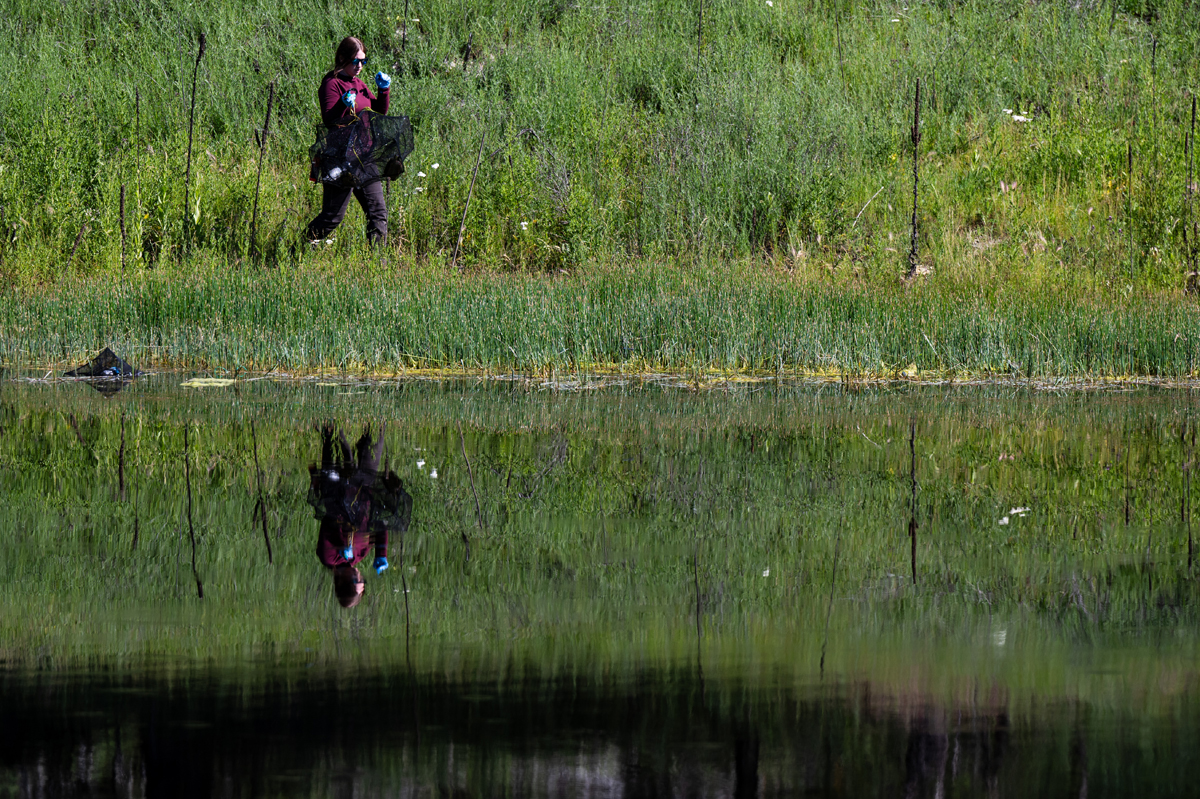
To collect the turtles, undergraduate wildlife biology students tossed 40 mesh, hexagonal traps into the pond from shore. Once the traps are set, turtles can swim through an opening along each of the six sides. The next day, students returned to the pond to begin pulling traps and collecting data. Most of the time students are greeted by turtles with fiery streaks across their bellies, but sometimes they capture a garter snake or two.
Incoming freshman Eden Finlinson of Missoula connected with Gómez while visiting the University on an admitted student day this past spring, when she asked him about upcoming research opportunities to participate in before classes start.
“It’s really exciting to be able to get my feet in the water before I even start my classes,” Finlinson said. “It’s nice to already have some familiar faces on campus in the Wildlife Biology Program.”
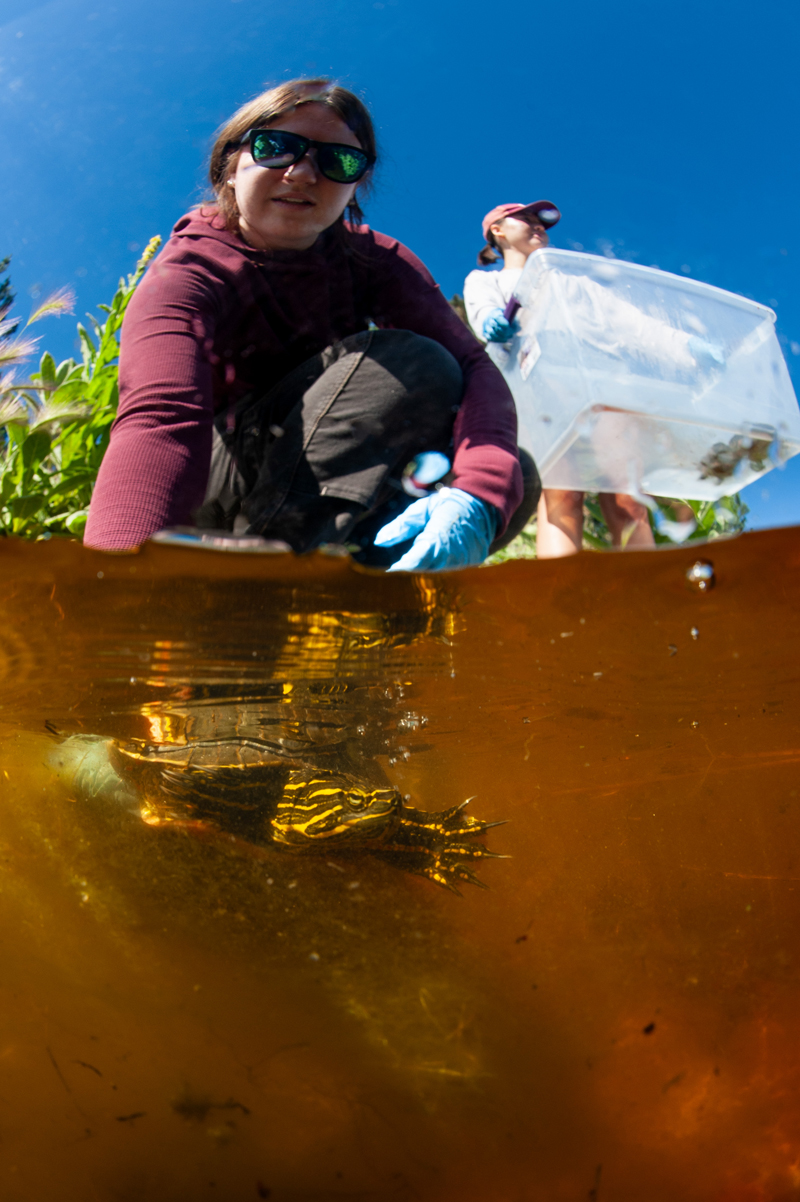
After measuring and tagging each turtle, students walked their tubs of turtles back down to the marshy shores of Jones Pond to release them one by one back to their home.
“There’s no way I would be able to just drive 45 minutes away and be able to do this kind of field experience back home in California,” said Kylie Mathews, a post-baccalaureate student completing her wildlife biology degree.
Mathews and three other students worked in pairs to carefully handle each turtle, determine its sex and age, and measure its size and weight. The turtles are tagged to help determine recapture rates.
“I think coming back to finish this degree was definitely worth it,” Mathews said. “I feel like I’m seeing everything from a new perspective. Earlier in my time in college, I was so burnt out and nervous to work with professors and graduate students.
“This time, I’ve made an effort to stay invested with the faculty and their projects as much as I can,” she continued. “What you put in is what you get out of it.”
###
Contact: Dave Kuntz, UM vice president of marketing and communications, 406-243-5659, dave.kuntz@umontana.edu.