The Art of Interaction: Booming UM Game Design Program in High Demand
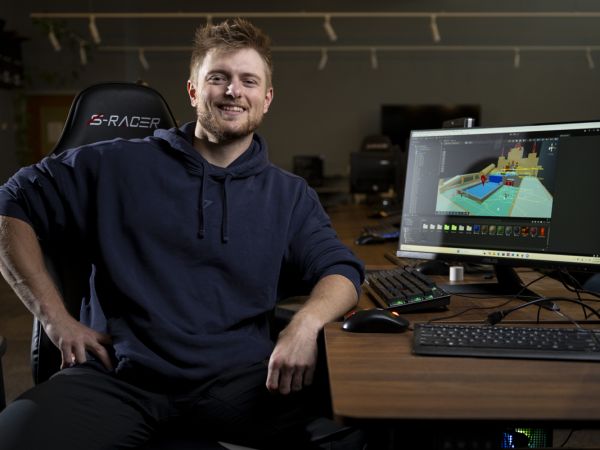
UM game design student Trevor Kleh shows off a behind-the-scenes look at a level he recently designed for class. Kleh is interested in worldbuilding and developing game mechanics after he graduates. (UM Photo by Ryan Brennecke)
By Austin Amestoy, UM News Service
MISSOULA – Pop into the University of Montana’s game design program, and you never know what you might find. Some days, it’s wizards facing down armies of evil skeletons or a tiny spaceman jumping toward the canopy of a twilight forest. On others, it’s a virtual-reality pharmacy simulation or buffalo drive experience.
From entertainment to education, everything interactive in our modern world is a game – and UM’s game design program is in high demand.
What started as a media arts concentration founded by Professor of Game Design and Interactive Media Michael Cassens just seven years ago with three students is now a full-fledged undergrad and graduate program. Enrollment has ballooned 20 times over. That growth is driven in part by industry demand. But UM game design faculty, students and alumni say it’s also the result of a close-knit program that puts community above all.
“A lot of people think they’re not gamers,” said Ashley Rezvani, UM assistant professor of game design and interactive media. “But if you play solitaire, you’re a gamer. If you’re playing catch with your grandkids, you’re a gamer.”
Video game creation is nowhere near as old as painting, acting, dancing or even filmmaking. But UM believes it’s just as much an artform. That’s why game design has earned its spot in the University’s newly christened School of Art and Game Design.
As one of the most popular hobbies for young people today, a love of gaming is often what introduces students to UM’s program – students like Trevor Kleh. Originally from New Jersey, Kleh bonded with his family through the Nintendo 64 when he was young.
“That was really the start for me,” Kleh said. “Me and my brother playing ‘Ocarina of Time,’ ‘Star Fox’ and ‘Smash Bros.’”
He grew up but never lost that passion for games. After serving in the U.S. Air Force for a few years, Kleh sat down to figure out his next steps. He wanted to do work that inspired him, and he realized game design might be the perfect fit.
That’s how Kleh wound up at UM, enrolling in its game design B.F.A. in 2024. He picked UM after hearing about the program while living and working in Polson.
And he hit the ground running. Right away, Kleh was learning more than just how to code and construct a game – he was learning how to build worlds. From concept art, character design and animation to music, sound, story, scripting and pacing, crafting a compelling game requires knowing a little about a lot.
Assistant Professor Cory McKague said the interdisciplinary nature of game design offers boundless creative potential. His classes focus on traditionally artistic fields like pixel art, digital painting, concept art, 3D modeling and animation – but they attract students with all kinds of interests, from philosophy and poetry to engineering and programming.
“To me, art is about pushing the boundaries of tradition and discovering new ways of creating, communicating and expressing ourselves,” McKague said. “Game design embraces this broader understanding of art as a universal act of human creativity.”
Just because it’s universal doesn’t mean it’s easy. One of Kleh’s first big projects found him attempting to build a reimagined version of his childhood game – “The Legend of Zelda: Ocarina of Time.”
“It was a bit bold of me, with the time I had,” Kleh said with a laugh. “My scope was too big.”
In the meantime, Kleh was finding his place through Grizzly Esports, UM’s competitive video gaming team directed by Cassens.
“Getting immersed in the esports team was amazing,” Kleh said. “Everyone connected and bonded, and there were a lot of military members on the team, too.”
One of Rezvani’s favorite aspects of the UM game design program is the way it welcomes students from all backgrounds and walks of life. She said the close ties between the academic and recreational sides of gaming nourish a tight-knit community.
“Above all, I just want to help make good people,” Rezvani said. “So much of what we teach are skills that can transfer to any industry, so teaching our students how to communicate, collaborate and lead is crucial.”
The UM program focuses on teaching students the fundamentals of every aspect of game design. In an industry where dozens or even hundreds of designers often work together to build a game, UM game design graduates can “speak the language,” Rezvani said.
And it’s not just about building games to entertain. UM game design emphasizes so-called “serious games” made to educate. Students have partnered with the Missoula Butterfly House and Insectarium, Blackfeet ECO Knowledge, American Indian Governance and Policy Institute, Rocky Mountain Elk Foundation, C.M. Russell Museum and more.
Freelance game designer and media arts graduate Taylor Miller played a part in several of those collaborations. Originally from Butte, Miller enrolled at UM in 2020, when the game design program was in its infancy, and graduated three years later.
Miller now works in Missoula as a freelance interactive media designer. The skills they picked up from UM’s game design faculty prepared them to thrive in unexpected gigs, like helping design interactive artworks with former UM Artist-in-Residence Peter Burr.
Miller was a nontraditional student, starting at UM in their late 20s. They’d spent a few years designing games on their own but ultimately decided nothing could replace the college experience.
“The soft skills – building relationships and community through UM – were more important than any other job I’ve had,” Miller said. “UM created this space and structure to learn that isn’t available anywhere else.”
To Miller, the artistry of game design is inherent.
“A lot of people look at games as escapism or as time-wasters,” Miller said. “But they’re so much more than that. It’s an art that reaches out and asks you to touch it. It’s a culmination of all the kinds of art we’ve made before.”
To learn more about UM’s game design program, visit the University admissions page.
###
Contact: Austin Amestoy, marketing and communications manager, UM College of the Arts and Media, 406-690-2783, austin.amestoy@umt.edu