
What Are Program Learning Outcomes?
The word outcome will be the term used to describe learning assessed at the course, program, and institutional levels. Learning outcomes are preferred over goals (aspirational statements) and objectives (course content) to describe demonstrable and measurable student learning.
Program learning outcomes (PLOs) are developed collaboratively among faculty to reflect shared disciplinary values and priorities. They describe what students should be able to know or do by the end of a program. Assessable PLOs meet the following criteria:
- Use active, measurable verbs (e.g., apply, analyze, evaluate);
- Written in clear, student-focused language (students will be able to…);
- Limited and targeted to support focused assessment; and
- Align with the courses and experiences that teach and assess them.
PLOs must ultimately map to programs’ curricula. Future assessment planning will demonstrate how the outcomes are introduced (I), developed (D), and mastered (M). Alignment between courses and PLOs helps identify gaps, redundancies, or unnecessary complexity in the curriculum—with the understanding that some complexity is necessary for rigorous learning and professional outcomes. Alignment also enhances transparency and supports advising, course scheduling, and degree-mapping for students.
PLOs in CourseLeaf
- Access the CourseLeaf platform using your NetID;
- Use the search bar to locate the program and click the green “Edit Program” button;
- Fill out all required fields, including the “Program Learning Outcomes” section found under Program Description;
- Complete any other necessary program modifications for ASCRC or Graduate Council you intend to make this academic year; and
- When all edits are complete, click the green “Start Workflow” button at the bottom of the form to submit your edits for review.
Defining Program Learning Outcomes
Program Learning Outcomes describe what students should be able to know or do by the time they complete the program. They are not aspiration goals or course objectives, but measurable indicators of student learning that support curriculum design and continuous improvement.
Strong PLOs should:
- Use active, measurable verbs (e.g., analyze, create, evaluate)
- Be written in clear, student-focused language ("Students will be able to…")
- Be limited in number—about one outcome per 9–12 credits
- Align with course and co-curricular learning experiences
Shared PLOs
PLOs can be shared between programs. The image below illustrates an approach to overlapping learning outcomes in an academic unit with examples of how each program contributes to the shared outcomes:
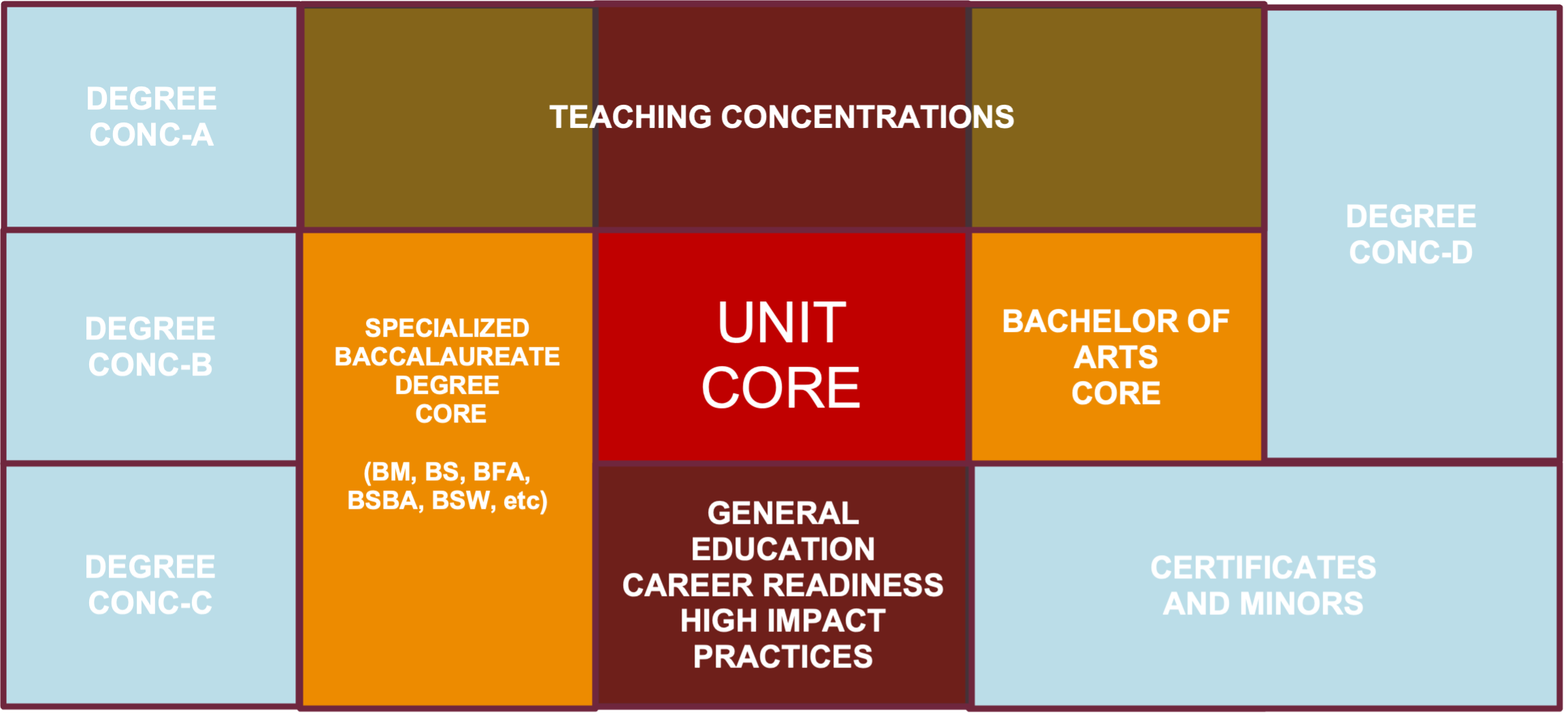
- The Unit Core represented by the central red box anchors the shared PLOs of the unit. These PLOs should be derived from the unit’s mission and values. In this example, the unit core may consist of 9-24 credits of coursework equating to one or two PLOs.
- The orange boxes represent different degrees or majors in the unit with PLOs that are unique to each. This may include 12-24 credits of coursework equating to one or two PLOs.
- The light blue boxes represent concentrations, minors, and certificates as both stackable and independent within the unit’s portfolio. These may represent 12-24 credits and one or two PLOs.
- The top and bottom horizontal bands show how overlapping curricula from other units reinforce learning across programs. This example includes a teaching concentration and participation in general education outcomes. Other examples could be a shared disciplinary methodology between programs (for example, social science research methods). Programs are not responsible for generating outcomes for these areas if they are already established. However, cataloging them in this process is worthwhile as they may inspire related outcomes for the program.
The layout above emphasizes that no program teaches in total isolation. Programs share connections within the unit and with each other, while also having learning outcomes that make the program distinct.
Sources for Developing Program Learning Outcomes
(Adapted from Maki, Peggy (2004). Assessing for Learning.)
- Mission Statements: Draw from institutional and college mission statements and core values. What specific abilities should students demonstrate based on these mission statements and core values?
- Professional Organizations: Adapt statements developed by disciplinary and professional organizations.
- Student Work: Derive outcomes based on collective examination of student work over time (e.g., capstone course projects).
- Input from Invested Groups: Identify outcomes through interviews and dialogues among colleagues, students, employers, etc.
- Deep and Surface Approaches to Learning: Consider how courses and educational experiences position students as learners across their continuum of learning. To what degree do we promote and value surface (e.g., memorization) and deep (e.g., analysis and synthesis) approaches to learning? How and when do the curriculum and other educational experiences position students to adopt a deep approach to their learning?
Assessment Resources
-
A national clearinghouse of practical tools, examples, and guidance for designing and communicating effective student learning outcomes assessment.
-
Home of the AAC&U VALUE Rubrics, the faculty-developed scoring criteria UM's ILOs draw on for assessing learning in areas like critical thinking, civic engagement, and quantitative literacy across general education and high-impact practices.
-
Practical guidance on designing course- and program-level assessments, from writing measurable learning outcomes to selecting appropriate assessment methods.
-
A validated instrument for measuring student attainment of the eight NACE Career Readiness Competencies employers most look for in new graduates.