A UM Doctoral Candidate Is Working to Improve Bird Identification
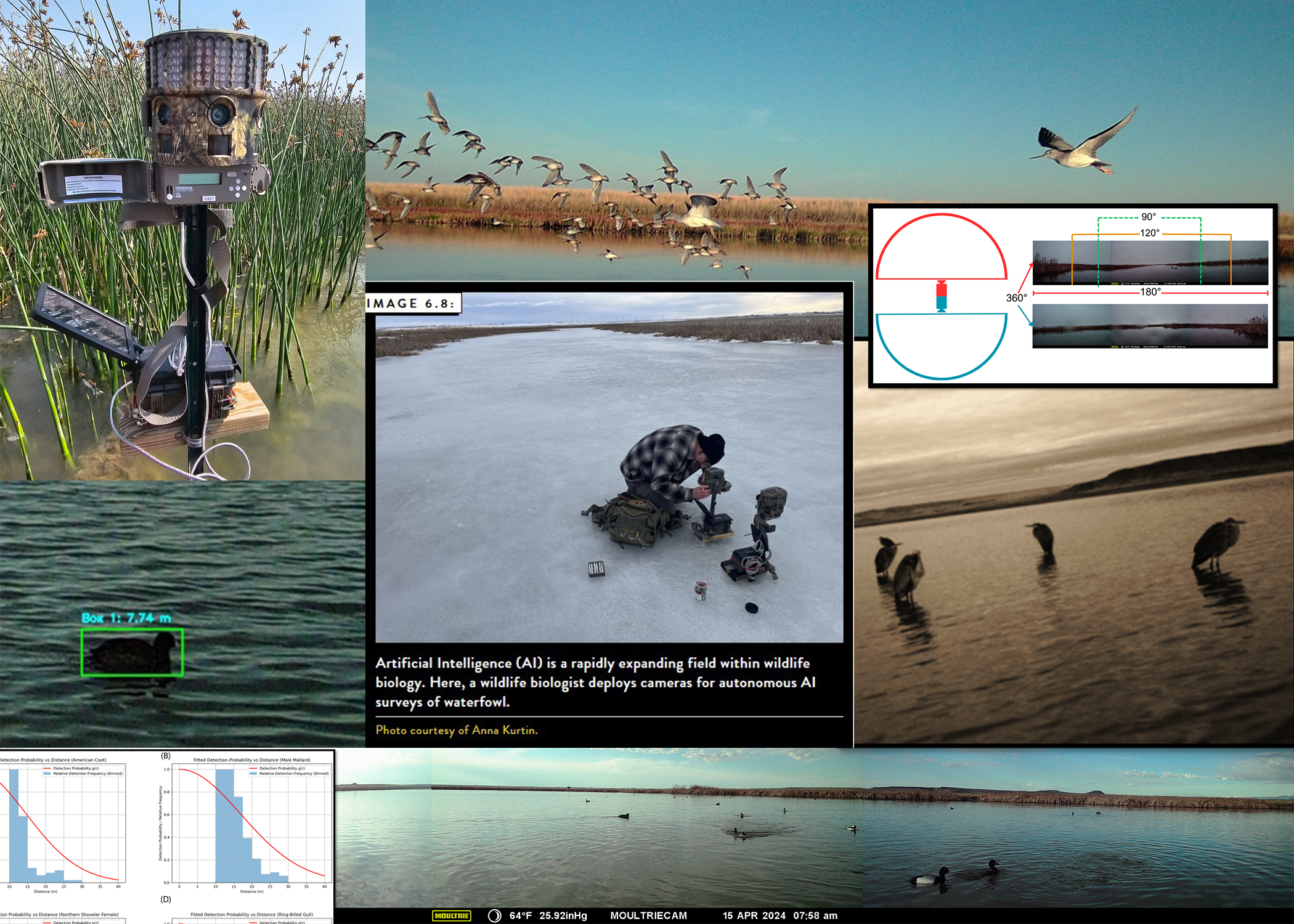
Christian Dupree is a PhD candidate in the Wildlife Biology program, helping to make avian observation more accurate and reliable by “building a competent, visual-based AI bird observer for the field, especially in places [they] can’t or don’t survey often” due to environmental limitations.
Reliance on human observers presents challenges because people hear and see birds through their own observational biases. For example, birds have many calls, and it is difficult to tell how many birds of the same species may be calling at once. Visual identification also presents challenges. Birds can be easily mistaken as having been counted or missed if they move. Incorrect bird counts have serious implications for conservation because land managers rely on this data to make decisions.
To help solve this problem, Christian Dupree has been working with Professor Victoria Dreitz on developing an “iterative AI-training workflow” to improve accuracy in bird identification, developing innovations that reduce misclassification by mimicking “double observer and distance-based detection” using multiple cameras. In the field, they use 180-degree cameras, cameras on elevated posts, and cameras set up so that no two cameras can capture the same bird.
Computer vision helps sort through the collected data and ID bird species, counting whether birds are present or not present and how many. Christian must then assess the AI’s success in identification, correcting it and providing additional training.
The goal is to create a consistent AI observer whose error is measurable to improve consistency in bird counts. Improved consistency means that researchers can more accurately estimate bird populations to assist with conservation decisions.
Christian’s path to developing AI to improve bird identification began during his six-year career in the Air Force. He met a game warden on the base and liked the work. When he got to UM, he earned his BS in Wildlife Biology and considered becoming a game warden himself but was drawn to research. That’s when he began working for Dr. Paul Lukacs in Wildlife Biology, manually sorting through camera trap data and “experimenting with machine learning algorithms...to solve smaller workflow problems." That eventually led him to the Avian Science Center, directed by Dr. Victoria Dreitz.
Christian will graduate with his PhD in Fall, 2029.
Contact: Naomi DeMarinis, Associate Director of Research Development, Communications, naomi.demarinis@umontana.edu; Chrisitan Dupree, PhD candidate, christian.dupree@umconnect.umt.edu