Anthropology Graduate Programs
The following table compares the four M.A. and two Ph.D. degree programs that the Department of Anthropology offers. Select a program name to learn more.
| Program | Degree | Primary Focus | Culminating Experience | Credits* | Typical Career Paths |
|---|---|---|---|---|---|
| Anthropology (General) | M.A. | Broad anthropological training across subfields | Thesis, Professional Project, or Portfolio | 30-36 | Research, NGOs, government, doctoral study |
| Anthropology: Cultural Heritage option | M.A. | Heritage preservation, CRM, museums, public anthropology | Thesis, Professional Project, or Portfolio | 30-36 | Cultural resource management, archaeology, museums, preservation, Tribal programs |
| Anthropology: Forensic & Biological Anthropology option | M.A. | Human skeletal biology, bioarchaeology, forensic anthropology, ancient DNA/ forensic DNA | Thesis, Professional Project, or Portfolio | 30-36 | Forensic anthropology, skeletal analysis, labs, doctoral study |
| Anthropology: Linguistics option | M.A. | Language documentation, Native language revitalization, linguistic analysis | Primarily thesis-based research | ~30+ | Language revitalization, research, education, doctoral study |
| Anthropology (General) | Ph.D. | Advanced anthropological scholarship and applied research | Dissertation | 60 post-baccalaureate credits | Academia, government, NGOs, consulting |
| Anthropology: Cultural Heritage & Applied Anthropology option | Ph.D. | Heritage studies and applied anthropology | Dissertation | Ph.D. curriculum | Academia, cultural heritage organizations, archaeology, applied research, international development |
*Credits shown are simplified for comparison purposes. Detailed requirements are found in the Course Catalog.
Admissions & Application Process
-
- Fall: Priority will be given to complete application packets submitted by January 15. Complete application packets received after this date will be considered on a space-available basis.
- Out-of-Cycle Terms: Other terms may be available based on program capacity. It is
recommended that applicants first contact the faculty they would like to work with to confirm space availability before applying. Complete applications submitted for Out-of-Cycle Terms will be reviewed on a space-available basis.
We highly recommend reaching out to the faculty you would like to work with and discussing your plans before application reviews.
-
- A B.A. or B.S. degree
- Grade point average of at least 3.0 for the M.A. degree and 3.2 for the doctorate on all college work.
- Test of English as a Foreign Language (TOEFL) scores (if applicable)
- The Department of Anthropology recommends students take the GRE and send scores to the University of Montana, but it is optional and not required for admission to the M.A. or Ph.D. programs.
There is no minimum GRE score, and scores are only one factor in evaluating applicants. Provisional admission may be offered to promising students who don't meet GPA standards. If the student's bachelor's degree is not in Anthropology, the student will work with their advisor to develop a course of instruction that includes developing a background in the four fields of Anthropology.
Students in an M.A. or B.A./B.S. program (at the University of Montana or another institution) may apply for admission to the Ph.D. program up to one year before completing the M.A. degree, but their admission to the program will be provisional, contingent upon finishing their M.A. or B.A./B.S. program.
-
Three (3) letters of recommendation are required to apply to any graduate program. We encourage you to check your application portal to confirm that the University has received all three letters, as your application cannot move forward until the Graduate School receives all of them.
-
Along with the application materials needed by the Graduate School, the Department of Anthropology also requires a letter of intent that clearly states your goals. This statement of purpose should outline your professional objectives and demonstrate alignment with the research specializations of the faculty.
-
Applicants to the Ph.D. program should include a significant writing sample as part of their application. For students with a master's degree, this should be their Master's level original work such as a thesis or professional paper. For students without a master's degree, this should consist of a selection of term papers or research reports that they have completed.
-
Please see the Graduate School's International Admission Overview page.
Funding & Assistantships
-
A small number of teaching assistantships are typically awarded for one semester to students who have completed part of the program. One or more teaching assistantships are typically available to American Indian students. All assistantships are competitive and awarded based on demonstrated excellence in coursework, research, and service.
Teaching assistants are expected to work 15 hours per week for 15 weeks. Depending on the class or classes assigned, their duties may include assisting course instructors with student contact, exam preparation and scoring, maintaining records of student performance, and lecturing or leading laboratory or discussion sections. In addition to their salaries, teaching assistants receive a tuition fee waiver (in-state or out-of-state) and a waiver of the registration fee. Other fees charged by the University are not included in the TA fee waiver package. Teaching assistants must register for 9 credits each semester.
Learn more about Graduate Assistantships (TA/RA) Information from the UM Graduate School.
-
All applying and current graduate students should complete the Graduate Student Evaluation Form/TA Application to be considered for a teaching assistantship or an Anthropology department scholarship for the academic year.
-
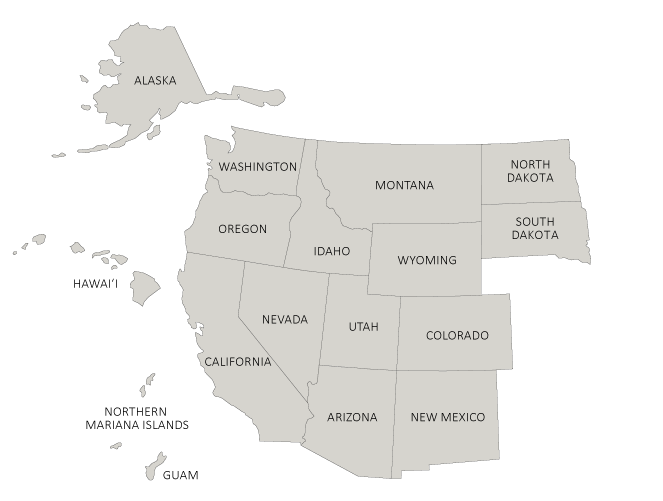
The UM Anthropology graduate programs are now part of the Western Regional Graduate Program (WRGP) of the Western Interstate Commission for Higher Education (WICHE). The Western Regional Graduate Program (WRGP) is an agreement among WICHE’s 16-member states and territories* in the western United States, allowing WICHE region students to attend select out-of-state graduate programs and pay only 150% of resident tuition. (See Student Tuition and Fees or Financial Aid WRGP page for more information.) If you are eligible and interested in completing the admission process as a WRGP student, you are responsible for providing proof of residency in one of the participating WICHE states or territories.
*Alaska, Arizona, California, Colorado, Hawai'i, Idaho, Montana, Nevada, New Mexico, North Dakota, Oregon, South Dakota, U.S. Pacific Territories, Utah, Washington, and Wyoming.
-
All graduate students are encouraged to complete the UM Scholarship Universe general application to determine their eligibility for university scholarships. Once submitted, the application enables the Scholarship Universe portal to automatically match students with scholarships for which they may be eligible to apply. Please note that some opportunities require supplemental application materials.
See the UM Graduate School Scholarships and Fellowships webpage for several scholarship opportunities for graduate students.
Graduate Student Handbook
Use the 2026-2027 UM Anthropology Graduate Student Handbook to read more information on the following:
- Advisor assignment
- Committee formation and procedures
- M.A. project options and requirements
- Ph.D. dissertation requirements
- Comprehensive evaluations
- Graduation process
For campus-wide graduate student information, please see the UM Graduate School Policies.
Questions?
Director of Graduate Studies
Meradeth Snow, PhD
meradeth.snow@umontana.edu