UM Research Studies How Children Decide Who and What to Trust
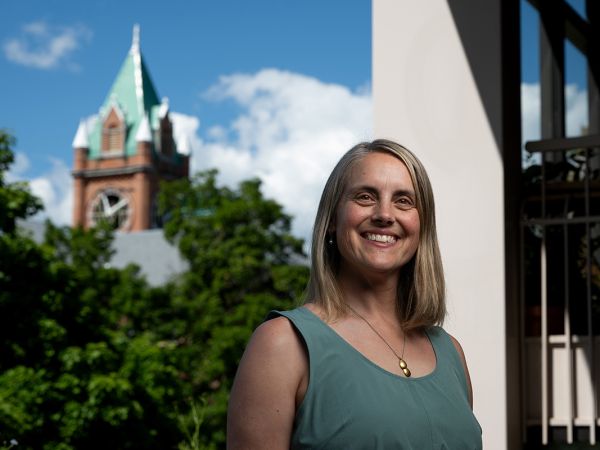
UM researcher Rachel Severson and her partners studied when children start to question whether confident speakers are actually trustworthy. (UM photo by Ryan Brennecke)
MISSOULA – When learning facts, people often assume that confident speakers are knowledgeable, while hesitancy signals a lack of understanding. Children and adults tend to equate confidence with knowledge.
New research from the University of Montana and its partners suggests children begin to think more critically about confidence by age 8, evaluating both the speaker and the context of the information.
“Older children interpret hesitancy as a sign of careful thought rather than uncertainty when someone is deliberating about a moral dilemma,” said Dr. Rachel Severson, a UM researcher and developmental psychologist. She was joined in this work by UM alumna Dr. Shailee Woodard and colleagues from the University of British Columbia.
Their research shows that younger children tend to trust confident individuals and prefer to learn facts from a person who is confident – even when that individual lacks knowledge or has been inaccurate in the past. This tendency is part of what researchers call the “confidence heuristic,” in which confident individuals are often perceived as smarter and more likable. Both adults and children confuse poise for expertise. But children start to become more discerning by age 8.
The research was published in Child Development, the flagship journal of the field of developmental psychology. It examines how children engage in what psychologists call selective social learning, the process of deciding who to trust when gathering information.
From choosing which friend to believe to deciding whether an adult is reliable, children make judgements about credibility.
“The roots of critical thinking emerge in childhood,” Severson said. “We wanted to understand how children interpret confidence differently depending on the context.”
This skill continues to develop into adulthood as students weigh the quality of information while grappling with increasingly complex issues.
The UM portion of the study was led by Woodard during her time as a doctoral student at UM’s Department of Psychology. Woodard and Severson also collaborated with researchers Parkly Lau and Dr. Susan Birch at the University of British Columbia.
“This research is especially important as children interact with confident-sounding chatbots and other AI programs,” Severson said. “Figuring out who – or what – to trust, and when, is an essential skill as children learn to evaluate information in an increasingly complex world.”
###
Contact: Rachel Severson, UM professor of developmental psychology, 406-243-4384, rachel.severson@umontana.edu; Dave Kuntz, UM director of strategic communications, 406-243-5659, dave.kuntz@umontana.edu.