When Trails Trend: UM Graduate Tracks Social Media Impact on Montana Landscapes
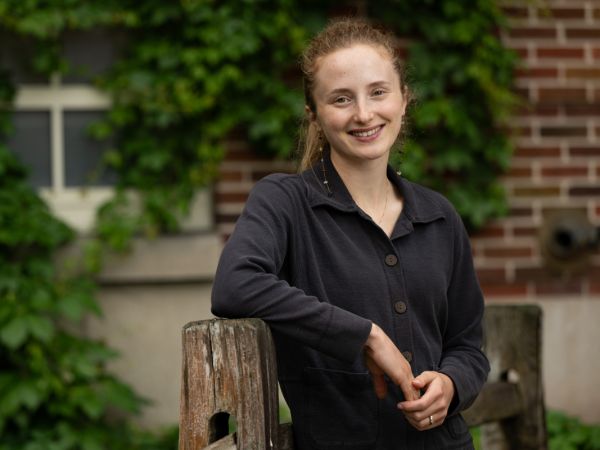
Recent University of Montana graduate Emma Keinath-Lopez researches a growing challenge in outdoor recreation: how social media-driven visitation reshapes landscapes. (UM photo by Ryan Brennecke)
By Naomi DeMarinis, UM News Service
MISSOULA – Emma Keinath-Lopez, a graduate of the University of Montana’s resource conservation graduate program, recently bridged her research into a career with UM’s Institute of Tourism and Recreation Research.
ITRR is the research arm for Montana’s thriving tourism and recreation industry. Keinath-Lopez’s new position will allow her to continue her research, telling meaningful stories about recreation, tourism and Montana’s communities and landscapes.
She was drawn to this field through a love of the outdoors and a curiosity about human behavior – in particular how people connect with places. Her research explores a growing challenge in outdoor recreation: how social media-driven visitation is reshaping landscapes.
“I wanted to understand not just where people go, but why,” Keinath-Lopez said.
Her career began in environmental education for the National Park Service and private nonprofits, sparking her interest in research communication. During her time in school, Keinath-Lopez built on her professional interests, researching why people choose to hike where they do – specifically, why they leave designated trails to follow unofficial routes known as social trails.
User-created paths often form organically over time, but in the modern digital world the resulting impacts are magnified with increased exposure. These “destination social trails” lead to places that have become popular through digital media, essentially “trending” outdoor destinations.
“In this era of increasing digital influence, destination social trails are a product of the viral spread of scenic imagery on social media,” Keinath-Lopez said. “They reflect recreationists’ desire for novel and adventurous experiences.”
What appears to be spontaneous exploration is often guided by social media influencers. In this way, outdoor recreation is becoming increasingly shaped by online narratives, and it has an impact. Destination social trails can lead to environmental degradation such as erosion and habitat damage. Land managers are tasked with balancing two realities: growing visitor demand and the need to protect natural resources.
“By better understanding visitor motivation, managers can design more effective communication strategies and sustainable recreation plans that meet people where they are, both physically and digitally,” said Keinath-Lopez. “Social media doesn’t just influence where people go, it shapes expectations and appeals to our intrinsic and extrinsic motivations and desires.”
Now graduated and officially employed by ITRR in summer 2026, Keinath-Lopez offers simple, direct advice to current students: “Graduate school can be intense and all-consuming, but it’s important to zoom out. The work matters, but so does everything beyond it. Balance isn’t just helpful, it’s necessary.”
###
Contact: Naomi DeMarinis, associate director of Research Development, Communications, 406-243-5303, naomi.demarinis@umontana.edu.