News
How much has the U.S.’s wildlife changed since Lewis and Clark?
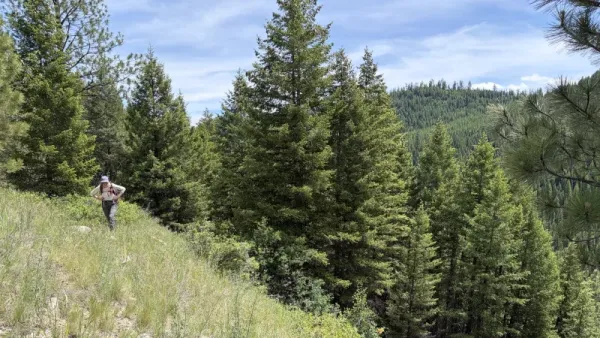
Ever wish you could have been part of the Lewis and Clark expedition? Us too. The Corps of Discovery came across scores of plants and animals that were new to Western science: Grizzly bears, ponderosa pines, a “barking squirrel” that William Clark would later call the prairie dog. A modern effort is underway to see how much the country’s wildlife has changed in the 220-some years since their journey. Host Nate Rott tags along with some scientists re-surveying a part of the expedition’s route in western Montana. And he wishes he was in better shape.
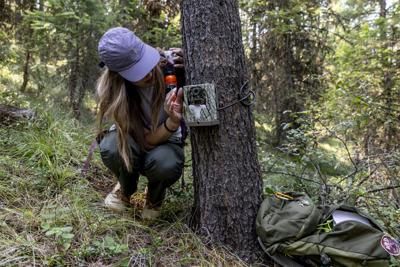
Camera traps enable researchers to see wildlife changes along Lewis and Clark Trail
For a group of University of Montana researchers surveying wildlife along the Lewis and Clark National Historic Trail near Lolo Pass, getting skunked was cause for celebration.

From snapshots to solutions: making camera-trap monitoring matter for conservation
Monitoring is fundamental to conservation, providing the vital data required to track progress against national and international biodiversity targets (Bennett et al. 2018, Helmstedt et al. 2025, Gonzalez et al. 2026). Across modern conservation technology, from satellite imagery and environmental DNA to drones and bioacoustics, managers often lack clear direction for using the deluge of data effectively. Although the information overload and subsequent decision paralysis are systemic across technologies, camera-trap monitoring is a particularly prominent example. Remotely triggered camera traps have reshaped the landscape of ecological monitoring, yet the technological revolution has created a bottleneck: while we can now observe ecological systems with unprecedented clarity, the resulting data rarely generates actionable insights at the level that it could.
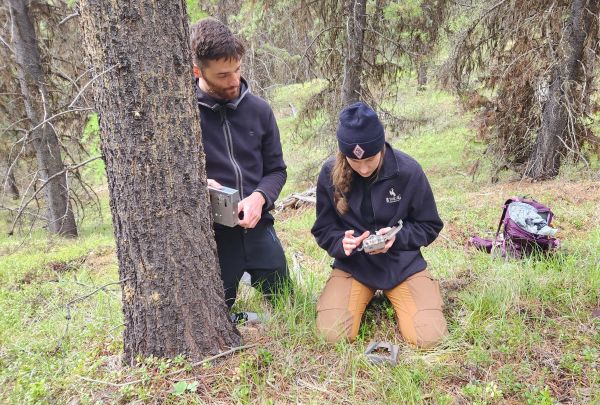
Tourani Lab is participating in the Lewis and Clark Resurvey
Smithsonian ecologists are returning to Lewis and Clark’s historic route, installing camera traps to document wildlife across those same landscapes. The project will unite scientists and the public by providing detailed information about the abundance, distribution, and behavior of wildlife. The resulting data will support land managers, researchers, and community scientists in understanding long-term changes in American biodiversity and informing conservation efforts along this nationally significant corridor.

UM Student Combines Wildlife Biology, Data Science as Goldwater Scholar
University of Montana student Bella Wengappuly recently was named a 2026-27 Goldwater Scholar, earning one of the nation’s most prestigious undergraduate honors for students pursuing research careers in science, engineering and mathematics.
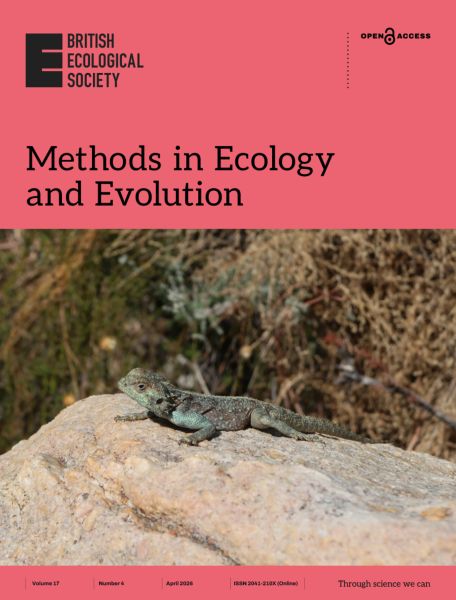
A novel generalized spatial mark-resight model that accounts for group associations
In this paper, we present a novel approach to overcome non-independence of detection and aggregation to estimate the population size of group-living species using a gSMR model. We evaluated the performance of the model in a simulation study before illustrating its application using long-term wolf population monitoring data from a Canadian national park complex.
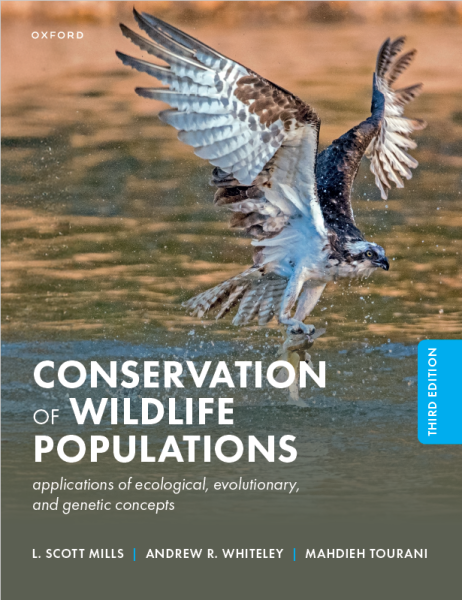
Conservation of Wildlife Populations, 3rd edition is published
In a world where threats of cataclysmic extinction loom and sustainable harvest approaches are essential, applied population ecology has never been more crucial. Conservation of Wildlife Populations, 3rd Edition provides evidence-based insight into how extinctions and human-wildlife conflicts can be minimized. L. Scott Mills, Andrew Whiteley, and Mahdieh Tourani blend rigorous science with practical solutions to illuminate paths where science and action can bring hope.

Snapshot Montana: UM Explores Animal Behavior with Camera Traps
UM’s Mahdieh Tourani, alongside Montana Fish, Wildlife and Parks, uses camera traps to monitor wildlife populations in northwest Montana, like these white-tailed deer.